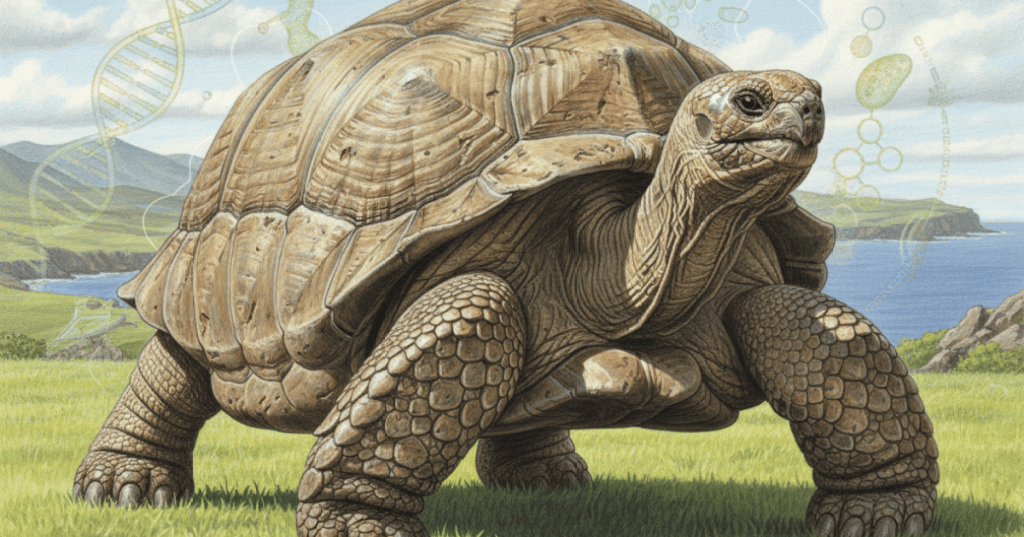
Scientists have sequenced genetic material from Jonathan, the 194-year-old giant tortoise recognized as the world’s oldest known living land animal, and found unusual biological features that may help explain how he has remained alive for nearly two centuries.
The peer-reviewed study, published October 7 in Science Advances, does not prove scientists have found a way to slow human aging. But it identifies several longevity-related pathways that overlap with mechanisms already studied in exceptionally old humans, giving researchers a rare natural experiment in extreme lifespan.
Jonathan Is About 194 Years Old
Jonathan is believed to have hatched around 1832. He arrived on the South Atlantic island of St Helena in 1882 already fully grown and has lived for most of his documented life on the grounds of Plantation House, the governor’s residence. Guinness World Records recognizes him as the oldest known living terrestrial animal.
Researchers from Kallel, Vanderbilt Health, the University of Cambridge and collaborating institutions studied tissue collected from inside Jonathan’s mouth. Because St Helena officials restricted blood collection to avoid infection risk, the team had to reconstruct parts of his genome from cheek tissue and compare the results with reference data from other giant tortoises.
Researchers Found 287 Jonathan-Specific Gene Variants
The team identified 287 genes containing variants unique to Jonathan. Some are associated with DNA repair, inflammation, insulin regulation, telomere biology and tumor suppression—all processes connected to how cells accumulate damage with age.
That does not mean each variant makes Jonathan live longer. The study examined one exceptionally old animal, so researchers cannot yet separate changes that caused longevity from changes that are simply unique to Jonathan. Larger comparisons with other long-lived tortoises will be necessary.
His Gene Switches Look Surprisingly Young
The more striking result came from Jonathan’s epigenome—chemical markers that influence whether genes are switched on or off without changing the underlying DNA sequence. Researchers compared Jonathan with four younger giant tortoises and measured disorder in DNA methylation patterns, sometimes described as methylation entropy.
Jonathan showed unusually low methylation entropy in important regulatory regions controlling genes involved in mitochondrial function and RNA processing. In some of these regions, his gene regulation looked more like that of a young tortoise than an animal approaching two centuries old.
Mitochondria May Be One Of The Biggest Clues
Mitochondria generate much of the usable energy inside animal cells, and mitochondrial dysfunction is one of the biological hallmarks associated with aging. Jonathan’s regulatory regions connected to mitochondrial energy production have retained unusually orderly patterns despite his extreme age.
The finding is especially interesting because researchers have observed unusually efficient mitochondrial function in some exceptionally long-lived humans as well. That does not establish a universal longevity mechanism, but it gives scientists another reason to investigate whether preserving mitochondrial regulation could extend healthspan—the portion of life spent in relatively good health.
DNA Repair And Cancer Suppression Also Stand Out
Cells constantly suffer DNA damage from normal metabolism and environmental exposure. Organisms survive by detecting and repairing that damage, eliminating badly damaged cells, and preventing uncontrolled cell growth. Jonathan carries unusual variants in pathways involved in DNA repair and tumor suppression, along with extra copies of a gene associated with targeting aging and cancerous cells.
That connects naturally with existing longevity research. BitcoinVersus.Tech previously covered experimental gene-therapy approaches aimed at age-related cellular decline. Jonathan’s biology is different: researchers are studying a naturally long-lived animal to learn which protective mechanisms evolution has already produced.
Could This Actually Help Humans Live Longer?
Potentially—but this research is nowhere near proving a human anti-aging treatment. Scientists first need to determine which features genuinely contribute to Jonathan’s longevity, whether they appear consistently in other exceptionally old tortoises, and whether comparable pathways can be safely influenced in humans.
Environment matters too. Jonathan has spent decades in a relatively protected tropical setting and receives a carefully managed diet and veterinary care. Genetics, epigenetics, metabolism, environment and chance can all contribute to an unusually long life.
Why Jonathan Matters
Most aging studies cannot directly examine an animal that has remained alive for almost two centuries. Jonathan gives researchers something unusual: a living biological record of extreme longevity whose genome can be compared with younger members of the same broad lineage.
The immediate discovery is not a longevity drug. It is a map of biological systems worth investigating—DNA repair, mitochondrial stability, insulin regulation, telomere maintenance, cancer suppression and unusually stable gene regulation. If some of those systems turn out to be shared with exceptionally long-lived humans, Jonathan’s nearly 200-year life could help scientists understand not simply how to live longer, but how cells remain functional while doing it.
Sources
Science Advances: “Epigenetic insights into extreme longevity in the world’s oldest terrestrial animal, Jonathan” · Vanderbilt Health
BitcoinVersus.Tech
Advertisement
Editor’s Note
We volunteer daily to keep the technical information on this platform verifiable.
BitcoinVersus.tech is not a financial or medical advisor. This media platform reports on science, technology, and financial subjects purely for informational purposes.


Leave a Reply