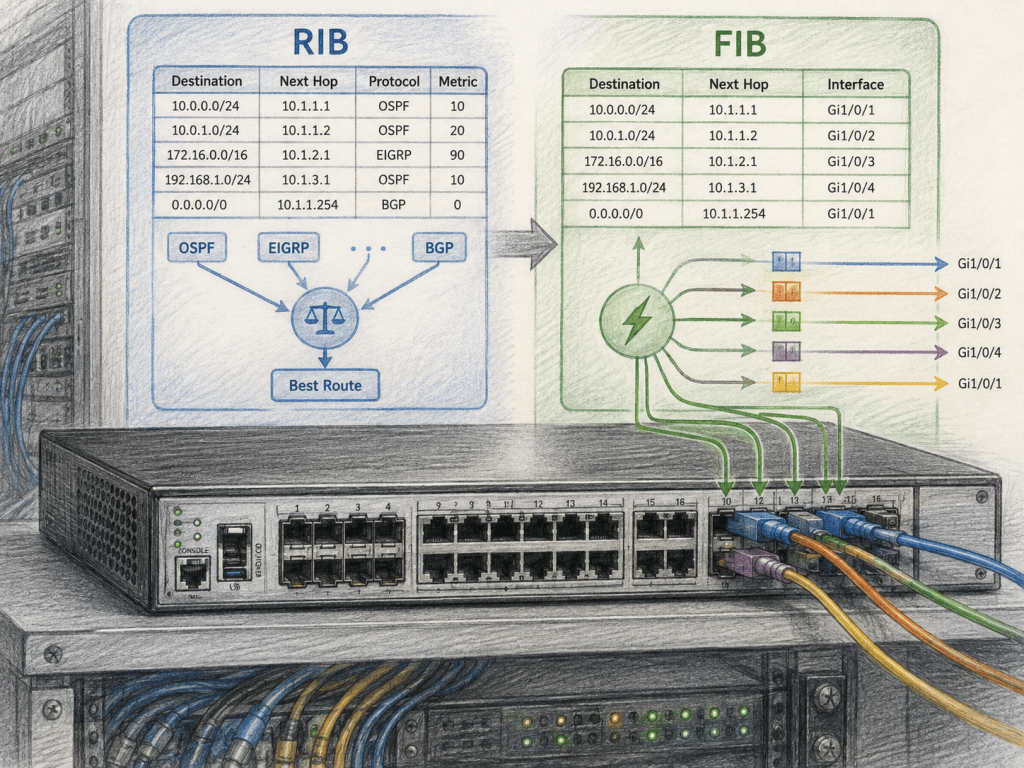
The Routing Information Base (RIB) and Forwarding Information Base (FIB) are two essential data structures used by routers and Layer 3 switches to determine how network traffic reaches its destination.
The RIB can be thought of as the router’s master routing database. It contains routes learned from connected networks, static configurations, and dynamic routing protocols such as OSPF, BGP, IS-IS, and RIP. Routing processes evaluate these available routes and determine which paths should become active routes.
The FIB, meanwhile, is optimized specifically for packet forwarding. After the routing system determines the preferred routes, relevant forwarding information is installed into the FIB so the router can rapidly determine the appropriate next hop and outgoing interface for incoming packets.
Cisco describes the FIB used with Cisco Express Forwarding as a reorganized version of the routing information designed for fast destination-prefix lookups, often allowing forwarding decisions to occur directly in hardware.
A simple way to understand RIB vs FIB is that the RIB helps the network device decide where traffic should go, while the FIB helps it actually send the traffic there. The RIB operates primarily as part of the routing or control-plane process, while the FIB supports high-speed forwarding in the data plane. Together, these databases allow modern routers to combine sophisticated route selection with extremely fast packet processing across enterprise, carrier, cloud, and data-center networks.
BitcoinVersus.Tech Editor’s Note:
We volunteer daily to ensure the credibility of the information on this platform is Verifiably True. If you would like to support to help further secure the integrity of our research initiatives, please donate here: 3C9o19EH5HSiwEPyCTmEKzxhNCbo2X6TTb
BitcoinVersus.tech is not a financial advisor. This media platform reports on financial subjects purely for informational purposes.


Leave a comment