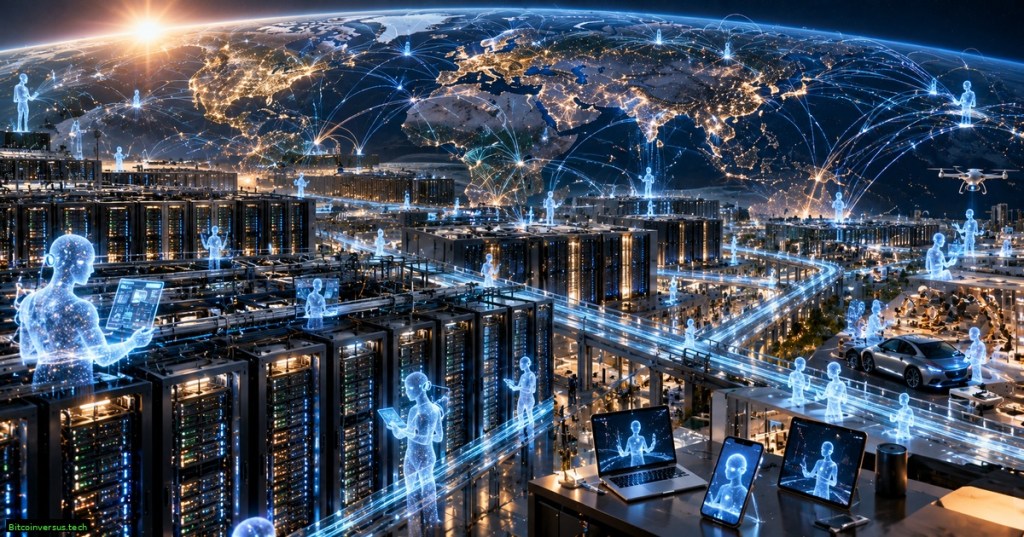
Huawei says the world could have as many as 900 billion active AI agents by 2035—roughly 100 agents for every person using the company’s rounded projection of a 9 billion global population.
The forecast comes from Huawei’s Intelligent World 2035 research. The company expects the internet to shift from an application-centric model toward an agent-centric one, where software agents continuously perceive conditions, reason, call tools, move data and act on behalf of people, companies, vehicles, machines and other systems.
900 Billion Does Not Mean 900 Billion Robots
Huawei’s number is easy to misread. The company is not predicting 900 billion humanoid robots walking around Earth. An AI agent can be software running in a cloud, phone, vehicle, factory controller, enterprise application, robot, smart-glasses system or network service.
One person could interact with dozens or hundreds of specialized agents. A company could operate millions of them. Some may remain active continuously while others appear only long enough to complete a task. That is why the agent count can exceed the human population by two orders of magnitude without implying a matching number of physical machines.
Huawei Expects Agents to Dominate AI Traffic
The bigger infrastructure claim may be even more important than the headline number. Huawei says more than 90% of global AI token traffic could come from autonomous agents by 2035, while annual token consumption rises roughly 100,000-fold from today’s levels.
That direction already has early real-world support. BitcoinVersus recently reported that AI agents were using about five times more tokens than humans on OpenRouter. The scale is nowhere near Huawei’s 2035 forecast, but the usage pattern shows why autonomous software can consume far more inference than a person manually typing prompts.
Why Agents Use So Many Tokens
A human may send one prompt and receive one answer. An agent can perform a long sequence: inspect data, make a plan, search, call an API, read the result, revise the plan, write code, test it, ask another model for help, retry a failed tool call and finally report back.
Every step can require another inference pass. Multi-agent systems amplify that further because agents can delegate work to other agents. A single human request can therefore expand into hundreds or thousands of model interactions behind the scenes.
The Forecast Is Really About Infrastructure
If Huawei is even directionally correct, the agent economy would place enormous pressure on AI accelerators, data centers, storage, fiber, wireless networks and power systems. The company says computing clusters may need to scale by roughly 100 times while the cost of completing agent tasks falls by about 1,000 times.
That helps explain why the current AI race is spreading beyond model architecture into chips, networking and electricity. BitcoinVersus has already covered the rapid build-out of power-hungry AI and data-center infrastructure, and Huawei’s forecast implies that today’s expansion may still be an early phase.
Security Becomes a Bigger Problem Too
Autonomous agents create a different security problem from ordinary chatbots because they can take actions. They can invoke software tools, manipulate files, send messages, access databases and operate systems without waiting for a human at every step.
That is why agent control is emerging as its own hardware and software layer. BitcoinVersus previously covered NVIDIA’s hardware watchdog for autonomous AI agents, an example of how the industry is beginning to design safeguards specifically for software that can act independently.
Reuters Says Huawei Sees Agents as China’s AI Scaling Path
Reuters independently reported the forecast in September, noting that Huawei expects autonomous agents to become the dominant source of AI traffic and that the company is positioning agent infrastructure as a major strategic opportunity.
The forecast also fits Huawei’s broader effort to compete in computing infrastructure while U.S. export restrictions limit China’s access to the most advanced NVIDIA hardware. That makes the 900-billion-agent figure both a technology prediction and a statement about where Huawei believes future network and compute demand will come from.
The Number Should Be Treated as a Forecast, Not a Count
No one knows whether the world will actually reach 900 billion active agents. The figure depends on how the industry defines an agent, how cheaply inference can be delivered, whether autonomous systems prove economically useful, and how governments respond to privacy, cybersecurity and labor concerns.
But the direction is easier to understand than the exact number: AI is moving from people manually asking models questions toward software continuously asking other software to perform work. If that transition continues, the internet of 2035 may have far more machine actors than human users.
BitcoinVersus.Tech
Advertisement
Editor’s Note
Huawei’s 900-billion-agent figure, 9-billion-population figure, 90% token-traffic share and 100,000-fold token-growth estimate are forecasts from the company’s Intelligent World 2035 research, not measured future outcomes.
Support and donation options are available through BitcoinVersus.Tech.
BitcoinVersus.tech is not a financial advisor. Content is provided for informational purposes.


Leave a comment