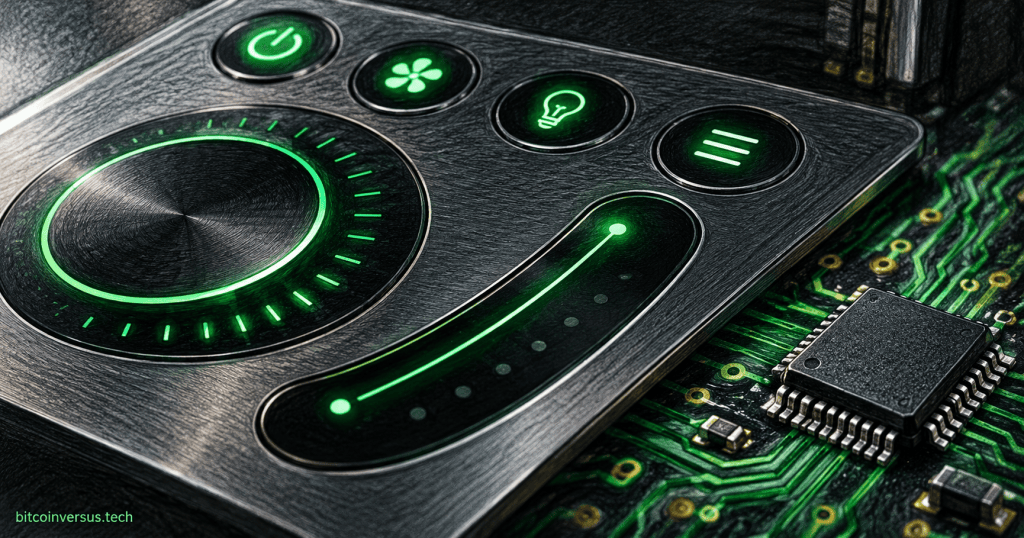
Microchip Technology has introduced two capacitive-touch controllers designed to make buttons, sliders and rotary touch wheels more responsive without requiring a display. Announced October 8, 2026, the MTCH3380P and MTCH3240P use 12 parallel analog-to-digital converters to acquire multiple touch signals at once, targeting appliances, outdoor kiosks and industrial control panels.
What Microchip Announced
The MTCH3380P supports up to 38 self-capacitance sensors or 64 mutual-capacitance sensors; the smaller MTCH3240P supports 24 or 32 respectively. Microchip says simultaneous sensing helps preserve response time and signal-to-noise ratio as interfaces grow more complex. The devices support operation up to 105°C and are designed to support customers pursuing IEC/UL 60730 Class B functional-safety certification; that does not mean every finished product is automatically certified. See Microchip’s announcement.
How Parallel Touch Sensing Works
A capacitive-touch surface detects a small change in electrical capacitance when a finger approaches a conductive electrode. In self-capacitance mode, the controller measures an electrode relative to ground. In mutual-capacitance mode, it measures coupling between electrodes. Parallel ADC channels can sample multiple sensing paths concurrently instead of sequentially, helping reduce acquisition delay. Noise from motors, chargers and nearby wiring can complicate detection, so the controller must distinguish a genuine touch from interference. This matters in industrial control environments as well as household products.
Why Display-Free Interfaces Matter
A refrigerator, oven or EV charging station does not always need a full touchscreen. A decorated glass or plastic panel with illuminated capacitive controls may be easier to seal against dirt and moisture, and can reduce display-related cost and mechanical wear. Microchip specifically highlights sensing through thicker cover materials and use with gloves, though final performance depends on electrode design, materials and environmental testing. Its supporting tools include mTouch Studio, evaluation hardware and host drivers for Linux and Zephyr.
Pricing and What Comes Next
Microchip lists starting prices of $1.06 for the MTCH3380P and $0.80 for the MTCH3240P at 10,000-unit quantities. These are component prices, not completed product costs. Engineers evaluating the chips will still need to test false-touch resistance, electromagnetic interference, glove behavior, moisture, temperature and safety requirements in the intended enclosure. The broader opportunity is making sophisticated human-machine interfaces practical without a screen.
Sources and Related Reading
Primary source: Microchip Technology product announcement, October 8, 2026. Related: LLDP and device discovery; software development platforms; HART industrial communications.


Leave a comment