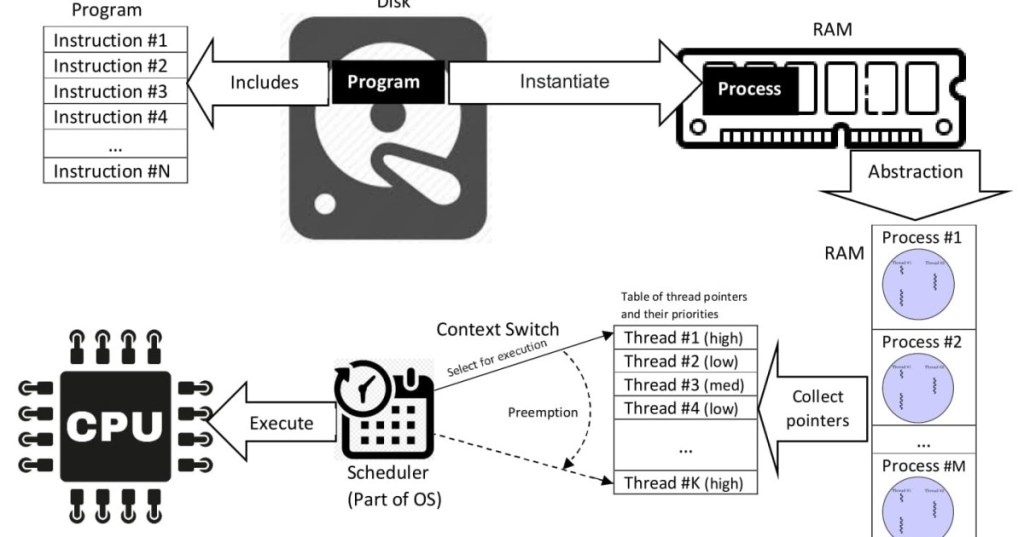
A context switch happens when the operating system stops running one task on a CPU, saves enough of that task’s execution state to resume it later, and loads the state of another task. Context switching is one of the basic mechanisms that makes multitasking possible.
The easiest way to remember it is: pause task A → save where A was → load where task B was → run B. Later, the operating system can restore A and continue almost as if it had never stopped.
Why Context Switching Exists
A single CPU core can execute only one instruction stream at a given instant, but a modern operating system may have hundreds or thousands of runnable processes and threads. The operating-system scheduler decides which runnable task gets CPU time. When it chooses a different task for that core, the kernel performs the work needed to switch execution contexts.
On a multicore CPU, several tasks can truly run at the same time on different cores. Context switching is still needed whenever one core stops running one task and begins running another.
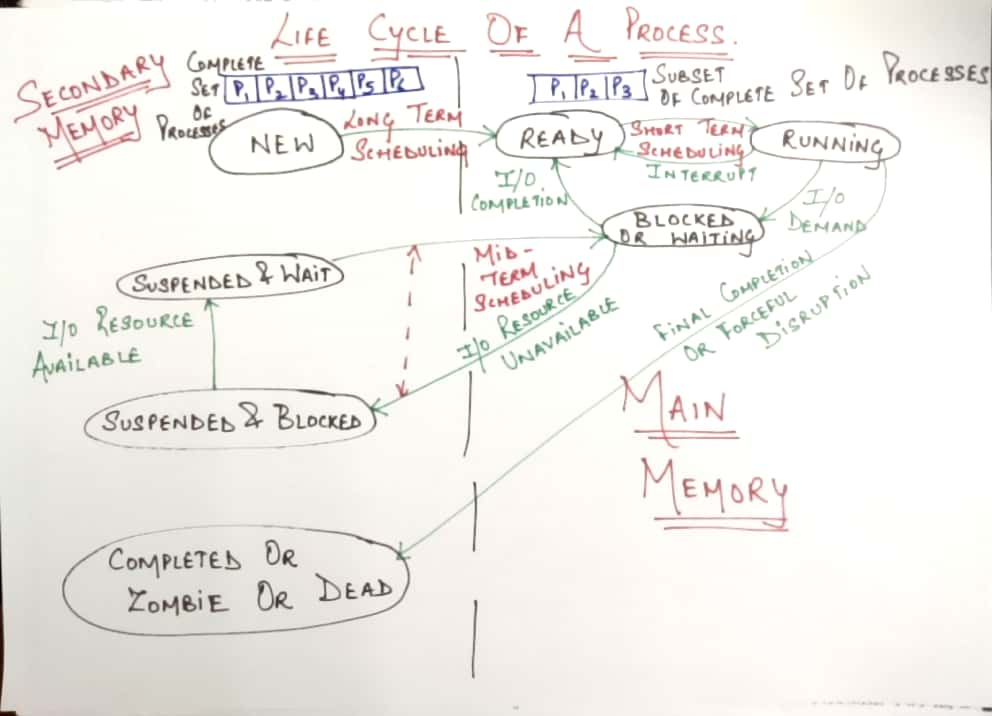
The CPU State Has to Be Saved
To resume a task correctly, the operating system must preserve the execution state that tells the CPU where that task was and what it was doing. That state can include the program counter or instruction pointer, stack pointer, general-purpose registers, processor flags, and architecture-specific state.
OpenStax’s processes and concurrency material describes the operating system saving process context and using process-control information so another process can run and the original process can later resume.
The Scheduler Chooses What Runs Next
The scheduler is the kernel subsystem that decides which runnable task should receive CPU time next. A task may be selected because another task used its available CPU time, blocked while waiting for I/O, went to sleep, yielded the processor, changed priority, or was preempted by a higher-priority scheduling decision.
The Linux kernel maintains detailed scheduler documentation because this decision affects latency, throughput, fairness, real-time behavior, energy use, and how work is distributed across CPU cores.
Voluntary and Involuntary Context Switches Are Different
A voluntary context switch commonly happens when the running task cannot continue immediately—for example, it waits for disk I/O, a network packet, a lock, a timer, or another event. The task gives up the CPU because it has useful work to wait for.
An involuntary context switch happens when the scheduler preempts a task even though that task could continue running. This can happen when its scheduling slice or policy says another runnable task should get CPU time.
An Interrupt Is Not Automatically a Task Context Switch
This distinction matters. A hardware interrupt can temporarily move execution into kernel interrupt-handling code and then return to the same task. A system call can also switch from user mode into kernel mode and return to the same process.
A true task context switch occurs when the scheduler changes which task is running. An interrupt or system call may create the opportunity for scheduling, but entering the kernel does not by itself mean the CPU changed from process A to process B.
Process Switches Can Disturb More Than Registers
Saving and loading registers is only part of the cost. A process switch can also change the active virtual-memory context, page-table state, translation lookaside buffer behavior, and the working data occupying CPU caches. BitcoinVersus.Tech’s virtual-memory and CPU-cache explainers cover those layers separately.
This is one reason a context switch has a performance cost even when the low-level register save/restore itself is fast. The newly scheduled task may have to rebuild useful cache and translation state before it reaches peak execution efficiency.
Thread Switching Can Be Cheaper, but It Is Not Free
Threads inside the same process usually share one virtual address space, so switching between them can avoid some of the address-space changes associated with switching between unrelated processes. But the CPU still has to save and restore execution state, and cache or scheduler effects can still occur.
The exact cost depends on the operating system, CPU architecture, workload, cache state, security mitigations, and which resources the two tasks share. “Threads are always cheap to switch” is therefore too simple.
Blocking I/O Often Creates a Useful Switch
Context switching is not merely wasted motion. If a task is waiting for storage, networking, or another event, leaving it on the CPU would waste execution time. The scheduler can run another task while the first one waits.
This connects directly to file descriptors and buffers. A process may issue I/O through a descriptor, block while data is unavailable, let another task run, and become runnable again after the device or network path completes the work.
Linux Lets You Inspect Context-Switch Counts
Linux exposes voluntary and nonvoluntary context-switch counters for each process in /proc/PID/status. That makes context switching visible during troubleshooting instead of leaving it as an abstract operating-system concept.
grep ctxt_switches /proc/1234/status

# Example fields:
voluntary_ctxt_switches:        1205
nonvoluntary_ctxt_switches:      317
System tools such as vmstat, pidstat, perf, and tracing utilities can provide broader context when switch rates appear unusually high.
Too Many Context Switches Can Hurt Performance
A healthy system performs context switches constantly. The problem appears when the machine spends too much time scheduling, synchronizing, waking, sleeping, and rebuilding execution state compared with doing useful application work.
High switch rates can come from too many runnable threads, lock contention, very short tasks, chatty I/O patterns, interrupt-heavy workloads, aggressive wakeups, or applications divided into more threads than the workload benefits from. A raw context-switch number therefore needs workload context before it means anything.
Context Switching Explains Multitasking
On one CPU core, tasks appear to run together because the scheduler can switch among them rapidly. A browser thread runs, then a music player, then a background service, then the browser again. Each task gets enough execution opportunities that the system feels concurrent even when only one task is executing on that core at a particular instant.
Multiple cores add true parallelism on top of that scheduling model. Each core can execute a different task while still context-switching independently as workloads change.
The Simple Way to Remember a Context Switch
A context switch is the operating system changing which task owns a CPU core while preserving enough state for the old task to resume later.
The chain is: task A running → scheduler event → save A’s CPU state → choose task B → restore B’s state → task B running. That simple mechanism connects processes, threads, interrupts, system calls, I/O waits, CPU caches, virtual memory, and the scheduler.
Editor’s Note
The 1200×630 featured image directly depicts programs, processes, threads, scheduling, preemption, and context switching. The separate body image directly shows process states and operating-system schedulers. Both are Wikimedia Commons diagrams chosen for direct subject relevance; no generic CPU or computer stock image is used. The two YouTube videos are distinct and directly about context switching and process-control state. The Reddit embed is directly about scheduler time slices and context-switch behavior.
Support and donation options are available through BitcoinVersus.Tech.
BitcoinVersus.Tech is not a financial advisor. Content is provided for informational and educational purposes.


Leave a comment