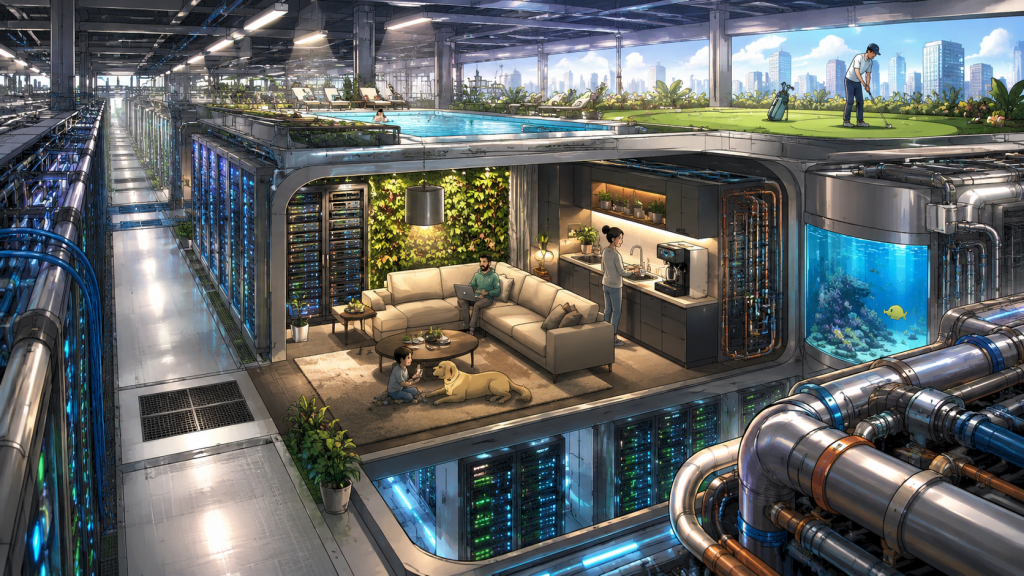
AI storyteller and experimenter Ari K has taken the data-center boom to its most ridiculous possible conclusion: why merely live near a data center when you could live inside one?
His satirical video, OPEN LIVING – A Data Center You Can Live in, transforms industrial computing infrastructure into a futuristic residential development, complete with rooftop pools, family spaces, coffee stations, recreational areas and the kind of lifestyle amenities normally associated with luxury apartments rather than rows of servers.
The concept is intentionally absurd. Golf simulators appear beside computing infrastructure. Families relax within environments seemingly designed around massive amounts of processing hardware. Server rooms become part of the architecture instead of something hidden in an industrial park outside town. The humor comes from treating the enormous physical infrastructure behind artificial intelligence as if it were simply the next fashionable mixed-use development. Instead of bringing computing closer to people, Open Living jokingly brings the people directly into the compute facility.
But the joke lands because the underlying infrastructure trend is very real. AI development is increasingly becoming a physical construction story involving power plants, substations, cooling systems, transmission infrastructure, fiber networks, land and enormous data-center campuses.
OpenAI, for example, says its Stargate initiative was originally designed around securing 10 gigawatts of U.S. AI infrastructure by 2029 and that the program has already moved beyond that initial capacity milestone as demand for compute continues growing. OpenAI describes compute as a critical input for training better models, operating AI services and lowering the long-term cost of delivering those systems.
That expansion also means communities increasingly encounter AI through physical infrastructure rather than software alone. Residents may see new construction, electrical infrastructure, water and cooling systems, backup generation and large industrial buildings long before they ever understand which AI models the facility will ultimately support.
Recent reporting has highlighted community concerns involving electricity, water, emissions, noise, land use and transparency surrounding some large AI developments. At the same time, developers point to construction employment, skilled-trades work, infrastructure investment and permanent technical jobs as important economic benefits.
This is where Open Living becomes more than a quick visual gag. Its exaggerated world asks an interesting question without seriously asking it at all: how much of society will eventually organize itself around compute? Previous technological eras reshaped cities around factories, highways, airports and electrical grids.
AI could similarly influence where power is produced, where new transmission is built, where technical workers live and which communities become major computing hubs. Nobody needs to start installing swimming pools above GPU clusters, but the distance between digital infrastructure and everyday life is clearly shrinking.
The funniest part of Ari K’s concept may therefore be that it feels simultaneously impossible and strangely recognizable. Open Living takes today’s AI infrastructure race, pushes it several steps beyond reason and produces something resembling an architectural advertisement from a compute-first future. It is pure comic relief, but like effective satire often does, it works because the ridiculous version is built from trends that are already happening.
For now, humans still live in homes and servers still live in data centers.
Open Living simply asks what happens when the servers get the better real estate.
BitcoinVersus.Tech Editor’s Note:
We volunteer daily to ensure the credibility of the information on this platform is Verifiably True. If you would like to support to help further secure the integrity of our research initiatives, please donate here: 3C9o19EH5HSiwEPyCTmEKzxhNCbo2X6TTb
BitcoinVersus.tech is not a financial advisor. This media platform reports on financial subjects purely for informational purposes.


Leave a Reply