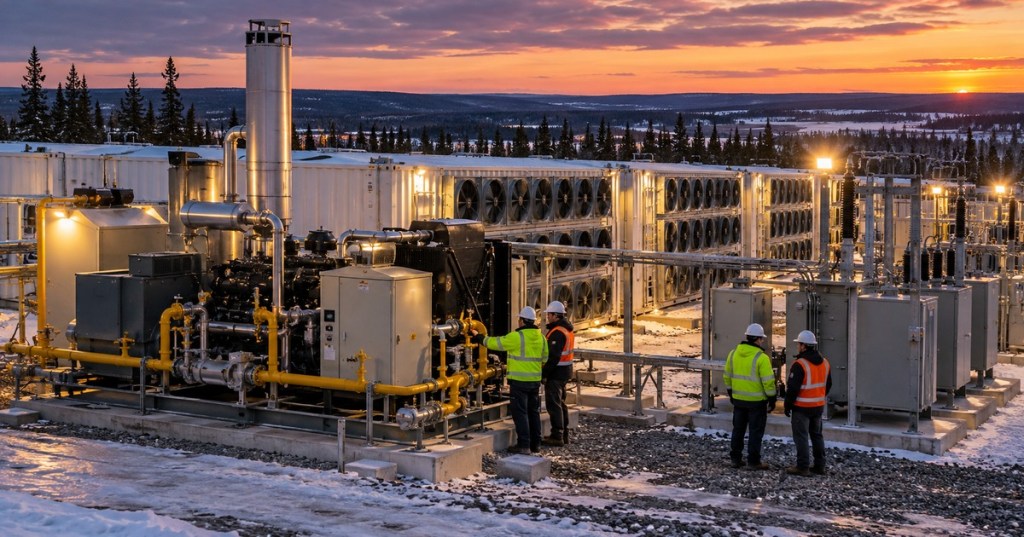
MicroBT says a 20 MW natural-gas-powered Bitcoin mining solution is now live in Canada, giving the WhatsMiner manufacturer another operating example of its push beyond ASIC sales and into full mining-energy infrastructure.
The disclosure came from MicroBT’s official LinkedIn feed, where the company described the project as a 20 MW natural-gas power mining solution and said construction is complete enough for the site to be live. MicroBT also published the same announcement through its official WhatsMiner Telegram channel.
What MicroBT Actually Confirmed
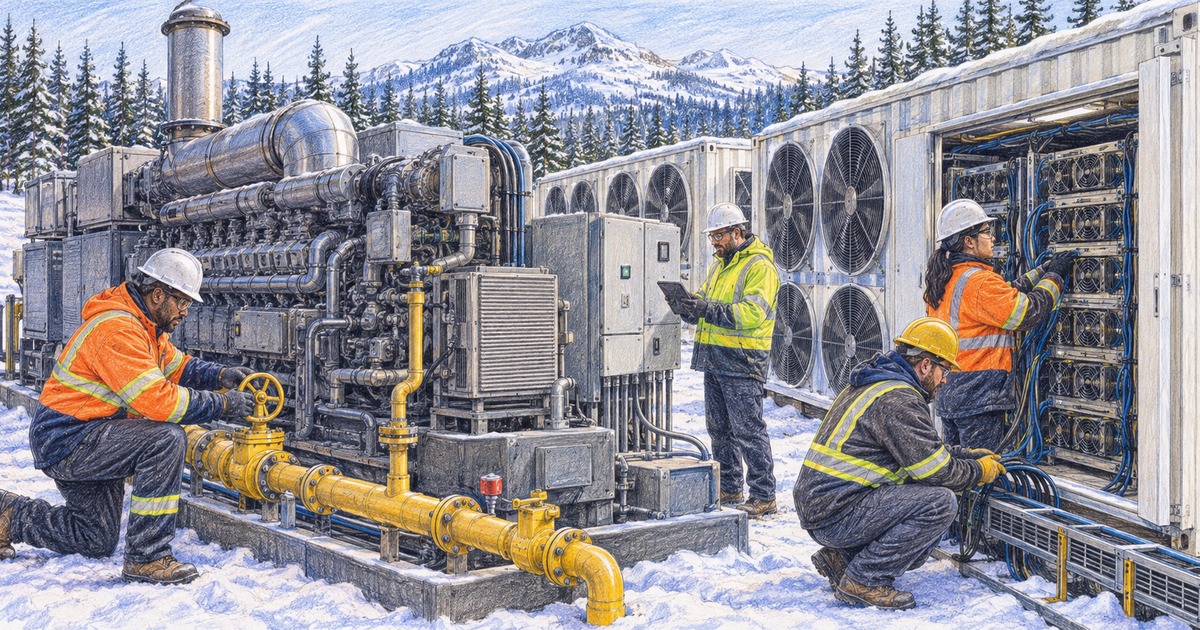
The confirmed facts are narrow but material: the project is in Canada, it is rated at 20 MW, it uses natural-gas generation for mining power, and MicroBT says it is live. The company’s post also shows that MicroBT is selling more than mining machines; it is positioning itself around engineering, construction, deployment and operating support for complete mining-energy systems.
MicroBT has not publicly identified the site operator, exact province, generator manufacturer, miner model mix, machine count, gas contract, delivered fuel price, electrical one-line, heat-recovery configuration or emissions-control package in the announcement. It also did not say the gas is stranded, flared or otherwise wasted, so BitcoinVersus is not labeling it that way without evidence.
That distinction matters. Stranded-energy mining can involve gas that has limited access to pipelines or markets, but a natural-gas mine can also run on ordinary commercial fuel supply. The economics and environmental accounting are different.
20 MW Could Support Roughly 1–1.6 EH/s of Modern ASIC Load
If the full 20 MW were available at the ASIC level, a modern fleet operating around 12.5 J/TH would imply roughly 1.6 EH/s of hashrate. At 15 J/TH, the same 20 MW would support about 1.33 EH/s; at 20 J/TH, about 1.0 EH/s.
Those are engineering illustrations, not disclosed project figures. A gas plant’s gross MW rating is not automatically the same as usable miner load. Generator auxiliaries, transformers, switchgear, cooling, networking and other site losses reduce the power that actually reaches ASICs.
MicroBT Is Moving Up the Mining Stack
MicroBT has spent 2026 talking more openly about complete power-and-mining systems. In recent official posts, the company has promoted natural gas as a dispatchable option for mining expansion because it can be deployed independently of large grid interconnections and can provide high annual runtime. It has also marketed solar, hydro and turnkey site-development services alongside WhatsMiner hardware.
The Canadian project turns that strategy into operating infrastructure. Instead of stopping at the ASIC, MicroBT is increasingly participating in the entire chain: fuel or power source, generation, electrical distribution, cooling, miner deployment, construction and operations support.
That same infrastructure logic is showing up outside mining. BitcoinVersus recently covered 450 MW of behind-the-meter gas generation ordered for data centers. The common bottleneck is not only compute hardware. It is getting reliable megawatts to the load on a schedule that works.
Canada Already Has a MicroBT-Linked Gas-Mining Footprint
Fire Technology Corp., which describes itself as a MicroBT subsidiary, says it operates natural-gas self-generation for Bitcoin mining in Calgary, Alberta. Its site says the team previously built Canadian blockchain infrastructure with 10 MW of power-generation capacity and had expanded its operating footprint to 7.4 MW by the end of 2025.
BitcoinVersus could not verify that Fire Technology’s Calgary operation is the same 20 MW project MicroBT just announced. The capacities do not match the older figures, and MicroBT did not name the new site. For now, they should be treated as separate disclosures unless the company connects them.
Why Natural Gas Can Change the Deployment Timeline
A behind-the-meter gas plant can move a mining project away from one of the hardest constraints in data-center development: utility interconnection. Instead of waiting for new transmission, substation capacity or a multi-year queue position, the operator can generate electricity near the fuel source and feed the mining load locally.
That does not make the project simple. Gas pressure and quality, engine maintenance, emissions permits, noise, heat rejection, black-start capability, spare parts, electrical protection and miner curtailment logic all become part of the mining operation. In practice, the mine starts to look as much like a small power plant as a server farm.
Watch: Natural-Gas Bitcoin Mining in Canada
The video below is not the MicroBT project. It is a 2026 walkthrough from Upstream Data in Lloydminster, Alberta, showing the same core architecture at smaller scale: a natural-gas engine, generator controls, power distribution and a Bitcoin mining load center operating as one integrated system.
What We Still Need to Know
- Who owns and operates the 20 MW Canadian site?
- Which province is it in?
- What generator technology and gas supply are being used?
- How much of the 20 MW reaches the ASICs after site losses?
- Which WhatsMiner models are installed and at what J/TH?
- Is the site grid-islanded, grid-connected or able to export power?
- What are the fuel cost, emissions controls and heat-recovery plans?
The most important development today is not a new ASIC specification. It is that one of the world’s largest Bitcoin-mining hardware manufacturers is showing a live 20 MW project where the product is effectively the whole mining power system. That is a different competitive layer—and one worth watching as miners chase power outside conventional utility queues.


Leave a Reply