
Python 3.15.0 is now officially available, bringing explicit lazy imports, UTF-8 by default, new built-in types, stronger free-threaded support, and another round of interpreter performance work.
The Python release team announced the final release on October 9, 2026. Python 3.15 contains work from 5,643 commits and 1,012 contributors compared with Python 3.14.
Lazy Imports Are Now Part Of The Language
One of the biggest practical additions is PEP 810, which adds explicit lazy imports. A developer can now write lazy import json or lazy from json import dumps and delay loading that module until the imported name is actually used.
That matters for command-line tools, test runners, serverless functions, and large applications where startup can trigger a long chain of imports that are never needed. The feature is opt-in, so ordinary import statements keep their existing behavior.
The accepted PEP says real workloads have shown startup-time reductions of roughly 50% to 70% in some cases, along with lower baseline memory use when large dependency trees contain modules that are never touched.
UTF-8 Is Now The Default Encoding
Python 3.15 also completes the move to UTF-8 as the default text encoding. That should reduce one of the more frustrating classes of cross-platform bugs where the same file opens correctly on one machine but fails because another operating system uses a different default encoding.
The change is especially useful for software that moves between Linux, Windows, containers, CI systems, and cloud machines. BitcoinVersus.Tech’s JSON explainer covers one common place where predictable text encoding matters across systems.
Python Adds Sentinel And Frozendict
Python 3.15 adds two useful built-ins: sentinel and frozendict. Sentinels provide a standard way to represent a special “not supplied” or “missing” value without overloading None. That is useful when None itself is a valid input.
frozendict provides an immutable mapping type. It fills a long-standing gap between ordinary dictionaries and immutable collection patterns. BitcoinVersus.Tech’s Python dictionaries lesson covers the mutable key-value structure that frozendict extends in a different direction.
Comprehensions Can Unpack More Naturally
PEP 798 adds unpacking inside comprehensions, making some transformations shorter and clearer. The feature lets developers express patterns that previously required extra loops or intermediate structures.
It is a smaller language change than lazy imports, but it fits Python’s broader direction: remove boilerplate where the meaning stays obvious. That same readability-first philosophy is why Python remains popular for scripting, automation, data work, and infrastructure tooling.
Free-Threaded Python Moves Closer To Normal Use
Python 3.15 also strengthens the free-threaded build introduced in recent releases. Several C API changes now provide a stable ABI for free-threaded builds, making it easier for extension authors to support Python configurations that do not depend on the traditional Global Interpreter Lock in the same way.
On macOS, official Python binaries now install free-threading support by default. That does not mean every Python program suddenly runs CPU-bound code in parallel with no changes, but it makes the free-threaded runtime easier to test and distribute.
The Experimental JIT Is Faster
The experimental just-in-time compiler also received a substantial update. Python reports a geometric-mean improvement of roughly 7% to 8% on x86-64 Linux compared with the standard interpreter and roughly 11% to 12% on AArch64 macOS compared with the tail-calling interpreter.
Those numbers describe the experimental JIT rather than a blanket speedup for every Python program. Performance still depends heavily on workload, libraries, interpreter configuration, and whether the hot code spends most of its time inside Python or optimized native extensions.
Windows Gets The Tail-Calling Interpreter
The official 64-bit Windows builds now use Python’s tail-calling interpreter. Frame pointers are also enabled by default to improve system-level observability, making it easier for profilers and performance tools to inspect running Python processes.
Python 3.15 adds a dedicated profiling package as well, including the high-frequency Tachyon sampling profiler. That gives developers more built-in tools for finding where execution time is actually being spent before attempting to optimize code.
Python 3.15 Also Arrives With A macOS Warning
The release team is warning macOS 27.0 users about a current issue affecting IDLE and other applications built on tkinter. Certain menu actions that open dialogs can hang because of an operating-system behavior change affecting the Tk toolkit.
That issue is not specific to Python 3.15, but it is important for developers who rely on Tk-based tools. The release team recommends testing workflows before moving affected systems to macOS 27.0.
Why This Release Matters
Python 3.15 is not one giant redesign. It is a collection of changes aimed at making Python start faster, behave more predictably across systems, expose fewer awkward missing pieces in the standard library, and continue the transition toward better multicore execution.
For developers learning the language, most existing Python code still looks and behaves the same. BitcoinVersus.Tech’s Python logging lesson and broader Open Source Python curriculum remain directly applicable. The new release mostly expands what experienced developers can do without changing Python’s basic programming model.
What Comes Next
Python 3.15 now enters its bug-fix lifecycle while library maintainers begin shipping compatible wheels and testing extension modules against the new runtime. Python 3.14 remains supported, so production teams do not need to upgrade immediately.
The more interesting long-term question is how quickly projects adopt lazy imports and free-threaded execution. Those two changes could affect how Python applications are structured far more than any single new built-in function.
Editor’s Note
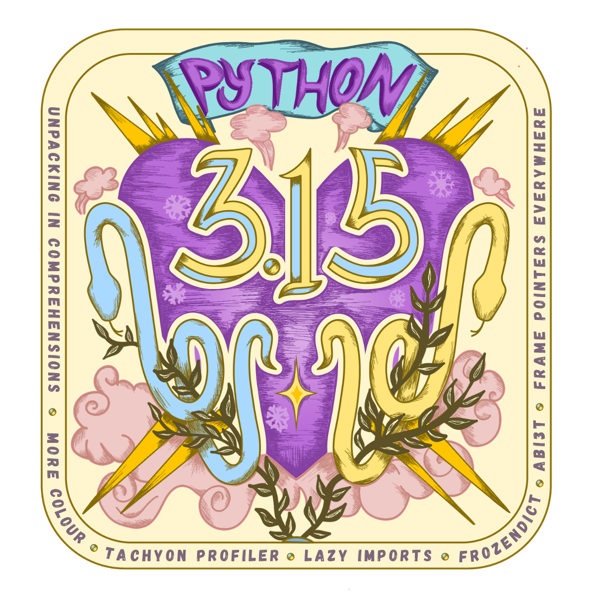
The featured image is original photorealistic editorial artwork created specifically for this coding story and is not reused in the body. The body image is the official Python 3.15 release artwork. The YouTube video is embedded as a responsive native Gutenberg player, and the Reddit discussion is embedded directly in the article. No normal story text is placed inside cards, panels, callouts, or text boxes.
BitcoinVersus.Tech content is provided for informational and educational purposes.


Leave a Reply