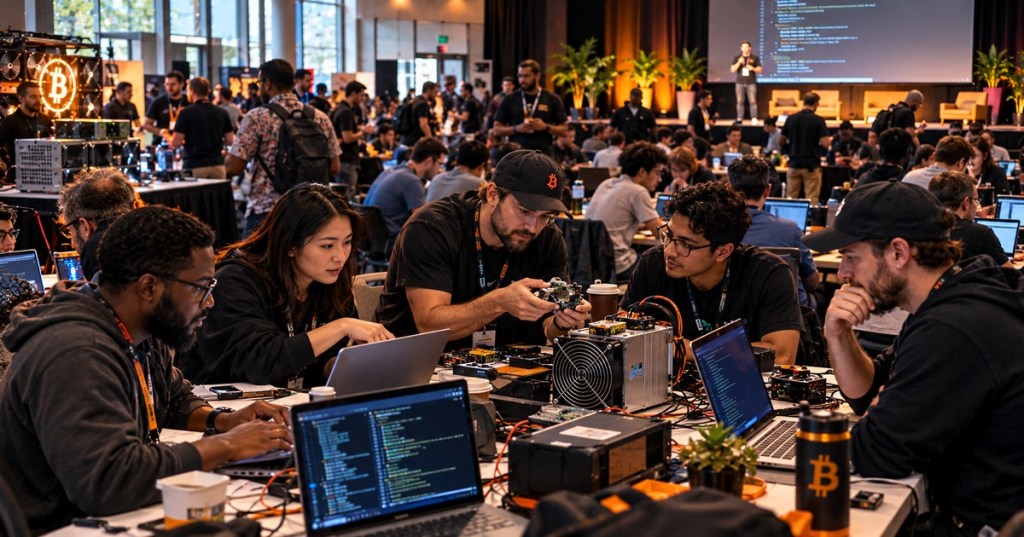
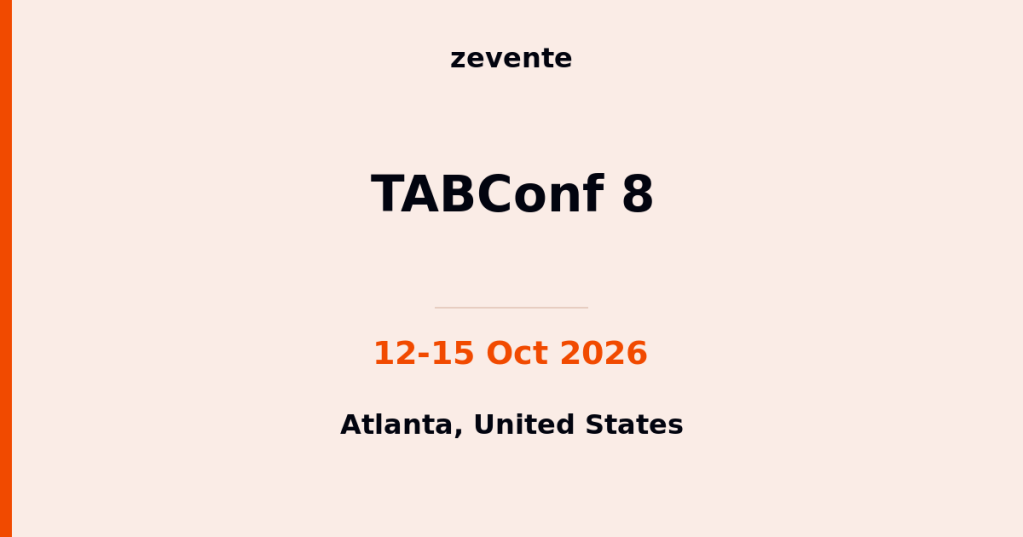
Bitcoin conference season is about to get unusually technical. TABConf 8 starts Monday, October 12, at Georgia Tech in Atlanta, and organizers say this will be the final TABConf after a run that began in 2018.
The four-day event opens with two Builder Days before shifting into conference sessions on October 14 and 15. The schedule reads less like a traditional crypto expo and more like an open-source engineering backlog: Bitcoin development with AI agents, Rust tooling, quantum-safe cryptography, mining-pool difficulty algorithms, wallet hardware, privacy, Lightning and hands-on projects.
Mining actually made the technical agenda
One session stands out for BitcoinVersus.Tech readers: “Recent Advances in Difficulty Adjustment for Mining Pools.” The talk is scheduled for Tuesday and focuses on how pools estimate a miner’s hashrate and adjust share difficulty from incoming work.
That sounds narrow, but it sits directly in the operating path between ASIC fleets and pool infrastructure. Share difficulty determines how frequently a miner submits valid shares to prove work to the pool. Anyone who wants the foundation first can start with our Stratum explainer, which covers how miners and pools exchange jobs and shares.
The conference also includes an all-event Proof Of Print project that integrates Bitcoin mining into a 3D printer and filament dryer so the machine’s waste heat can perform useful thermal work. That fits a broader engineering trend we have been following, from home heat reuse to commercial heat-recovery systems.
AI is showing up inside Bitcoin development
Monday begins with a workshop called “Agentic Engineering for Bitcoin Developers.” Another session, “Agentic Autoresearch for Bitcoin,” focuses on tools that let AI agents conduct Bitcoin research. Later in the week, a BitLab “Acceleration” track asks what small teams can build when coding agents become part of the development workflow.
That makes the timing interesting. The Linux Foundation’s Open Source Summit Europe wrapped up in Prague on Friday after a week centered on Linux, open AI, software security and open infrastructure. Now a Bitcoin conference is picking up many of the same questions—but inside Bitcoin’s protocol and application ecosystem.
Rust, open source and the next generation of contributors
TABConf’s schedule is itself organized in the open, and several sessions are explicitly about open-source development. Monday includes a talk on exposing Rust Bitcoin libraries across Kotlin, Swift, Python and Dart, plus a session on the growing center of Bitcoin open-source development in the Global South.
Thursday is scheduled to open with “rust-bitcoin: The Road to 1.0,” covering the push toward a production-ready 1.0 release. If Rust is unfamiliar, our Rust introduction explains why memory safety and strong tooling have made the language increasingly important in infrastructure software.
The open-source funding side matters too. Bitcoin development is not only about conferences and GitHub commits; long-lived infrastructure needs maintainers and grants. We recently covered how Btrust funded Stratum V2, Braidpool and Bitcoin Core mining infrastructure, another example of open-source work moving deeper into the mining stack.
Quantum risk is back on the schedule
Quantum computing is not treated as a single keynote topic. TABConf 8 lists sessions on isogeny-based signatures, post-quantum bridges and quantum-safe Bitcoin designs. That does not mean Bitcoin faces an immediate quantum break; it means developers are already debating what cryptographic migration paths could look like before the problem becomes urgent.
Why this conference is worth watching
TABConf is small compared with giant finance-oriented Bitcoin events, but that may be exactly why its schedule is useful. The agenda exposes what builders are arguing about before those ideas become product announcements: AI-assisted development, Rust libraries, mining-pool algorithms, privacy, post-quantum cryptography, open hardware and new Layer 2 designs.
SmartNews takeaway: the final TABConf starts Monday, and the most interesting part may be how little of its agenda resembles a price conference. Bitcoin’s developer community is spending its time on code, cryptography, mining infrastructure and open-source tooling—and that is often where the next wave of Bitcoin technology appears first.
Sources: TABConf 8 live schedule and Linux Foundation Open Source Summit Europe 2026.


Leave a Reply