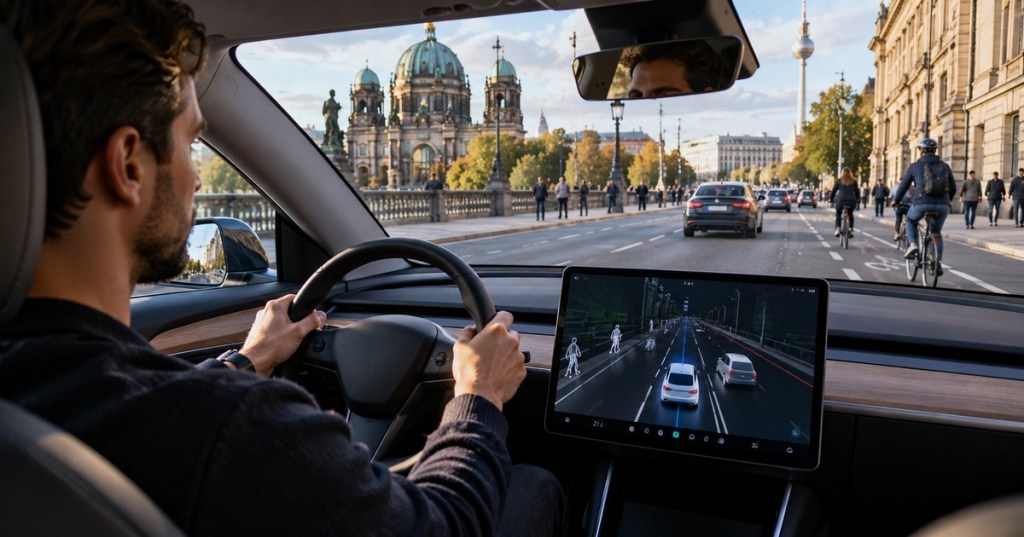
Tesla has stopped calling its advanced driver-assistance software “Full Self-Driving” across much of Europe. The new name is simpler and more literal: Tesla Assisted Driving.
The software can still steer, change lanes, follow a route, handle intersections and park, but the driver is still responsible for supervising it. Tesla’s own European product page now explicitly says the enabled features require active driver supervision and do not make the vehicle autonomous.
The distinction matters because the old name suggested a destination the current product has not yet reached. A current X post documenting the change shows the new branding appearing across European Tesla pages and apps.
The name changed. The supervision rule did not.
Tesla Assisted Driving remains a driver-assistance system. That means the car can perform a large portion of the mechanical driving task while the human continues to monitor the road and must be ready to take over. The company’s European page says its vision-based AI can navigate city streets and highways under active supervision.
That is different from a vehicle being legally autonomous. The difference is easy to miss because the software can look highly capable from inside the car: steering inputs, lane choices, braking and route decisions can all happen without constant manual control. But capability and legal responsibility are not the same thing.
Europe pushed Tesla toward clearer language
Reuters reported that regulators had questioned whether “Full Self-Driving” could mislead drivers about what the system actually does. Tesla is pursuing broader EU approval, while national approvals already exist in several European markets. A bloc-wide decision has been pushed back to at least December.
The rebrand therefore solves one problem but not the larger regulatory one. Changing the name does not itself grant Europe-wide approval, and it does not convert the software into unsupervised autonomy. It makes the product label better match the current operating model while the technical and legal approval process continues.
Why the wording matters
Names shape expectations. “Full Self-Driving” sounds like the driver can hand over responsibility. “Assisted Driving” tells the driver that the machine is helping rather than replacing them. For safety-critical software, that difference is not cosmetic.
It also highlights the gap between today’s advanced driver assistance and the robotaxi future. BitcoinVersus covered the policy side of that transition back in 2024 when a U.S. federal autonomous-vehicle framework was becoming a policy priority. The central regulatory question remains the same: when does software assistance become autonomous operation, and who is responsible when it does?
Tesla’s longer-term ambition is much more aggressive than supervised assistance. Its Cybercab concept was built around a vehicle with no conventional driver controls, a very different product category from a Model 3 or Model Y running supervised software.
Competitors are pushing toward the same destination through different architectures. BitcoinVersus recently covered Waymo’s multibillion-dollar robotaxi expansion, where the business model assumes the human driver is eventually removed from the operating loop entirely.
What actually changed for drivers
- The European name: Full Self-Driving (Supervised) is becoming Tesla Assisted Driving.
- The responsibility: the human driver still has to supervise and remain ready to take control.
- The underlying ambition: Tesla still wants broader approval and eventually much higher levels of automation.
- The regulatory status: a branding change is not the same thing as Europe-wide authorization.
The most interesting part of the change may be what it says about the maturity of autonomous-driving language. For years, automakers have sold a spectrum of features under names such as Autopilot, pilot assist, hands-free driving and self-driving. Regulators increasingly want the name on the screen to describe who is actually responsible for the vehicle.
What comes next
Tesla now has a clearer European label, but the harder work is unchanged: winning broader approval, proving the software works safely across different road systems, and keeping drivers engaged enough to supervise a machine that may perform most of the driving for long stretches.
If Europe eventually approves the system more broadly, the name change could look like a small but important step toward mainstream adoption. If approval remains fragmented, Tesla Assisted Driving will also become a useful reminder that software capability can advance faster than the legal framework governing it.
Editor’s Note: Tesla Assisted Driving remains a supervised driver-assistance system. Availability and enabled features vary by market and regulatory approval.
Support independent technology reporting: Bitcoin donations help fund BitcoinVersus.Tech research and publishing.
Disclaimer: BitcoinVersus.Tech provides technology news and analysis for informational purposes only.


Leave a Reply