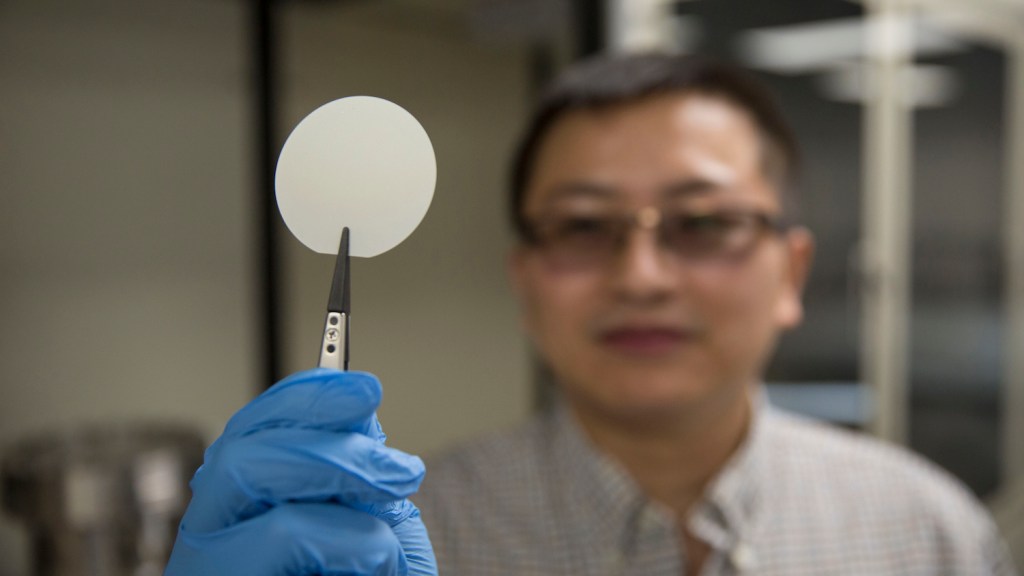
XMax Inc. says its planned acquisition of Hexa Creation will give the company a foothold in 1200-volt vertical gallium nitride power semiconductors for AI data centers. The signed deal documents tell a more precise story: XMax agreed to pay $4,123,711.34 for Hexa, and the purchase agreement states that Hexa’s sole material intellectual-property asset is a license covering technology owned by the Arizona Board of Regents on behalf of Arizona State University and licensed through Skysong Innovations.
The same agreement says Hexa has no material contracts other than that license. That distinction matters. XMax is not disclosing the purchase of a semiconductor fab, established production line, or a portfolio of customer supply agreements. It is acquiring a company built around licensed university-developed intellectual property and a technology roadmap that still has to cross the difficult gap from research to qualified, manufacturable power devices.
That does not mean the technology is imaginary. The research trail is unusually easy to verify. Arizona State University records show Professor Yuji Zhao and collaborators working on vertical GaN power transistors for years, including federally backed work aimed at the 1.2 kV class. The investigation therefore lands in a more interesting place than either hype or dismissal: the underlying engineering has substance, while the commercial readiness remains largely undisclosed.
What XMax Is Actually Buying
According to XMax’s October 9 SEC filing, the company signed the share purchase agreement on October 5. Professor Zhao owns 97% of Hexa Creation and Skysong owns the remaining 3%. XMax agreed to pay Zhao $4 million and Skysong $123,711.34.
The payments are split into two tranches. At closing, XMax owes $2 million to Zhao, reduced by a previously paid $500,000 deposit, plus $61,855.67 to Skysong. Another $2,061,855.67 is due by December 31, 2027, with interest.
The signed purchase agreement also assigns the buyer responsibility for a change-of-control fee under the technology license. The agreement describes that fee as 5% of the $4,123,711.34 transaction valuation. That works out to about $206,186, putting the acquisition-related amount at roughly $4.33 million before deferred-payment interest.
Most important for understanding the deal, the agreement says the licensed intellectual property is owned by the Arizona Board of Regents on behalf of ASU. It also states that the license is Hexa’s sole material IP asset and that Hexa has not granted sublicenses. Certain U.S. government rights are attached to the licensed technology as well.
The Engineering Trail Is Real
University records provide a much longer technical history than XMax’s recent AI pivot. Zhao’s ASU research group lists 1.2 kV-class GaN vertical power transistors among its projects and identifies support from the U.S. Department of Energy’s ARPA-E PNDIODES program. ASU reporting from 2017 describes Zhao’s team developing new methods for GaN vertical power transistors and working on the difficult materials problem of selective-area doping.
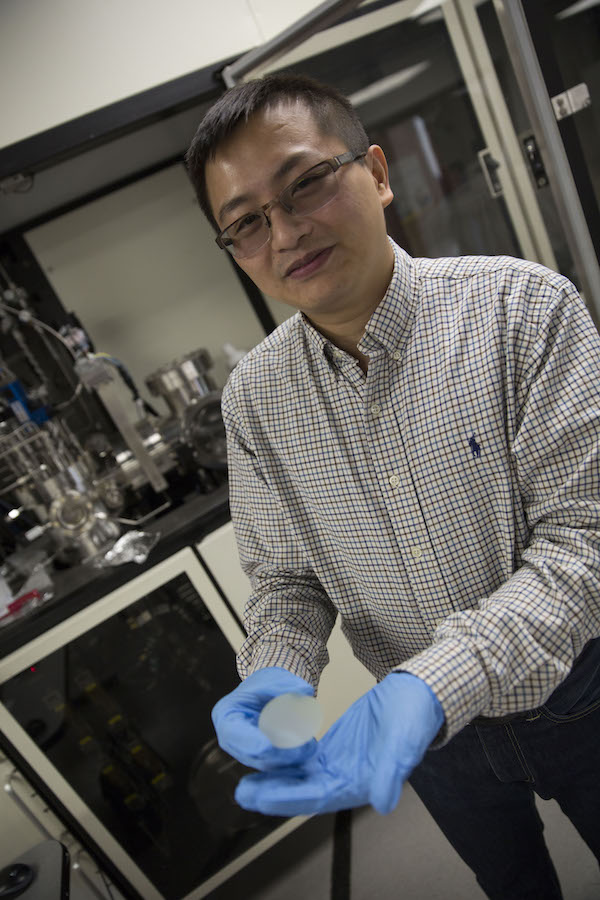
That history matters because 1200V vertical GaN is not just a bigger version of the GaN used in phone chargers. Much of today’s commercial GaN market uses lateral devices concentrated at lower voltages. Vertical GaN sends current through the device structure and is being developed for much higher-voltage power conversion. That makes it potentially relevant to the emerging 800V DC architectures being designed around megawatt-scale AI racks.
BitcoinVersus has been following that power transition from several directions. Renesas has been shrinking 650V GaN power stages for megawatt AI systems, while Microchip and Navitas are working on the 800V-to-low-voltage conversion problem. Navitas has also moved GaN production work toward GlobalFoundries. Those stories show why high-voltage GaN is strategically interesting—but also how much manufacturing, packaging, qualification and systems work sits between a device concept and large-scale deployment.
The Foundry Question Is Still Open
Zhao has publicly described a relationship between HexaGaN and TSMC. In an August LinkedIn post, he wrote about work being built “together with TSMC Fab 9.” That is relevant evidence of industry engagement, but it is not the same thing as a disclosed wafer-supply, foundry-capacity or production agreement.
That is where the signed acquisition agreement becomes especially important. Its representation on material contracts lists only the ASU/Skysong license. Public records reviewed by BitcoinVersus do not establish Hexa’s wafer capacity, production yield, device qualification status, commercial shipment volume or binding customer orders. They also do not establish the commercial terms of any TSMC relationship.
None of those absences prove that technical or commercial work is not happening. They do mean investors should distinguish between research collaboration, a technology roadmap and production-ready semiconductor supply. Those are different milestones.
XMax’s AI Pivot Is Only Months Old
XMax’s own filings add another layer of context. The company was formerly Nova LifeStyle and remains a distributor of contemporary furniture while building an AI software and services business. Its board approved expansion into AI in March 2026, and XMax AI Inc. was formed in April.
In its June-quarter filing, XMax reported about $34.63 million in cash and cash equivalents at June 30. The $4.12 million Hexa purchase price therefore equals about 11.9% of that cash balance. XMax reported roughly $4.52 million in sales for the first six months of 2026, meaning the Hexa purchase price is also about 91% of six-month sales.
The same filing says XMax launched API-based AI services in June and recorded about $1.10 million in revenue from that business during the six-month period. In other words, the company is moving into semiconductors while its AI operating history is still very short.
A Separate Nasdaq Issue Is Still Pending
There is also a separate corporate-governance issue that should not be conflated with the Hexa deal. XMax disclosed in September that Nasdaq found the company out of compliance with Listing Rule 5635(d) after several discounted private placements, when aggregated, exceeded the 20% threshold that would have required prior shareholder approval. XMax said the notice had no immediate effect on trading and that it had until October 26, 2026, to submit a compliance plan.
That notice does not establish anything about the quality of Hexa’s GaN technology. It does, however, matter when evaluating the corporate vehicle that is attempting to commercialize it.
What Comes Next
The next evidence to watch is concrete: whether the acquisition closes, what additional license details become public, whether Hexa identifies a manufacturing path, whether 1200V devices are independently characterized, whether reliability and qualification data appear, and whether named customers or foundry agreements move from public discussion into disclosed contracts.
The competitive bar is rising quickly. U.S. policy is already pushing capital toward wide-bandgap semiconductor capacity, while established power-chip companies are demonstrating increasingly aggressive GaN and SiC roadmaps for AI infrastructure.
For now, the evidence supports two conclusions at once. Hexa’s technology is rooted in years of serious university GaN research. But XMax’s acquisition filing describes a small company whose disclosed material IP position centers on an ASU license, not a mature vertically integrated semiconductor business. Whether that licensed research becomes a commercially significant 1200V GaN platform is the part of the story that has not yet been proven.
Editor’s Note: This investigation is based on public filings, university research records and public statements available as of October 10, 2026. Contract representations can use negotiated materiality standards; the absence of a separately disclosed agreement should not be read as proof that no informal, developmental or non-material relationship exists.


Leave a Reply