
CODESYS has released CODESYS 4, a new browser-based PLC engineering environment that brings IEC 61131-3 logic closer to modern software-development workflows. The first production release supports Structured Text and Ladder Diagram, stores projects as ordinary text files, and adds command-line build automation for Git and CI/CD pipelines.
The change is important because the PLC runtime itself is not being replaced. CODESYS says Version 1.0.0.0 uses the same compiler, libraries, and controller runtime as CODESYS 3. What changes is the engineering layer around the logic: where projects live, how teams compare changes, how builds are automated, and which operating systems can host the development environment.
PLC logic is still IEC 61131-3
CODESYS 4 does not invent a new PLC language. It continues to use IEC 61131-3 programming concepts, with Structured Text and Ladder Diagram available in the first release.
That continuity matters to controls engineers. Ladder logic still represents contacts, coils, conditions, and Boolean control in a visual form familiar to technicians. Structured Text still provides a higher-level textual language for calculations, state logic, reusable functions, and more complex program structures.
The real change is that the source project is no longer trapped inside one large proprietary project file. CODESYS 4 stores projects as folders containing JSON, XML, and other text files that standard version-control tools can compare.
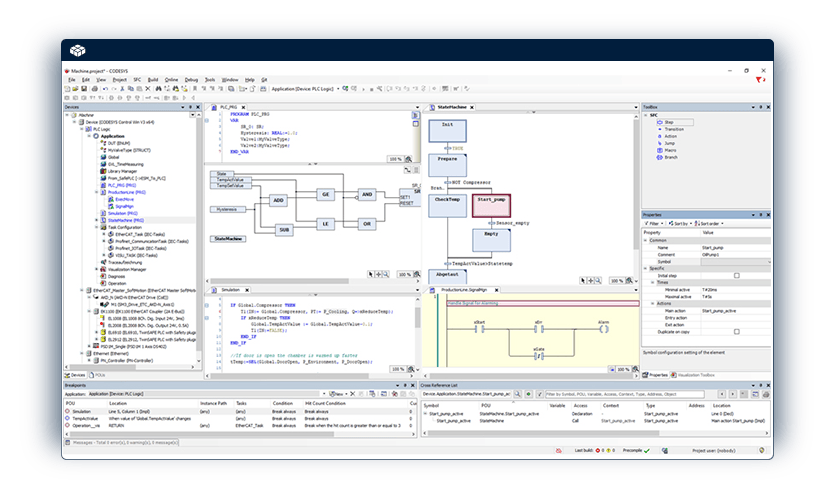
Projects can now behave more like software repositories
Text-based storage changes what engineering teams can do around PLC logic. Git can show which lines changed. Code reviews can happen before a change reaches a machine. Branches can isolate experimental work. Automated pipelines can rebuild libraries after every commit.
CODESYS also ships a command-line tool called c4-cli. According to the release documentation, it can generate compiled libraries and boot applications, resolve dependencies, create workspaces, log into control systems, and support automated build processes.
This is a significant cultural shift for industrial controls. PLC programs have historically been maintained more like machine documents than software repositories. Git and CI/CD move the workflow closer to the practices already common in application development, cloud infrastructure, and firmware engineering.
The browser does not mean the PLC logic runs in the cloud
“Web-based” describes the user interface. It does not require a public-cloud connection. The CODESYS 4 back end can run on a local Windows or Linux workstation, on a server inside the company network, or eventually directly on higher-performance controllers. The browser is simply the front end used to reach the engineering environment.
That distinction matters in factories and critical infrastructure where engineering networks may be intentionally isolated from the public internet.
Linux becomes a first-class PLC engineering host
The new environment runs on Windows x64, Linux x64, and Linux ARM64. That opens PLC engineering workflows to development servers, industrial PCs, ARM systems, and automated build machines that do not run Windows.
BitcoinVersus has followed this convergence from the hardware side. Our 2024 embedded-systems guide showed how controllers increasingly combine general-purpose processors, Linux-capable hardware, I/O, communications, and dedicated control logic inside the same machine architecture.
Version 1.0 is intentionally limited
CODESYS is unusually explicit about what the first release does not do. Version 1.0 is approved primarily for two scenarios: Structured Text library development with automated compilation, and relatively small controller projects using limited digital or analog I/O through Modbus TCP.
For commissioning and deeper online troubleshooting, CODESYS 3 remains the stronger tool. CODESYS 4 does not yet include the full set of online functions controls engineers expect, including Online Change, breakpoints, writing and forcing variables, and some live controller-monitoring capabilities.
That makes the release closer to a new engineering foundation than a complete replacement for the mature V3 environment.
Modbus TCP is one of the first practical device paths
The first CODESYS 4 release includes a Modbus configurator aimed at small applications. Modbus TCP moves the familiar Modbus register model across Ethernet/IP networking instead of the two-wire RS-485 physical layer used by Modbus RTU.
That connects directly to our older 2024 Modbus RTU and RS-485 guide. The register concepts remain recognizable, but the transport changes from serial communication to TCP/IP networking.
Ladder logic is moving into software-development workflows
CODESYS is not alone. Siemens introduced XLad ladder programming inside Simatic AX earlier this year, pairing graphical ladder logic with Git and CI/CD workflows. The direction is increasingly clear: vendors are trying to preserve the readability controls technicians expect while making PLC projects easier to version, review, automate, and integrate with modern software tools.
Siemens says XLad can switch between graphical and human-readable textual representations, with the text representation intended to support future AI-assisted control-logic development.
Why version control matters more than it sounds
A PLC program can stop a conveyor, open a valve, start a motor, enable a robot, or change an interlock. Knowing exactly what changed between revisions is therefore an operational issue, not merely a software-development convenience.
Text-based projects can make reviews more granular. A team can see that one rung, variable, function, or configuration file changed instead of comparing entire binary project archives manually.
The networking side remains equally important. Our 2025 network-port explainer provides the foundation for understanding how engineering tools, PLC runtimes, Modbus TCP devices, gateways, and remote services communicate across industrial Ethernet networks.
What changes for a controls technician today?
- Ladder and Structured Text remain relevant. CODESYS 4 changes the development architecture more than the PLC languages.
- Git becomes easier to use. Projects are stored as text files instead of one opaque binary project.
- Linux can host the engineering environment. Windows is no longer the only practical development host.
- Builds can be automated.
c4-clisupports headless compilation and CI/CD pipelines. - CODESYS 3 still matters. Most full commissioning, debugging, forcing, and mature online workflows remain there for now.
- Small Modbus TCP applications are an early production target. Larger or more complex device projects may still be better served by V3.
Bottom line
CODESYS 4 does not replace PLC logic with conventional software development. It brings conventional software-development practices around PLC logic.
Ladder Diagram and Structured Text remain at the center. The news is that those programs can increasingly live in Git, build from a command line, run through automated pipelines, and be edited from a browser on Windows or Linux.
The first release is narrow enough that many plant technicians will stay in CODESYS 3 for daily commissioning. But the architecture points toward a future where PLC logic is reviewed and maintained much more like the rest of a modern software stack.
BitcoinVersus.Tech Editor’s Note: CODESYS 4 Version 1.0.0.0 is a production release for a deliberately limited set of use cases. It should not be described as a full replacement for CODESYS 3. Features, licensing, and supported workflows may expand in later releases.
Follow BitcoinVersus.Tech for PLC logic, SCADA, industrial networking, Modbus, robotics, firmware, data centers, and emerging automation technology.
Support independent technology reporting: Bitcoin donations help fund BitcoinVersus.Tech research and publishing.
Disclaimer: BitcoinVersus.Tech provides technology news and education for informational purposes only.


Leave a Reply