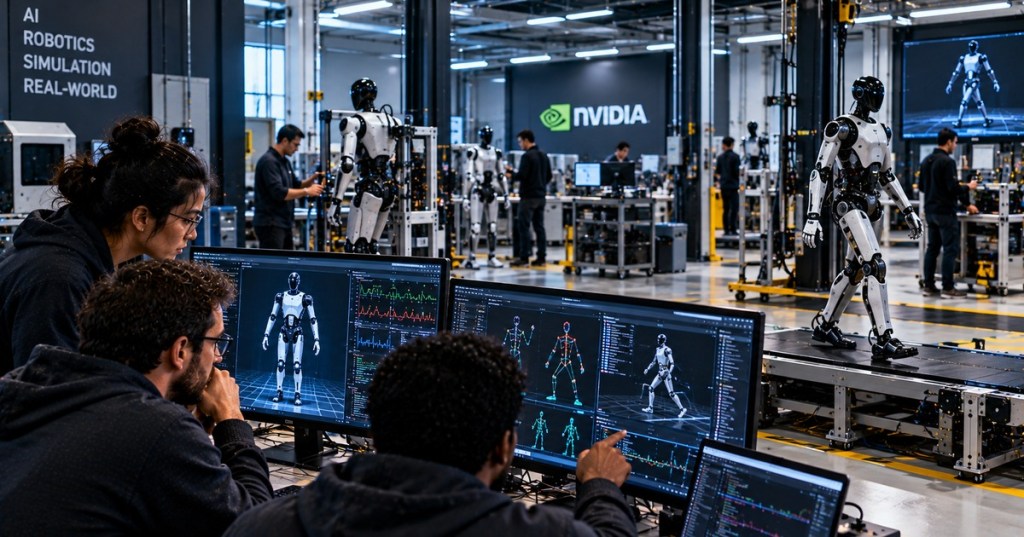
NVIDIA says its Seattle Robotics Lab has built robotic systems capable of assembling key parts of GB300 tester trays, including busbars and high-density electrical connectors. The work is a strong demonstration of physical AI and industrial robotics—but NVIDIA is also unusually clear that the system is not yet ready to replace skilled factory workers on the production line.
In a new NVIDIA Technical Blog report, researchers describe more than a year of work with NVIDIA Operations and Foxconn on two difficult assembly tasks: installing a heavy busbar and inserting four cable-mounted electrical connectors into a GB300 tester tray.
The manufacturer’s bar is much higher than a typical robotics demo. NVIDIA says the target is at least 99.5% success, tight cycle-time requirements, and no unintended collisions that could damage high-value hardware.
The first task: installing a busbar
The busbar task looks simple until the tolerances are considered. The robot has to pick up a long conductive bar, position it correctly, insert fixtures, drive 16 screws, release a clamp, and remove the temporary fixture without damaging the tray.
NVIDIA used three robot arms: two Flexiv Rizon 4S systems and a Universal Robots UR10e fitted with an OnRobot screwdriver. Perception came from camera-based pose estimation, while planning and contact control were handled through a modular robotics stack.
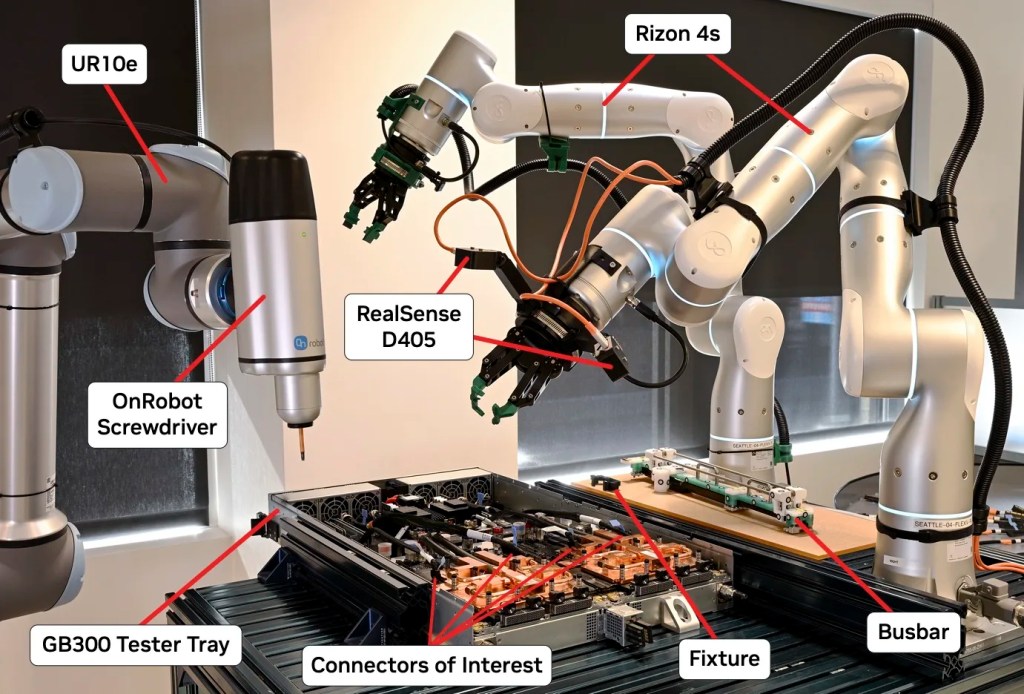
The result was better than 95% success on busbar assembly, according to NVIDIA. That is impressive for a difficult flexible-automation task, but it still falls short of the 99.5% deployment requirement.
Cycle time also remains a problem. NVIDIA says the full busbar sequence currently takes about 160 seconds, versus a manufacturer target of no more than 124 seconds. The biggest bottleneck is the sequence of screwdriver operations.
The connector problem is harder
The second task is more difficult because the electrical connectors are attached to flexible cables. Cable shape changes as the parts bend and wear, the connectors have little visual texture, and the sockets have tight clearances.
NVIDIA first used Meta’s SAM3 model to segment the cables from camera images and identify a reliable grasp point. The simple cable-grasping method produced almost no observed failures.
Grasping the actual connector was much harder. General-purpose pose estimation struggled, and end-to-end imitation-learning approaches also performed poorly because NVIDIA did not have enough durable physical cables to generate the large amounts of training data those systems normally need.
NVIDIA went back to specialized engineering
One of the most interesting parts of the project is that the researchers did not simply keep scaling a larger AI model when learning-based approaches failed.
NVIDIA developed a specialist pose-estimation system called DOPER, or Deep Object Pose Estimation Revisited, and combined it with custom 3D-printed gripper fingers. The gripper geometry physically guides the connectors into more repeatable positions during contact.
The lesson is surprisingly traditional: better mechanical design can remove uncertainty that software would otherwise have to solve.
That fits with older BitcoinVersus coverage of Boston Dynamics’ Atlas moving into industrial manipulation. The most capable factory robots increasingly combine software intelligence with purpose-built mechanics rather than treating one as a substitute for the other.
Simulation helped, but real-world data still mattered
For the actual connector-insertion motion, NVIDIA trained reinforcement-learning policies inside Isaac Lab and then transferred those policies to physical robots.
The simulation-to-real approach worked well for the larger connector, but small pose-estimation errors still caused failures on tighter connectors. NVIDIA then added real-world reinforcement learning using force and torque feedback to refine the insertion behavior.
This connects directly to our 2025 coverage of the open-source Newton physics engine. Simulation is becoming central to robot development, but NVIDIA’s latest results reinforce that factory-grade reliability still depends on real-world data and physical validation.
Connector assembly is still below the deployment target
NVIDIA reports overall success rates of roughly 90% to 95% for the complete four-connector workflow. Remaining failures are concentrated mainly in multi-arm coordination during connector grasping.
Cycle time is the bigger gap. NVIDIA says the system averages about 40 seconds per cable. The manufacturer’s target for all four connectors is no more than 72 seconds total.
That means the current system is technically capable but not yet economically competitive enough for the production target NVIDIA and Foxconn defined.
Why this matters for AI hardware manufacturing
NVIDIA’s AI systems are becoming physically larger, more complex, and more expensive. Scaling AI infrastructure therefore depends on more than designing faster GPUs. The industry also has to manufacture, assemble, cable, test, and deploy the hardware at enormous scale.
BitcoinVersus covered that manufacturing push in our 2025 report on NVIDIA’s plan to expand U.S. AI-supercomputer manufacturing. If that infrastructure buildout continues, automation around high-value server hardware could become as strategically important as the chips themselves.
NVIDIA also points to a broader labor constraint. A Deloitte manufacturing study estimates that U.S. manufacturing could face 1.9 million unfilled jobs by 2033 if workforce gaps are not addressed.
The most important result may be what did not work
The project is a useful counterweight to the idea that every robotics problem should be solved with one giant end-to-end model.
NVIDIA found that classical perception, mechanical fixtures, specialized pose estimation, impedance control, simulation-based reinforcement learning, and real-world reinforcement learning each worked best in different parts of the problem.
The engineering lesson is not that AI failed. It is that factory automation is a full-stack problem. A successful system may need machine vision, learned policies, conventional control theory, mechanical design, networking, software infrastructure, and carefully designed hardware all working together.
Bottom line
NVIDIA has shown that robots can perform difficult parts of GB300 tester-tray assembly, but the company has not claimed the system is ready for unsupervised mass production.
Busbar assembly has surpassed 95% success but is still too slow and below the 99.5% reliability target. Multi-connector insertion sits around 90% to 95% success and remains substantially slower than the required production cycle.
The bigger story is the direction of travel: the company building the AI hardware is now using AI-assisted robotics to learn how to assemble that hardware. NVIDIA’s next step is moving the work from the lab into contract-manufacturer factories and closing the remaining reliability and cycle-time gap.
BitcoinVersus.Tech Editor’s Note: NVIDIA’s results are laboratory results published by NVIDIA researchers. The company explicitly states that the current system still falls short of its factory deployment requirements. Success rates, cycle times, and future deployment plans should therefore be read as experimental engineering results rather than proof of production-scale automation.
Follow BitcoinVersus.Tech for robotics, AI hardware, semiconductors, data centers, automation, and emerging technology.
Support independent technology reporting: Bitcoin donations help fund BitcoinVersus.Tech research and publishing.
Disclaimer: BitcoinVersus.Tech provides technology news and analysis for informational purposes only.


Leave a Reply