
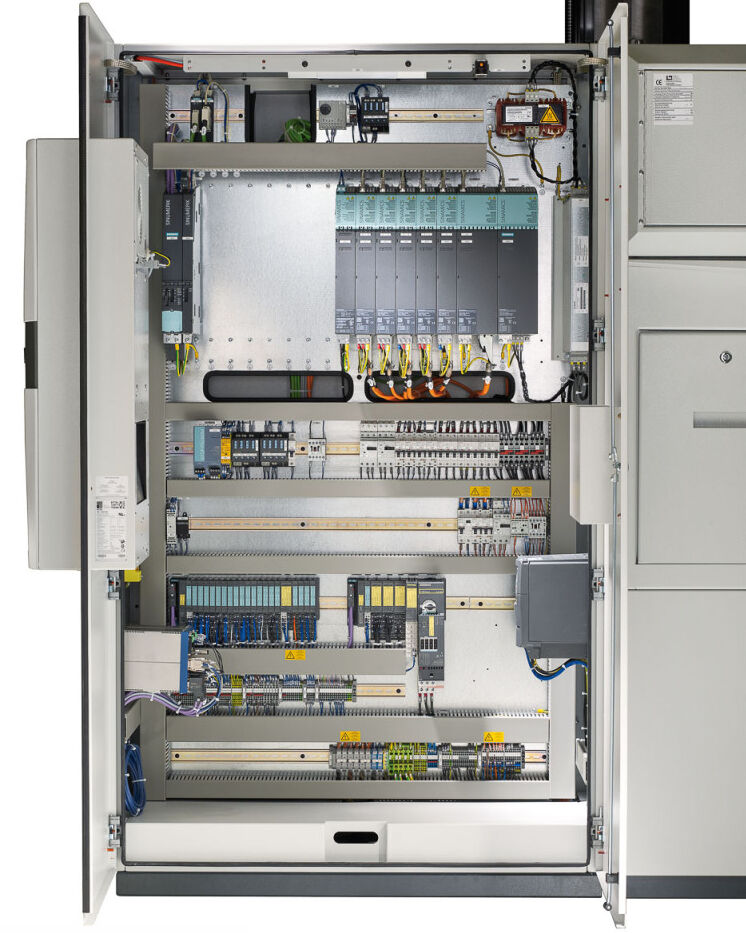
A PLC and a PAC can sit in nearly identical control cabinets, read the same sensors, drive the same motors, and even use the same programming languages. The difference is usually not that one controls machines and the other does not. The difference is how much control, data, networking, motion, process logic, and system integration the controller is designed to handle at once.
The simplest way to remember it is:
PLC = focused industrial control.
PAC = broader multi-domain automation control.
That distinction is useful, but modern hardware has blurred the line so much that the label on the product box matters less than the actual controller specifications.
What a PLC is
A programmable logic controller is a rugged industrial computer designed to run control logic reliably and predictably. The classic PLC repeatedly reads field inputs, executes its program, updates outputs, performs communications and diagnostics, and begins the cycle again.
That model is excellent for conveyor sequencing, motor starts, interlocks, packaging equipment, pumps, valves, sensors, machine safety coordination, and thousands of other tasks where deterministic behavior matters more than general-purpose computing.
The hardware can be tiny or enormous. A compact PLC may have built-in I/O for one machine. A modular rack may connect to remote I/O, drives, HMIs, robots, SCADA systems, and multiple industrial networks.
What a PAC adds
A programmable automation controller takes the PLC concept and stretches it across a larger application. A PAC is typically designed to coordinate several control disciplines—discrete logic, analog process control, motion, drives, safety, communications, and larger data structures—inside one integrated platform.
A useful technical overview from Wevolver notes that the PAC category emerged to describe controllers that integrate several automation domains, larger memory and I/O systems, richer networking, and shared development environments. The same source also makes an important modern point: the PLC/PAC boundary has become increasingly blurry.
Rockwell Automation provides a practical example. Its ControlLogix platform has long been described in company material as a programmable automation controller when one platform is coordinating larger production systems, process information, networking, and multiple wells or machines.
Both still execute real-time control
A PAC is not simply a normal office computer placed in a control cabinet. Both PLCs and PACs are built around real-time industrial control. They have to respond predictably to sensors, machine states, interlocks, process values, and faults.
That is why the most useful comparison is not “industrial computer versus normal computer.” It is how much industrial control work the platform is designed to coordinate at once.
The scan cycle is still fundamental
Traditional PLC programming is closely associated with the scan cycle: read inputs, execute logic, update outputs, repeat. That mental model remains extremely useful even on advanced controllers.
PAC-class systems may add multiple periodic tasks, event tasks, motion tasks, process loops, communications, and different priority levels. Instead of thinking about one simple program scanning from top to bottom, the engineer may be coordinating several real-time workloads under one controller.
Programming language is not the dividing line
Older PLCs are strongly associated with Ladder Diagram because ladder was designed to be familiar to electricians replacing relay panels. Modern PLCs, however, may also support Structured Text, Function Block Diagram, Sequential Function Chart, and other IEC 61131-3 languages.
PACs commonly support the same language set. Some add C, C++, Python, Linux applications, or edge-computing environments alongside deterministic control.
That means using Structured Text does not magically turn a PLC into a PAC, and using Ladder does not make a PAC a basic PLC. The application architecture matters more than the syntax.
A PLC is often the better choice for a focused machine
If the job is one packaging machine with digital sensors, pneumatic valves, several motors, an HMI, and a few VFDs, a conventional PLC may already provide everything the machine needs.
Adding a more expensive controller simply because the word PAC sounds more advanced can increase cost and engineering complexity without improving the machine.
This is one reason plant standards matter. Technicians already trained on the platform, available spare parts, familiar programming software, known firmware, and established troubleshooting procedures can be more valuable than theoretical controller capability.
A PAC starts to make sense when several domains converge
Now imagine the controller has to coordinate 20 servo axes, several hundred analog values, complex PID loops, recipe data, safety tasks, dozens of VFDs, distributed I/O, a historian connection, SCADA, redundant Ethernet, and production data moving toward MES or enterprise systems.
That is where the PAC idea becomes useful. Instead of adding separate motion controllers, data computers, gateways, and process controllers, one higher-capability automation platform may handle more of the system in a common project.
PAC usually means more data and more networking
A small PLC may only need several Ethernet connections and a handful of field protocols. A larger controller may need EtherNet/IP or PROFINET for I/O and drives, Modbus TCP for third-party devices, OPC UA for supervisory data, time synchronization, remote racks, redundant networks, historians, and upstream applications.
Those layers connect naturally with our older 2025 guide to network ports. Once automation systems move onto Ethernet and IP, controller engineering becomes inseparable from networking fundamentals.
Field protocols do not care what marketing label is on the controller
A PLC and a PAC can both read Modbus registers, exchange industrial Ethernet traffic, monitor analog sensors, and command actuators. The field device does not care whether the upstream CPU was sold as a PLC or a PAC.
BitcoinVersus covered the lower-level side of this in our 2024 Modbus RTU and RS-485 guide. A temperature controller returning holding registers over RS-485 can feed a small PLC, a large PAC, a gateway, or an industrial computer. The protocol remains the protocol.
Hardware architecture matters more as systems grow
Both categories are embedded computers. They contain a processor, memory, firmware, communications hardware, buses, I/O interfaces, watchdogs, power circuitry, and real-time software.
Our 2024 embedded-system hardware guide provides useful background because a PLC or PAC is ultimately a specialized embedded system designed for industrial reliability.
As controller requirements grow, memory size, processor performance, task scheduling, remote I/O limits, network connections, redundancy, motion axes, and data throughput become more important than the three-letter category.
PLC vs. PAC
| Question | PLC | PAC |
|---|---|---|
| Core purpose | Reliable machine and process control | Integrated multi-domain automation control |
| Typical application | Machine, cell, conveyor, pump system, skid | Large machine, hybrid plant, motion/process system, infrastructure |
| Discrete logic | Excellent | Excellent |
| Process control | Common on modern PLCs | Often a core design target |
| Motion | Available depending on model | Often deeply integrated |
| Programming | IEC 61131-3 languages depending on platform | IEC 61131-3 plus broader software options on some platforms |
| Memory and data | Small to very large depending on family | Usually designed for larger structured data sets and applications |
| Networking | Can be extensive | Usually designed around broad multi-network integration |
| Enterprise / edge integration | Often possible | More commonly a major design objective |
| Cost | Often lower for focused control | Often higher but may replace several separate systems |
| Boundary today | Increasingly blurred; capability matters more than the label | |
Do PACs replace PLCs?
No. The market has largely moved toward convergence instead.
Small PLCs remain excellent for compact, cost-sensitive control. High-end PLCs now contain many capabilities that would once have justified the PAC label. PAC platforms continue to push toward edge computing, software-defined control, large distributed architectures, advanced motion, process control, and enterprise integration.
The result is that two engineers may look at the same controller and one calls it a PLC while the other calls it a PAC—and both may have a reasonable argument.
The software-defined future makes the distinction even fuzzier
The newest automation systems are moving control software into virtualized or software-defined environments. CODESYS 4, virtual PLCs, industrial Linux, edge controllers, and software-defined automation all push the industry away from a simple hardware category.
We recently covered that transition in CODESYS 4 Brings PLC Logic Into the Browser, where traditional PLC programming is being wrapped in Git, Linux, browser-based engineering, and CI/CD workflows.
Which one should you choose?
Choose the smallest controller architecture that comfortably handles the final application—not only the machine as it exists on day one.
- Choose a PLC when: the application is contained, I/O is manageable, logic is mostly discrete or straightforward process control, the existing plant standard already supports the job, and simplicity matters.
- Consider a PAC when: the system combines large I/O counts, advanced motion, process loops, complex structured data, multiple networks, redundant architectures, heavy SCADA integration, or significant edge and enterprise data requirements.
- Ignore the label when: a modern controller marketed as a PLC already meets every PAC-like requirement in the specification.
The easiest way to remember it
A PLC is the industrial-control foundation. A PAC is the same idea expanded for larger, more integrated automation systems.
The most important question is not “Is this officially a PLC or a PAC?” The useful question is: Can this controller execute the logic, motion, process, networking, safety, data, and lifecycle requirements of the machine or plant without unnecessary complexity?
BitcoinVersus.Tech Editor’s Note: PAC is not a universally standardized technical boundary. Vendors and engineers use the term differently, and many modern PLC families now provide capabilities that historically defined PACs. Controller selection should therefore be based on documented performance, I/O, networking, safety, motion, software, redundancy, cybersecurity, and lifecycle requirements rather than the acronym alone.
Follow BitcoinVersus.Tech for PLC logic, PACs, SCADA, industrial networking, Modbus, robotics, data centers, and emerging automation technology.
Support independent technology reporting: Bitcoin donations help fund BitcoinVersus.Tech research and publishing.
Disclaimer: BitcoinVersus.Tech provides technology news and education for informational purposes only.


Leave a Reply