
A hash is a fixed-size digital fingerprint produced from data. Give a cryptographic hash function some input—a word, a file, a transaction, or a Bitcoin block header—and it transforms that input into a seemingly random output. The same input always produces the same hash, but changing even one small part of the input produces a dramatically different result.
Bitcoin depends on hashes everywhere. Transactions are identified with hashes. Blocks are linked using hashes. Merkle trees compress thousands of transaction identifiers into a single root. And Bitcoin miners perform enormous numbers of hash calculations while searching for a block header whose hash falls below the network’s target.
A hash turns data into a fixed-size result
A cryptographic hash function accepts data of almost any practical size and produces an output with a fixed length. Bitcoin uses SHA-256 extensively. SHA-256 produces a 256-bit result, commonly displayed as 64 hexadecimal characters.
The NIST Secure Hash Standard defines SHA-256 as one of the standardized secure hash algorithms. NIST describes hash outputs as message digests that can be used to detect whether data has changed.
The input can be short or huge. SHA-256 still returns a 256-bit digest. That fixed output size is one reason hashes are useful as compact identifiers.
One tiny change gives a completely different hash
Consider two inputs that differ only by one capital letter. A single SHA-256 calculation of Bitcoin produces b4056df6691f8dc72e56302ddad345d65fead3ead9299609a826e2344eb63aa4.
Change the first letter to lowercase—bitcoin—and the SHA-256 output becomes 6b88c087247aa2f07ee1c5956b8e1a9f4c7f892a70e324f1bb3d161e05ca107b.
The outputs do not look slightly different. They look unrelated. This behavior is commonly called the avalanche effect: a small change in the input produces a large, unpredictable change in the digest.
A hash is not encryption
Encryption is designed so authorized users can reverse the operation with a key and recover the original data. A cryptographic hash function is designed to be one-way. You can easily calculate the hash of known data, but the hash itself is not meant to provide a practical method for reconstructing the original input.
That does not mean hashes are mathematically unique. A finite 256-bit output space means collisions must theoretically exist because there are more possible inputs than outputs. The security goal is that finding a useful collision or reversing a strong hash is computationally infeasible.
Bitcoin uses SHA-256 twice for proof of work
Bitcoin mining does not simply hash the word “Bitcoin.” Miners work with an 80-byte block header containing the block version, previous block hash, Merkle root, timestamp, encoded target, and nonce.
The Bitcoin developer reference specifies that the serialized block header is hashed as part of proof of work and that block-header hashes use SHA256(SHA256()). In other words, the header is passed through SHA-256 twice.
The resulting 256-bit number must be less than or equal to the current network target. If it is too high, the miner changes data that affects the header and tries again.
What miners are actually doing
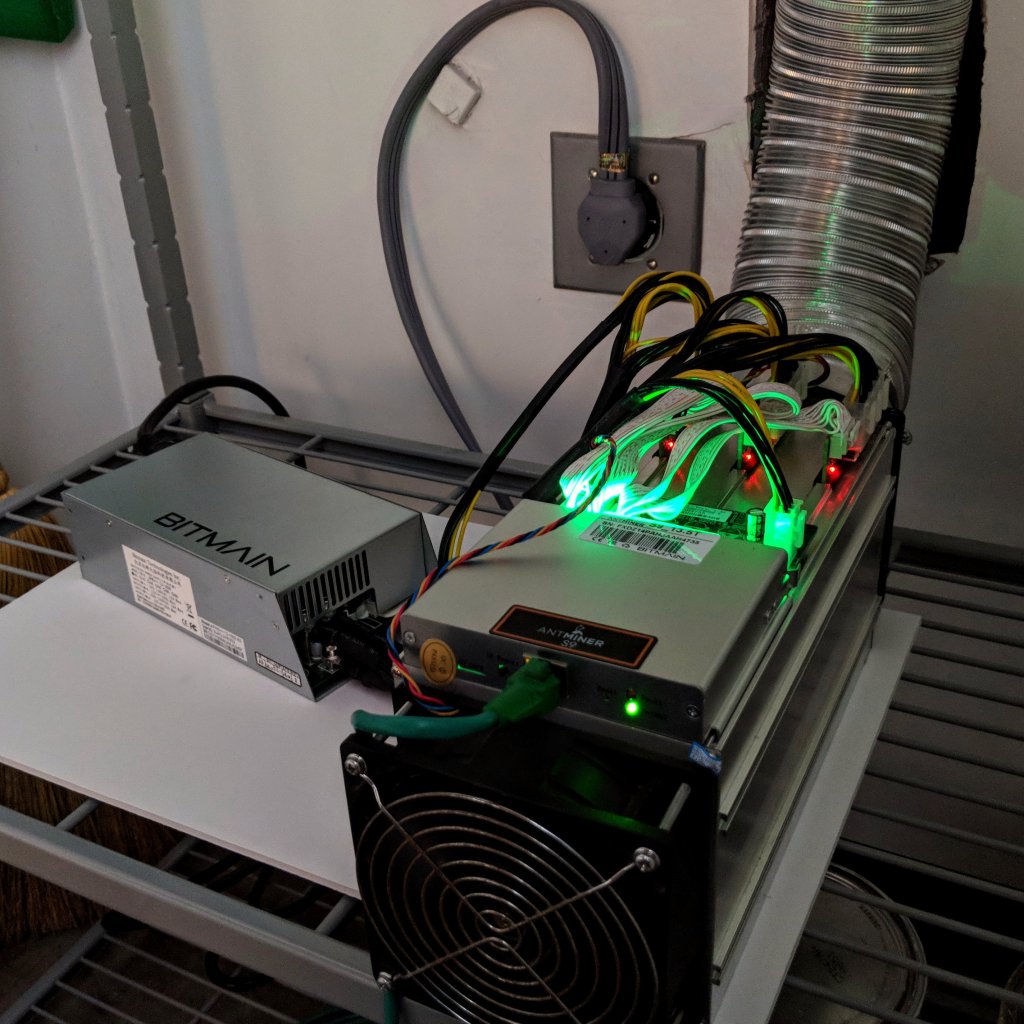
A Bitcoin ASIC is essentially an extremely specialized machine built to calculate SHA-256 hashes at extraordinary speed. It receives candidate block-header work and repeatedly changes values to generate new hash outputs.
The most familiar changing field is the nonce. But a modern miner can exhaust the 32-bit nonce range quickly, so mining software also changes extra-nonce data in the coinbase transaction. That changes the Merkle root, which changes the block header and gives the ASIC an entirely new search space.
This is the physical meaning behind the SHA-256 mining hardware we covered in our 2024 look at SHA-256 and Scrypt ASIC mining. The ASIC is not solving a traditional equation step by step. It is testing vast numbers of candidate hashes until one happens to satisfy the target.
Hash vs. hashrate
A hash is one output from the hash function. Hashrate describes how many hash attempts a miner or network can perform per second.
- 1 H/s: one hash per second.
- 1 kH/s: one thousand hashes per second.
- 1 MH/s: one million hashes per second.
- 1 GH/s: one billion hashes per second.
- 1 TH/s: one trillion hashes per second.
- 1 PH/s: one quadrillion hashes per second.
- 1 EH/s: one quintillion hashes per second.
So a 200 TH/s Bitcoin miner is capable of roughly 200 trillion SHA-256 hash attempts per second under its rated conditions. Our 2024 coverage of petahash-scale ASIC hardware showed how far individual machine throughput had progressed beyond the terahash era.
More hashes mean more chances—not a smarter guess
Mining hardware does not know which nonce will produce a winning hash. Each valid attempt is effectively another draw from the possible SHA-256 output space. More hashrate simply gives a miner more attempts per second and therefore a larger statistical share of the network’s block-finding probability.
This is also why overclocking raises hashrate: the chips perform more work per unit of time. In our 2025 Bitaxe overclocking test, changing operating conditions increased the miner’s measured hash throughput. The underlying job remained the same—calculate candidate hashes faster.
Difficulty decides how rare a winning hash must be
A miner does not win merely by producing a hash. Every ASIC produces hashes constantly. A block is valid only when its header hash is numerically at or below the network target.
When Bitcoin’s mining difficulty rises, the target effectively becomes harder to hit. More attempts are expected before the network finds a successful result. When difficulty falls, the acceptable target becomes easier. Bitcoin adjusts this difficulty every 2,016 blocks to keep average block production near 10 minutes.
Hashes link Bitcoin’s history together
Every Bitcoin block header contains the hash of the previous block header. That means changing an older block changes its hash, which causes the next block’s stored previous-block hash to stop matching.
The chain therefore behaves like linked cryptographic fingerprints. Rewriting old history is not as simple as editing a database row. The attacker would have to recreate valid proof of work from the altered block forward and catch the honest chain.
The easiest way to remember it
A hash is a digital fingerprint. Hashrate is how fast a miner can generate fingerprints. Mining difficulty controls how rare the acceptable fingerprint must be.
Bitcoin takes those three ideas and turns them into proof of work. ASICs generate enormous numbers of hashes. The network sets a target. Eventually one miner produces a block-header hash below that target, broadcasts the block, and the process starts again.
BitcoinVersus.Tech Editor’s Note: The two text examples in this article show one SHA-256 operation to demonstrate how a hash changes with its input. Bitcoin proof of work applies SHA-256 twice to the serialized block header. “Hashrate” is an estimate of computational throughput and should not be confused with the hash output itself.
Follow BitcoinVersus.Tech for Bitcoin mining, ASIC hardware, firmware, networking, semiconductors, energy, and open-source infrastructure coverage.
Support independent technology reporting: Bitcoin donations help fund BitcoinVersus.Tech research and publishing.
Disclaimer: BitcoinVersus.Tech provides technology news and education for informational purposes only.


Leave a Reply