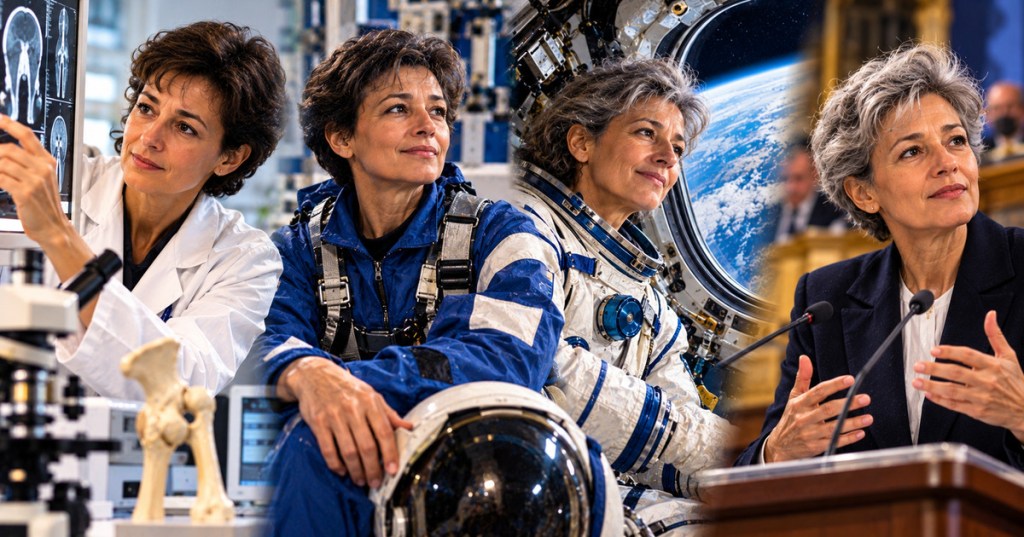
Claudie Haigneré built one of the most extraordinary careers in European science and public service: physician, neuroscientist, astronaut, Soyuz commander-qualified spacefarer, government minister and science-policy leader.
Her story is newly relevant in 2026. Thirty years after Haigneré became the first French woman in space, ESA astronaut Sophie Adenot publicly credited her with helping ignite her own dream of becoming an astronaut. Adenot returned to Earth this month after a 237-day mission aboard the International Space Station.
Haigneré began in medicine. She trained as a doctor specializing in rheumatology, earned additional qualifications in sports medicine and aviation and space medicine, and completed a PhD in neuroscience in 1992. She worked at Cochin Hospital in Paris while also conducting research in neurosensory physiology and human adaptation to weightlessness.
France’s CNES space agency selected her as an astronaut candidate in 1985. After years of scientific work and training, she flew to the Mir space station on the Cassiopée mission in 1996, becoming the first French woman in space. In 1999, she became the first woman to qualify as a Soyuz Return Commander. Two years later, she flew to the International Space Station as a Soyuz flight engineer and became the first European woman to visit the ISS. ESA’s biography documents the full sequence.
Then the career changed again. In 2002, Haigneré entered the French government as Minister for Research and New Technologies. She later served as Minister for European Affairs, bringing firsthand experience in medicine, research and spaceflight into national policy.
Her influence is still visible. In August 2026, Adenot wrote that watching Haigneré head to the launch pad three decades earlier made spaceflight feel possible to her. La Dépêche documented that direct line of inspiration between France’s first and second women in space.
Haigneré’s résumé belongs beside Mae Jemison’s path from engineer to doctor to astronaut, Kathryn Sullivan’s career from spacewalk to Challenger Deep, and Myron Rolle’s journey from Florida State safety to pediatric neurosurgeon. Few careers move so convincingly from hospital medicine to neuroscience, spacecraft operations and national government.
BitcoinVersus.Tech is not a financial advisor. This media platform reports on financial subjects purely for informational purposes.
BitcoinVersus.Tech Editor’s Note:
We volunteer daily to ensure the credibility of the information on this platform is Verifiably True. If you would like to support to help further secure the integrity of our research initiatives, please donate using the QR code provided
For best QR-code scanning results, please scan this donation code from a desktop or larger screen. Mobile screens may prevent camera recognition.



Leave a Reply