Mind Robotics has hired Doug Field as president as the industrial AI startup moves from early development toward factory-scale deployment.
Mind Robotics says Field will oversee product, engineering and operations while working closely with founder RJ Scaringe. Field most recently served as Ford’s chief EV, digital and design officer. Earlier in his career, he led Apple’s Special Projects Group and Mac hardware engineering and served as Tesla’s senior vice president of engineering during development of the Model 3.
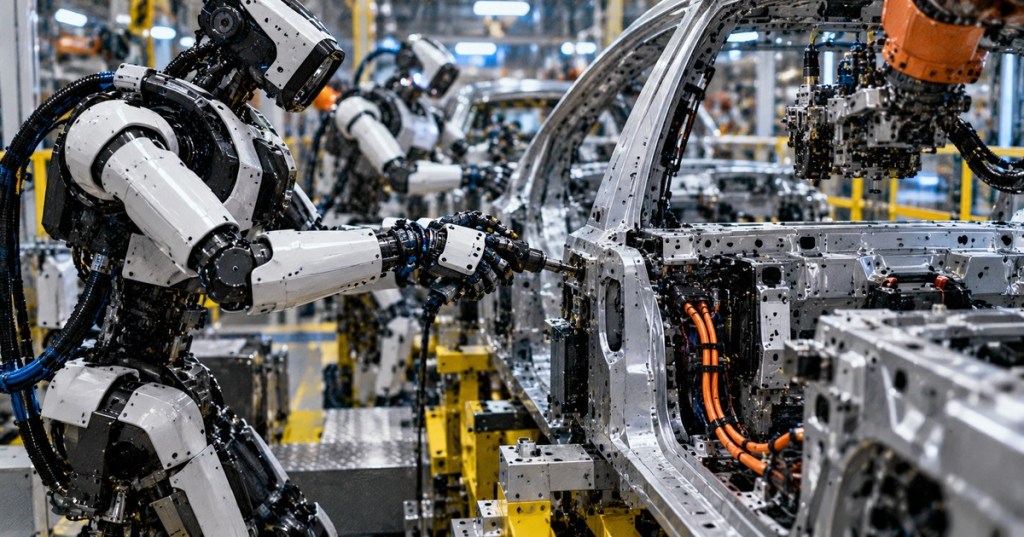
The hire matters because Mind is trying to solve a different robotics problem than the headline-grabbing humanoid race. The company is building purpose-designed industrial robots and foundation models for tasks that require dexterity, variability and physical reasoning inside real factories.
Mind Robotics’ public X channel tracks the company’s industrial robotics work and deployment progress.
Rivian is Mind’s first manufacturing partner and launch customer. The startup says it is collecting video and production data from active automotive lines so its models can learn tasks such as pick-and-place work, sorting, fastening and handling flexible connectors. That gives the company a live feedback loop rather than relying only on lab demonstrations.
That approach fits a broader shift BitcoinVersus.Tech has been following. Robot gyms are becoming data factories for physical AI, while Skild S1 is pushing robots toward learning new tasks from a single video.
Kleiner Perkins describes Mind Robotics’ AI-native manufacturing platform and its use of real factory environments for training and deployment.
Mind’s October 13 announcement says the company is now moving toward industrial-scale deployment. Field’s background is unusually relevant to that stage: he has worked across vehicle engineering, consumer hardware and high-volume manufacturing rather than purely research-oriented robotics.
Mind has also raised more than $1 billion across its 2025 seed round, a $500 million Series A in March and a $400 million financing in May. The money gives the company room to build not only models, but also custom robot hardware and the deployment infrastructure required to operate machines continuously on factory floors.
The strategy is still early. Mind has not publicly shown a broad commercial rollout, and today’s announcement is a leadership change rather than a product launch. The real test will be whether the company’s factory-trained models can generalize beyond Rivian’s lines and handle unfamiliar parts, tools and workflows with enough reliability for industrial customers.
That challenge is already shaping the industry. BitcoinVersus.Tech recently covered L&T’s new AI manufacturing lab, another example of physical AI moving closer to production environments where uptime, repeatability and recovery matter more than demo-room spectacle.
Field’s appointment gives Mind an executive with direct experience taking complex hardware from design into high-volume production. For a robotics company trying to prove itself on live factory floors, that is the part of the résumé that matters most.
BitcoinVersus.Tech Editor’s Note:
We volunteer daily to ensure the credibility of the information on this platform is Verifiably True. If you would like to support to help further secure the integrity of our research initiatives, please donate using the QR code provided

For best QR-code scanning results, please scan this donation code from a desktop or larger screen. Mobile screens may prevent camera recognition.


Leave a Reply