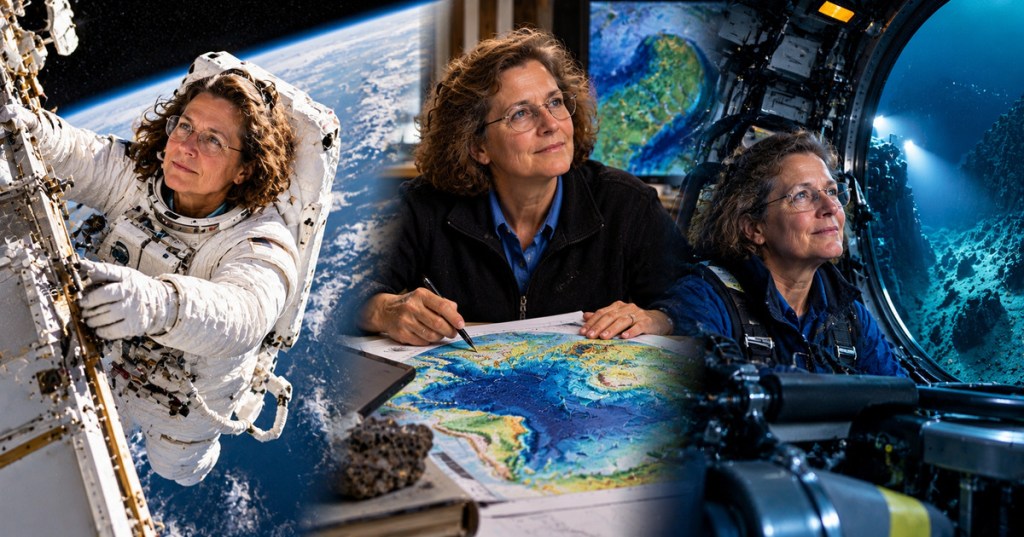
Kathryn Sullivan has built one of the most extraordinary exploration careers of the modern era: geologist, NASA astronaut, first American woman to walk in space, Hubble deployment crew member, NOAA leader and the first woman to reach Challenger Deep.
Her résumé gained fresh attention in October 2026 when she signed the American Geographical Society’s historic Fliers & Explorers Globe, joining a tradition associated with explorers including Amelia Earhart, Edmund Hillary, John Glenn and Neil Armstrong. The New Yorker reported on the ceremony as the society marked its 175th anniversary.
Sullivan’s path began with Earth science. She earned a bachelor’s degree in Earth sciences from the University of California, Santa Cruz, followed by a doctorate in geology from Dalhousie University. NASA selected her in 1978 as part of the astronaut class that included the first six women chosen for the U.S. astronaut corps.
On October 11, 1984, Sullivan stepped outside Space Shuttle Challenger during STS-41G and became the first American woman to perform a spacewalk. She later flew aboard Discovery on STS-31, the mission that deployed the Hubble Space Telescope, and Atlantis on STS-45. NASA records three shuttle missions and more than 532 hours in space.
After NASA, Sullivan moved into another major chapter of public science. She served as NOAA’s chief scientist and later as Under Secretary of Commerce for Oceans and Atmosphere and NOAA Administrator. She also served as a U.S. Navy Reserve oceanography officer.
Then, at age 68, she went in the opposite direction from orbit. On June 6, 2020, Sullivan descended roughly seven miles to Challenger Deep in the Mariana Trench. The dive made her the first woman to reach the deepest known point in the ocean and the first person known to have both walked in space and reached Challenger Deep.
Sullivan’s résumé belongs beside Story Musgrave’s path from Marine mechanic to doctor to astronaut, Jonny Kim’s journey from Navy SEAL to doctor to astronaut, and Brian May’s career spanning rock music, astrophysics and NASA asteroid science. Sullivan’s version is almost unmatched in vertical range: from working outside a spacecraft above Earth to physically reaching the deepest known point beneath its oceans.
BitcoinVersus.Tech is not a financial advisor. This media platform reports on financial subjects purely for informational purposes.
BitcoinVersus.Tech Editor’s Note:
We volunteer daily to ensure the credibility of the information on this platform is Verifiably True. If you would like to support to help further secure the integrity of our research initiatives, please donate using the QR code provided
For best QR-code scanning results, please scan this donation code from a desktop or larger screen. Mobile screens may prevent camera recognition.



Leave a Reply