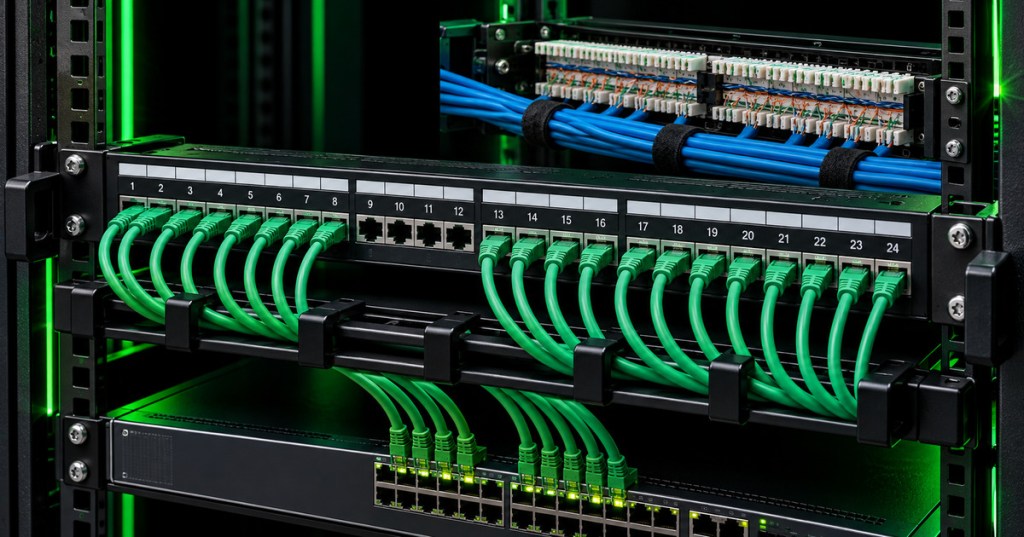
A patch panel is the organized handoff between a building’s permanent network cabling and the active equipment in a rack. It does not route traffic or assign IP addresses. The switch does that. The patch panel simply gives each cable run a fixed, numbered place to terminate.
How it works
A typical copper path is: wall jack → in-wall Ethernet cable → patch panel → short patch cord → switch. That layout keeps the long solid-conductor cable stationary while the short, replaceable patch cord handles the daily moves and changes inside the rack. Fluke Networks describes the fixed patch-panel portion as part of the permanent link, while the full channel also includes the patch cords and active equipment connections.
Punch-down vs. pass-through
Traditional copper patch panels use rear insulation-displacement contacts, usually 110-style terminals. Each twisted pair is placed into the correct color-coded slot and punched down. Many panels support both T568A and T568B wiring. Leviton’s Cat 6 installation guide shows the rear termination field, the two wiring schemes, and the need to preserve pair twist close to the contact.
Pass-through or keystone panels work differently. Instead of punching individual conductors into the panel, the installer snaps couplers or keystone jacks into the panel and plugs cables into the rear. They are easier to rearrange, but a well-terminated punch-down panel remains common in permanent structured cabling.
Why patch panels matter
The biggest advantage is serviceability. If port 12 on the panel feeds a wall jack labeled A-12, a technician can trace, test, move or repatch that connection without disturbing the cable inside the wall or overhead tray. Clear labels also make troubleshooting much faster when a switch port, jack or cable fails.
Good patch-panel work depends on the same fundamentals as the rest of structured cabling: consistent T568B Ethernet termination, enough service-loop slack to support future work, and proper strain relief so the connectors are not carrying cable weight.
A patch panel is therefore not an Ethernet switch and not a router. It is the physical organization layer that makes a wired network easier to build, document and repair.
BitcoinVersus.Tech Editor’s Note:
We volunteer daily to ensure the credibility of the information on this platform is Verifiably True. If you would like to support to help further secure the integrity of our research initiatives, please donate using the QR code provided

For best QR-code scanning results, please scan this donation code from a desktop or larger screen. Mobile screens may prevent camera recognition.


Leave a Reply