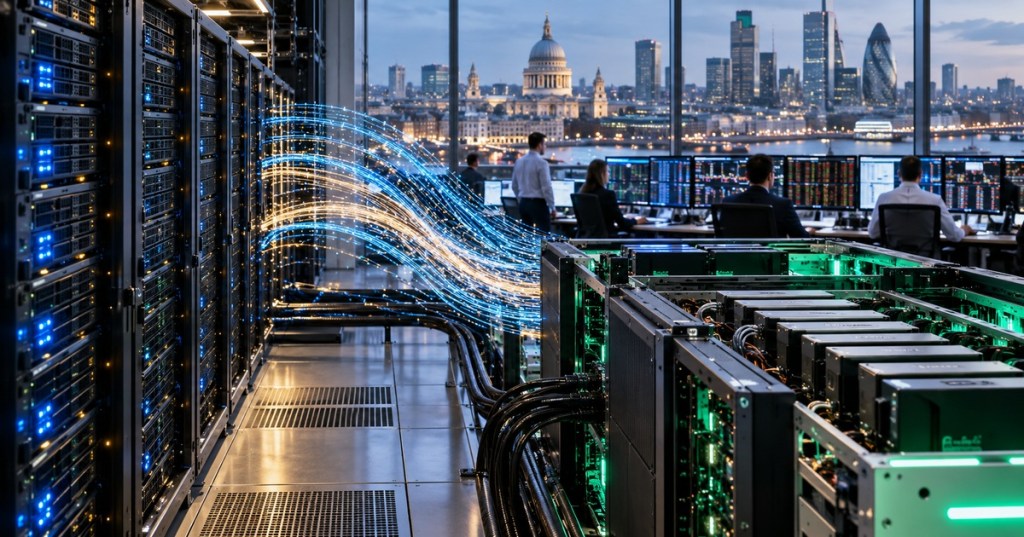
London Stock Exchange Group is pushing one of finance’s largest historical market-data archives onto GPU-accelerated workflows. On October 14, 2026, LSEG announced a collaboration with NVIDIA that uses NVIDIA cuDF and GPUs to analyse large portions of LSEG Tick History far faster than traditional CPU-centered pipelines.
The headline claim is striking: LSEG says benchmark analysis reduced jobs that previously took hours to results measured in seconds. The company says the work uses cuDF with Polars for GPU-accelerated data processing while preserving the licences, permissions and controls attached to the underlying market data.
This is not a small laboratory dataset. LSEG says Tick History contains roughly 110 trillion rows covering about 100 million instruments, more than 580 exchanges, trading venues and contributors, and more than 30 years of market activity. That scale helps explain why the computing layer matters: even relatively straightforward filters, joins, rolling calculations and historical comparisons become expensive when the underlying archive is measured in tens of trillions of rows.
LSEG’s official LinkedIn page carried the October 14 collaboration announcement, describing the use of NVIDIA cuDF to analyse large volumes of Tick History data at greater speed and scale.
Why the GPU Changes the Workflow
Traditional market-data research often begins with CPUs loading, transforming and scanning large tables. GPUs approach the problem differently. Instead of relying on a smaller number of general-purpose CPU cores, the workload can be split across thousands of parallel GPU execution units. That architecture is particularly well suited to repeated operations across very large columns of structured data.
NVIDIA’s cuDF documentation describes cuDF as a Python GPU DataFrame library built on Apache Arrow’s columnar memory format. It supports loading, joining, aggregating, filtering and other tabular operations, while its cudf.pandas mode can accelerate supported pandas operations on the GPU and fall back to pandas where needed.
For readers new to accelerated computing, BitcoinVersus.Tech’s guide to CUDA explains the software layer that lets developers send highly parallel work to NVIDIA GPUs. Our comparison of CPUs, GPUs and NPUs also shows why a GPU is useful for workloads where the same class of operation must be repeated across enormous amounts of data.
NVIDIA Developer demonstrates RAPIDS cuDF processing 18 million rows of stock data with GPU acceleration, including grouping and rolling-window operations used in financial analysis.
The Importance of Keeping the Data Governed
The less flashy part of LSEG’s announcement may be just as important as the speed result. LSEG says customers can accelerate analysis without creating another complete copy of the underlying Tick History dataset. In institutional finance, copying data is not merely a storage decision. Market-data products can carry detailed entitlements, licences, user permissions and compliance requirements. A faster analytical system is less useful if it creates uncontrolled duplicate datasets that are harder to govern.
LSEG is therefore positioning the collaboration as part of its “Everywhere AI” strategy: bring governed financial data closer to the computing environments where researchers and AI systems already work. The practical objective is to shorten the distance between stored historical evidence and a decision model without removing the controls attached to the original data.
That matters because market-data traffic itself continues to grow. LSEG said traffic across its real-time network increased 29% in the first half of 2026 compared with the first half of 2025. It also reported a new peak of 26 million messages per second in June 2026, while customer API requests for Tick History increased 48%.
NVIDIA Developer shows cuDF accelerating familiar pandas DataFrame operations on a GPU, illustrating the underlying approach behind moving large tabular workloads away from CPU-only execution.
What Financial Firms Could Do With It
LSEG lists several target workflows. Quantitative researchers can test strategies across longer histories, more venues and more market regimes without immediately reducing the dataset through aggressive sampling. Execution teams can reconstruct historical order books and compare pricing, liquidity and execution quality. Risk teams can run larger replay or scenario-analysis workloads. AI researchers can place their own models closer to a governed historical data source.
The near-24-hour direction of global markets adds pressure. If exchanges and trading venues continue expanding access across the day, a workflow based on “load everything after the close, process overnight, inspect in the morning” becomes less attractive. Continuous markets create demand for continuous analytics. Cutting a historical query from hours to seconds could allow more of the research loop to happen while markets are still moving.
There is also an infrastructure lesson here. The GPU is no longer only a device for rendering graphics or training large AI models. It is increasingly becoming a general acceleration engine for data movement, tabular processing, networking and simulation. BitcoinVersus.Tech recently examined Linux KNOD using GPUs to process network packets, another example of developers shifting data-intensive work onto massively parallel hardware.
NVIDIA Developer’s accelerated data-science presentation explains the broader RAPIDS strategy, including GPU acceleration for pandas and other widely used data tools.
What the Announcement Does Not Prove Yet
The benchmark should not be interpreted as proof that every financial-data query will now run in seconds. LSEG did not publish a universal speedup factor for the entire 110-trillion-row archive, and workload performance will vary with the query, dataset size, storage architecture, data movement, GPU configuration and software implementation.
The result is also vendor-reported. That does not make it invalid, but it means readers should distinguish the confirmed collaboration and disclosed benchmark from independent performance testing across a wider range of customer environments. The most useful next evidence would be detailed benchmark methodology, hardware configurations, query definitions and real customer deployments.
Still, the direction is clear. Financial institutions are dealing with larger historical archives, denser real-time feeds and a growing number of AI and quantitative models competing for the same data. LSEG and NVIDIA are betting that GPU-accelerated DataFrame processing can move historical analysis closer to real time without forcing firms to duplicate the governed source data.
That makes this less a story about one fast benchmark and more a story about where institutional computing is headed. The boundary between databases, analytics engines and AI infrastructure is becoming thinner. If a financial institution can keep its licensed data governed while moving the computationally heavy parts of analysis onto GPUs, the research cycle can become faster without discarding the controls that make institutional data usable in the first place.
BitcoinVersus.Tech Editor’s Note:
We volunteer daily to ensure the credibility of the information on this platform is Verifiably True. If you would like to support to help further secure the integrity of our research initiatives, please donate using the QR code provided

For best QR-code scanning results, please scan this donation code from a desktop or larger screen. Mobile screens may prevent camera recognition.


Leave a Reply