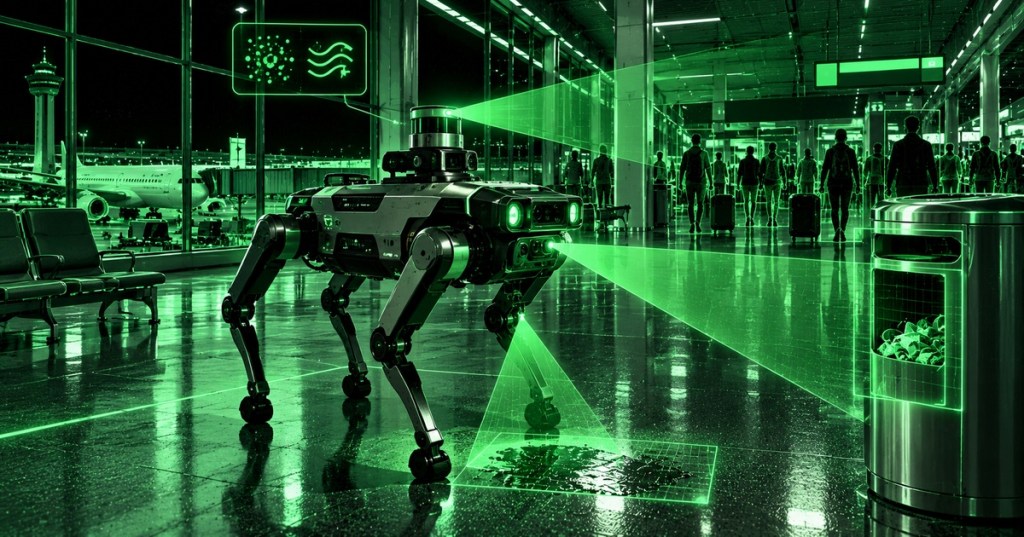
Pittsburgh International Airport is turning part of its terminal into a real-world robotics testbed, deploying four-legged robots from Skild AI to monitor air quality, detect spills, identify full trash bins and eventually explore more advanced safety and delivery tasks.
The project is part of the airport’s xBridge innovation program. In its official project announcement, Pittsburgh International said up to four autonomous quadrupeds and two charging stations will be deployed across defined areas of the Airside Terminal. Skild AI is responsible for installation, mapping, supervision, monitoring and staff training.
The first job is environmental monitoring. Each robot can carry sensors through the terminal, collect location-specific air-quality readings and alert airport personnel when measurements move outside defined thresholds. That turns a stationary sensing problem into a mobile one: instead of waiting for a fixed sensor to detect a local issue, the robot can repeatedly sample different parts of a large building.
The second phase moves closer to daily airport operations. The robots will be evaluated on whether they can spot potential floor spills, identify full or nearly full trash bins and monitor passenger congestion. Those tasks sound simple, but they require perception, localization and reliable navigation in a constantly changing environment filled with luggage, children, wheelchairs, cleaning carts and crowds.
That autonomy is the technical core of the pilot. Skild says its broader robotics approach is “omni-bodied,” meaning the same foundation-model strategy is designed to work across quadrupeds, humanoids, arms and mobile manipulators rather than being tied to one machine. BitcoinVersus.Tech previously covered how Skild S1 can learn a new robot task from one video demonstration.
Pittsburgh’s airport gives that kind of model a much harder proving ground than a controlled lab. A terminal changes minute by minute, and a useful robot has to know the difference between a normal crowd and abnormal congestion, between harmless reflections and an actual liquid spill, and between an object it can walk around and an area it should never enter.
The third phase could become more ambitious. The airport says it may pair the quadruped platform with BioFlyte technology for mobile airborne biological-threat detection. Autonomous food and beverage delivery is also being considered. Technical.ly reports that the airport is treating the deployment as a six-month proof-of-concept rather than an immediate replacement for human workers.
The deployment fits a wider shift in physical AI. Robot developers are building large training environments to collect real-world manipulation data, while industrial platforms are also adding more resilient wireless connectivity for mobile robots. The airport pilot combines those trends in one public setting: general-purpose AI models, autonomous mobility, sensors and a live operational workflow.
Why it matters: the important question is no longer whether a quadruped robot can walk through an airport. It is whether the robot can repeatedly perform useful work, generate trustworthy data and operate safely around thousands of people. Pittsburgh is giving Skild AI a chance to answer that question outside the lab.
BitcoinVersus.Tech Editor’s Note:
We volunteer daily to ensure the credibility of the information on this platform is Verifiably True. If you would like to support to help further secure the integrity of our research initiatives, please donate using the QR code provided

For best QR-code scanning results, please scan this donation code from a desktop or larger screen. Mobile screens may prevent camera recognition.
BitcoinVersus.tech is not a financial advisor. This media platform reports on financial subjects purely for informational purposes.


Leave a Reply