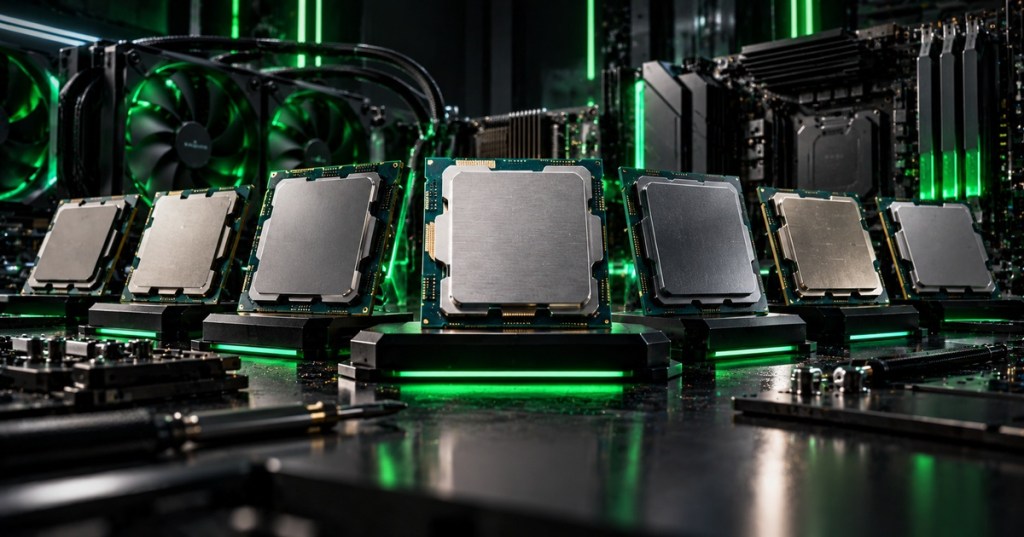
Desktop processors are difficult to rank with one number because gaming, single-threaded work, rendering, compiling, compression, and scientific workloads stress different parts of a CPU. For this countdown, BitcoinVersus.Tech is using one consistent definition of fastest: current multi-threaded application performance in the Tom’s Hardware 2026 CPU benchmark hierarchy, updated October 5, 2026.
That hierarchy uses a broad application test suite rather than theoretical peak specifications. The scores below are normalized against the fastest processor in the current pool, which receives 100%. This is therefore a productivity-throughput countdown, not a pure gaming ranking. Tom’s Hardware separately identifies AMD’s Ryzen 7 9850X3D as the current gaming leader.
The distinction matters. A CPU can be exceptional in games because of cache and latency while losing badly in Blender, code compilation, compression, or other heavily threaded work. Likewise, a processor with 24 cores may dominate creator workloads while sitting much farther down the gaming chart. This countdown focuses on the machines that finish the largest multi-core jobs fastest.
If you are comparing whole computers rather than processors, see BitcoinVersus.Tech’s Top 7 Fastest Laptops Right Now. For the architectural difference between processor types, our CPU vs. GPU vs. NPU guide explains why different workloads favor different silicon. And for accelerator efficiency rather than CPU throughput, see our AI accelerator ranking by tokens per second and joules per token.
7. AMD Ryzen 9 7950X3D — 81.8%
The countdown starts with AMD’s Ryzen 9 7950X3D. The Zen 4 chip combines 16 cores and 32 threads with AMD’s 3D V-Cache design. In Tom’s Hardware’s current multi-threaded hierarchy, it scores 81.8% of the performance of the #1 processor.
The 7950X3D is unusual because it was designed to balance two very different priorities: high-end gaming and heavy productivity. One chiplet carries the extra stacked cache that helps many games, while the full 16-core design still gives it serious workstation throughput. Its current hierarchy entry lists a 120 W TDP and 162 W maximum power.
That balance is why it remains relevant several generations of benchmark updates later. It is not the fastest production CPU anymore, but it still provides substantially more multi-threaded horsepower than mainstream eight-core gaming processors while retaining the cache architecture that made the X3D family famous.
Gamers Nexus benchmarks the Ryzen 9 7950X3D across production, gaming, efficiency, power, and creator workloads.
6. AMD Ryzen 9 7950X — 84.6%
At #6 is the non-X3D Ryzen 9 7950X. It also has 16 cores and 32 threads, but instead of dedicating silicon and operating behavior to stacked gaming cache, the standard 7950X focuses on high clock rates and straightforward Zen 4 throughput. Tom’s Hardware measures it at 84.6% in the current multi-threaded hierarchy.
The chip’s listed 170 W TDP and 230 W maximum power are higher than the 7950X3D’s. That additional power envelope helps explain why the older standard model can still beat its X3D sibling in heavily threaded applications despite losing badly to modern X3D processors in many games.
The 7950X is a useful reminder that “faster CPU” always needs a workload attached to it. For rendering, compiling, compression, and other tasks that scale across many threads, a high-frequency 16-core design can remain formidable even after newer architectures arrive.
Gamers Nexus tests the Ryzen 9 7950X in rendering, code compilation, compression, Adobe applications, power, thermals, and games.
5. Intel Core Ultra 9 285K — 85.3%
Intel enters the countdown at #5 with the Core Ultra 9 285K. Arrow Lake changed Intel’s desktop architecture substantially, including the removal of Hyper-Threading from this generation. The 285K uses 24 physical cores — eight performance cores and 16 efficiency cores — for 24 threads total.
Tom’s Hardware currently places it at 85.3% in multi-threaded applications. Its listed power limits are 125 W TDP and 250 W maximum power. Single-threaded performance is one of its strengths: it remains near the very top of Tom’s current single-thread chart even though several newer chips beat it in aggregate multi-core throughput.
This makes the 285K a particularly interesting example of why core count alone cannot rank processors. Its 24 physical cores do not automatically beat AMD’s 16-core Zen 5 parts. Core architecture, clock behavior, memory subsystem, scheduling, software optimization, and workload mix all contribute to the final result.
Gamers Nexus tests the Core Ultra 9 285K across workstation applications, gaming, power, efficiency, clocks, and memory behavior.
4. Intel Core Ultra 7 270K Plus — 91.9%
The newer Core Ultra 7 270K Plus jumps all the way to #4. Despite the “Ultra 7” name, this Arrow Lake Refresh processor uses the same broad 8-performance-core plus 16-efficiency-core arrangement associated with Intel’s high-end desktop configuration, for 24 cores and 24 threads.
Its 91.9% multi-threaded score is a major result because it also tops Tom’s Hardware’s current single-threaded chart at 100%. That combination makes the 270K Plus one of the strongest current consumer desktop processors for general application responsiveness and multi-core production work at the same time.
Tom’s lists 125 W TDP and a 250 W maximum power limit. The processor also demonstrates how quickly a refresh can change a hierarchy: it overtakes Intel’s nominal Ultra 9 flagship in the current test set and closes much of the gap to AMD’s 16-core Zen 5 products.
Gamers Nexus benchmarks the Core Ultra 7 270K Plus and compares its gaming, application, efficiency, and platform behavior against current AMD and Intel alternatives.
3. AMD Ryzen 9 9950X — 93.0%
The Ryzen 9 9950X takes third place. AMD’s standard Zen 5 flagship has 16 cores and 32 threads and reaches up to 5.7 GHz. In Tom’s Hardware’s current hierarchy, it posts 93.0% of the multi-threaded performance of the leader.
Its 170 W TDP and 230 W maximum power figures match the class expected of a high-end 16-core desktop processor. Unlike the X3D versions above it, the standard 9950X does not use stacked 3D V-Cache. That makes it less specialized for gaming but exceptionally strong in workloads that simply want fast Zen 5 cores and lots of threads.
The 9950X also scores 93.3% on Tom’s current single-threaded chart, almost exactly mirroring its multi-thread result. That balance is rare: it is not #1 in either category, but it stays extremely close to the front in both.
Hardware Unboxed benchmarks the Ryzen 9 9950X in Cinebench, Blender, compression, Adobe workloads, power, and gaming.
2. AMD Ryzen 9 9950X3D — 96.2%
Second place goes to the Ryzen 9 9950X3D. It takes the 16-core, 32-thread Zen 5 foundation and adds 3D V-Cache to one CCD, creating a processor that can compete near the top of both creator and gaming charts.
Tom’s Hardware places it at 96.2% in multi-threaded performance — only 3.8 percentage points behind the current leader — while its 1080p gaming score is 95.7% of the fastest gaming CPU in the same hierarchy. That combination is why the 9950X3D remains one of the most balanced enthusiast CPUs available.
It carries a 170 W TDP and 230 W maximum power rating, with 16 cores, 32 threads, and boost clocks up to 5.7 GHz. In other words, the extra cache does not force buyers to give up the high core count needed for serious production work.
Gamers Nexus reviews the Ryzen 9 9950X3D against the 9800X3D, 285K, standard 9950X, and other CPUs in gaming, production, power, and efficiency testing.
1. AMD Ryzen 9 9950X3D2 — 100%
The current #1 processor in this countdown is AMD’s Ryzen 9 9950X3D2. Tom’s Hardware explicitly identifies it as the top overall performer in the current hierarchy and sets its multi-threaded score at 100%, making every other result in this list relative to it.
The 9950X3D2 is AMD’s first consumer Ryzen design with 3D V-Cache on both CCDs. It keeps 16 Zen 5 cores and 32 threads but expands the cache-heavy approach across the entire dual-chiplet CPU. Tom’s lists a 200 W TDP and 270 W maximum power, the highest envelope among the processors in this countdown.
That extra power and dual-cache configuration do not make it the fastest chip in every individual task. Its current single-threaded score is 92.2%, for example, below Intel’s 270K Plus. But in the heavily threaded application composite used for this ranking, nothing in the tested consumer desktop pool is faster.
This also shows why one processor cannot be called the universal winner without defining the job. The Ryzen 7 9850X3D currently leads the gaming hierarchy. Intel’s Core Ultra 7 270K Plus leads the single-threaded hierarchy. The Ryzen 9 9950X3D2 leads the multi-threaded hierarchy and is identified by Tom’s Hardware as the current overall performance leader. Different workloads produce different champions.
Hardware Unboxed benchmarks the Ryzen 9 9950X3D2 in Cinebench 2026, Blender, compression, Photoshop, Premiere, gaming, and power-use testing.
The final countdown
- #7 — Ryzen 9 7950X3D: 81.8%
- #6 — Ryzen 9 7950X: 84.6%
- #5 — Core Ultra 9 285K: 85.3%
- #4 — Core Ultra 7 270K Plus: 91.9%
- #3 — Ryzen 9 9950X: 93.0%
- #2 — Ryzen 9 9950X3D: 96.2%
- #1 — Ryzen 9 9950X3D2: 100%
The gap at the top is relatively small compared with the huge generational jumps seen in some GPU and AI-accelerator workloads. The 9950X3D is within four percentage points of #1, and the 9950X is within seven. What changes dramatically is specialization: extra cache can radically alter game performance, while additional cores and higher sustained power matter more in all-core application work.
For buyers, the practical lesson is not automatically to purchase #1. The correct processor depends on what the computer actually does. But if the question is simply which current consumer desktop CPUs finish heavily threaded application workloads fastest in a consistent modern test hierarchy, this is the present order.
Benchmark note: Rankings and normalized percentages are based on Tom’s Hardware’s CPU Benchmarks and Hierarchy 2026, updated October 5, 2026. Hardware rankings can change as new processors, BIOS versions, operating-system updates, microcode, memory configurations, and test suites are introduced.
BitcoinVersus.Tech Editor’s Note:
We volunteer daily to ensure the credibility of the information on this platform is Verifiably True. If you would like to support to help further secure the integrity of our research initiatives, please donate using the QR code provided

For best QR-code scanning results, please scan this donation code from a desktop or larger screen. Mobile screens may prevent camera recognition.


Leave a Reply