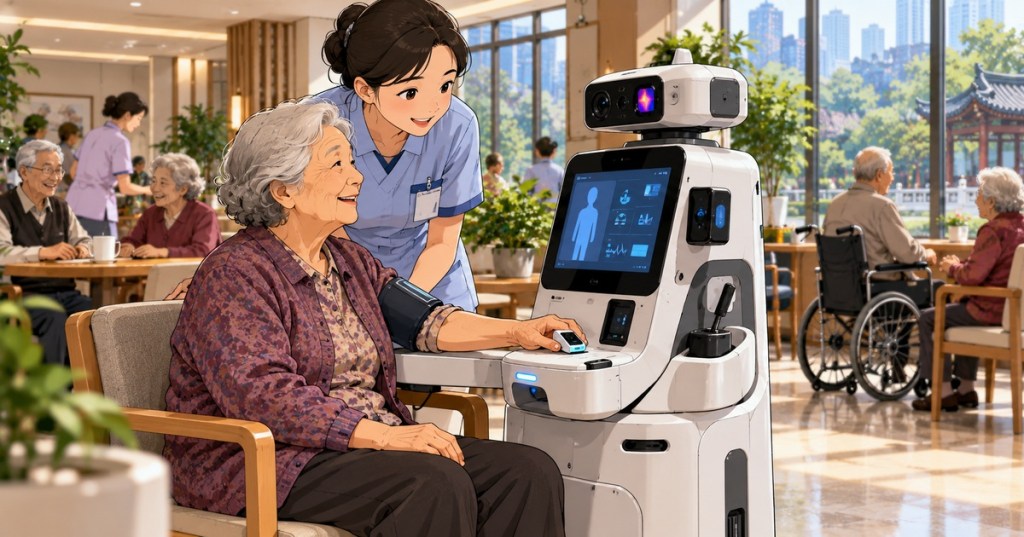
Decent Holding says it plans an initial deployment of up to 3,000 AI-powered health-management robots from Taihao Intelligent across selected senior-care centers in China. The important word is plans: the company has not said that 3,000 robots are already operating.
In its October 15 announcement, Decent said the target applies to selected locations within a network of roughly 700 senior-care operation centers. The company says the machines are intended to function as connected service terminals for health-data collection, AI-assisted analysis, family alerts, online-hospital connectivity and care coordination.
A recent AskRobotics discussion captures the practical question behind senior-care robotics: whether today’s machines are useful and safe enough to assist aging parents in real homes and care settings.
According to the company, Taihao’s health-management robot can collect a wide range of wellness data, including blood pressure, heart rate, electrocardiogram, temperature, blood oxygen, weight and other measurements. It also uses thermal imaging to analyze surface-temperature patterns. Those are product claims and intended functions, not proof that the system can diagnose disease or replace clinicians.
The regulatory record makes the rollout look earlier-stage than the headline number alone suggests. In a September SEC filing, Decent said its planning contemplated partner evaluation and technical-feasibility work in the second half of 2026, pilot design and safety, consent, privacy and data-governance work in the first half of 2027, followed by limited pilots. The filing also states that the company may not proceed and that commercialization depends on technical validation, approvals, partner agreements and capital.
WION’s 2026 report shows how robots are already being tested alongside human caregivers in a Chinese eldercare facility.
The broader technology story is the move from isolated robot demonstrations toward real operating environments where machines can be tested repeatedly around people, workflows and messy physical conditions. BitcoinVersus.Tech has followed that transition through Mecka’s Physical AI data work, NEURA’s multimodal robot model and FORT Robotics’ machine-connectivity systems.
Decent’s 3,000-unit figure therefore matters as a deployment ambition rather than a completed installation count. If the program advances through the required validation, privacy, safety and regulatory steps, the company’s care-center network could become a large real-world test bed for AI-assisted senior-care robotics. For now, the technically accurate description is simpler: Decent has set a target and still has substantial execution work ahead.
BitcoinVersus.Tech Editor’s Note:
We volunteer daily to ensure the credibility of the information on this platform is Verifiably True. If you would like to support to help further secure the integrity of our research initiatives, please donate using the QR code provided

For best QR-code scanning results, please scan this donation code from a desktop or larger screen. Mobile screens may prevent camera recognition.


Leave a Reply