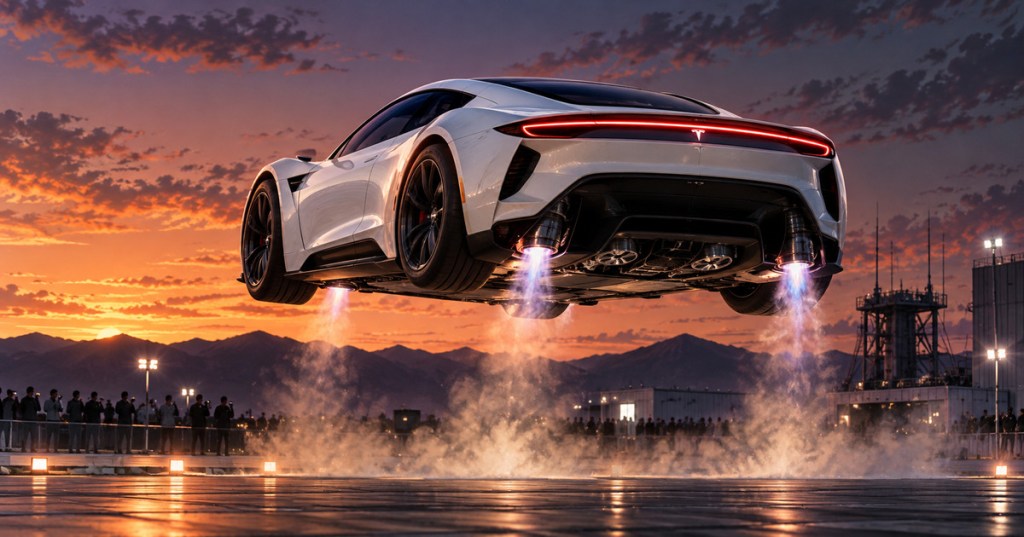
Tesla’s next-generation Roadster did something its earlier prototypes never publicly demonstrated: it became airborne under its own onboard system.
The October 15, 2026 demonstration in Texas showed the Roadster briefly flying during a controlled event, adding a second headline to the car’s already extreme performance reveal. BitcoinVersus.Tech had already covered Tesla’s sub-one-second 0–60 mph claim. The flight demonstration now shows that Tesla’s long-discussed SpaceX-assisted package is not just a theoretical feature.
The Polymarket post that highlighted the moment framed the question simply: could the Roadster actually fly? The demonstration provided the clearest public answer yet.
How the Roadster Gets Off the Ground
The engineering appears to combine two different ideas. Reuters reported that the Roadster uses SpaceX-linked thrusters together with a specialized suction and propulsion system. Cold-gas thrusters can produce force without relying on tire grip, while fan-based aerodynamic hardware can dramatically alter the forces acting on the vehicle.
That same hardware helps explain both of Tesla’s major Roadster claims. Extra thrust can improve launch acceleration, while carefully directed force can also lift or redirect the vehicle for short airborne maneuvers. The result is closer to aerospace-assisted automotive engineering than a conventional electric sports car.
Flying Prototype, Not Yet a Flying Production Car
The distinction matters. Tesla demonstrated a Roadster prototype becoming airborne, but that does not yet mean customers will be able to buy a road-legal flying car with the same capability. Certification, repeatability, safety rules, maintenance requirements and the final production hardware remain open questions.
Tesla’s official Roadster livestream is the primary event record. The company is currently targeting production around 2028, after years of delays since the second-generation Roadster was first introduced in 2017.
Why This Matters
The Roadster is increasingly looking like a technology demonstrator rather than a normal high-volume vehicle. That fits Tesla’s wider shift toward robotics and advanced systems. BitcoinVersus.Tech has also covered Tesla converting factory space for humanoid robot production and the rise of mobile grid-independent EV charging.
For now, the most accurate conclusion is straightforward: Tesla has demonstrated a Roadster flying briefly under its own onboard propulsion system. Whether that capability survives unchanged into customer production is the next engineering question.
BitcoinVersus.Tech Editor’s Note:
We volunteer daily to ensure the credibility of the information on this platform is Verifiably True. If you would like to support to help further secure the integrity of our research initiatives, please donate using the QR code provided

For best QR-code scanning results, please scan this donation code from a desktop or larger screen. Mobile screens may prevent camera recognition.


Leave a Reply