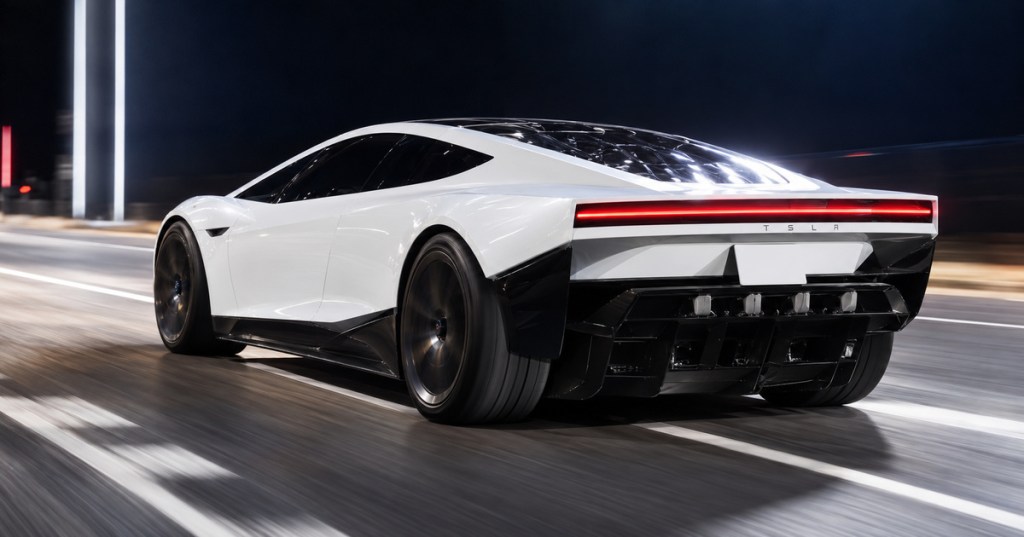
Tesla has finally brought its next-generation Roadster back onto center stage, and the headline number is now even more aggressive than the specification that stunned the industry in 2017: 0–60 mph in under one second.
That figure needs one important qualifier. It is a Tesla performance claim tied to the Roadster’s SpaceX-assisted configuration, not yet an independently verified instrumented test. Reuters reported on October 15 that the redesigned four-seat Roadster is being presented with a sub-one-second 0–60 mph target through collaboration with SpaceX. Tesla’s original 2017 prototype was quoted at 1.9 seconds.
Why SpaceX Changes the Acceleration Math
A conventional road car can only accelerate as hard as its tires can transfer force into the pavement. Tesla’s SpaceX concept adds another source of thrust. Cold-gas thrusters can create force directly, meaning some of the initial launch is no longer limited only by tire grip. That is the engineering logic behind Tesla’s claim that the Roadster can cross 60 mph before one second has elapsed.
The number would put the car into territory normally associated with specialized drag machinery rather than street vehicles. But until a production-spec Roadster performs the run under independently measured conditions, the correct description is claimed sub-one-second acceleration, not a verified production-car record.
A Halo Car After Nearly Nine Years
The Roadster was first shown in November 2017 with a 620-mile range target, a top speed above 250 mph and a $200,000 starting price. Production was originally expected in 2020, but the program repeatedly moved back. Tesla is now treating the Roadster more as an engineering showcase than a mass-market product. The company’s official Roadster livestream places the vehicle alongside a broader push into autonomy, robotics and aerospace-influenced hardware.
That broader direction is already visible elsewhere. BitcoinVersus.Tech has covered Tesla retrofitting factory space for humanoid robots, the growing pressure from Chinese automakers entering global markets, and how new systems such as mobile grid-independent EV charging are changing the infrastructure around electric vehicles.
The Roadster’s significance may therefore be less about sales volume and more about what Tesla wants a high-performance EV to demonstrate. If the SpaceX-assisted system reaches production and the acceleration claim survives independent testing, the Roadster would reset the benchmark for launch performance. For now, the technical achievement to watch is not the headline alone—it is whether Tesla can turn the demonstration hardware into a repeatable, road-legal production system.
BitcoinVersus.Tech Editor’s Note:
We volunteer daily to ensure the credibility of the information on this platform is Verifiably True. If you would like to support to help further secure the integrity of our research initiatives, please donate using the QR code provided

For best QR-code scanning results, please scan this donation code from a desktop or larger screen. Mobile screens may prevent camera recognition.


Leave a Reply