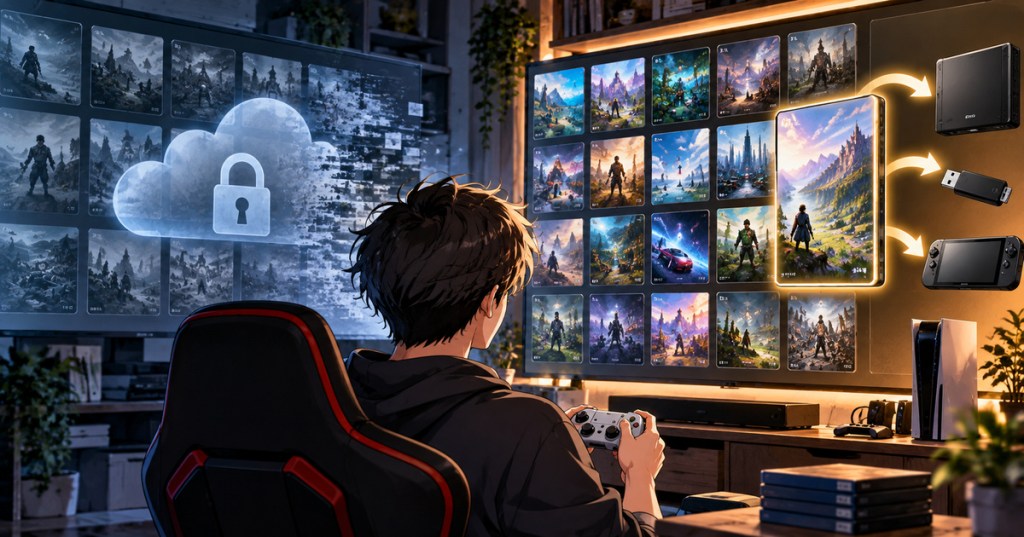
U.S. Rep. Ritchie Torres of New York says he plans to introduce federal legislation aimed at changing one of modern gaming’s most basic legal assumptions: when players pay for a digital game, they often receive a revocable license rather than ownership of a copy.
The proposal, called the Power To The Players Act, would direct the Federal Trade Commission to develop rules protecting consumers’ ability to own, play, and transfer purchased video games. Torres’s office says games with online functionality would also have to provide an offline mode before the servers supporting them are shut down.
IGN highlighted the proposal on X shortly after it was announced.
What the proposal would change
Today, major digital storefronts generally structure game access through license agreements tied to an account, platform, or service. The practical result is that a player may keep access for years, but that access can still depend on the publisher, storefront, authentication system, or online servers continuing to operate. Torres is proposing a different consumer model: paying for a game would establish ownership rights to the purchased copy rather than only permission to use it under a revocable license.
The proposal also goes beyond simple access. Torres says consumers should retain a right to transfer the games they buy. That could have major implications for digital resale, account-bound libraries, DRM, and storefront infrastructure. Those implementation details matter because digital transfer is more complicated than handing someone a disc or cartridge: a system would need to transfer the buyer’s rights while ending the seller’s access.
BitcoinVersus.Tech has been following the technologies around this increasingly digital game ecosystem, including the most-played games on Steam, Epic’s work to rebuild its launcher, and the latest GTA VI launch coverage.
NBA 2K25 is the example Torres is using
Torres’s office points to NBA 2K25. The game launched at $69.99 for the standard edition and $99.99 for the All-Star Edition, and is scheduled to be delisted from digital storefronts on October 30 before its online servers shut down at the end of December. The concern is not that every part of the game instantly disappears, but that major functionality can be lost only a little more than two years after players paid full retail price.
What is still unresolved
The most important limitation is that this is still an announced proposal. Torres says he will introduce the legislation, but the final bill text, exemptions, enforcement details, treatment of multiplayer-only games, transfer mechanics, and exact FTC rulemaking authority are not yet settled. PC Gamer’s coverage likewise describes the measure as legislation Torres plans to introduce, not an enacted ownership regime.
That distinction matters. The announced principle is broad and easy to understand—if a store sells something as a purchase, consumers should have durable rights to use it—but converting that idea into workable law will require precise rules for online services, copyrighted software, resale, DRM, patches, authentication, and games that cannot realistically function without live servers.
For now, the Power To The Players Act puts a federal spotlight on a question the industry has largely handled through terms of service: when a gamer clicks “buy,” what exactly should that purchase legally guarantee?
BitcoinVersus.Tech Editor’s Note:
We volunteer daily to ensure the credibility of the information on this platform is Verifiably True. If you would like to support to help further secure the integrity of our research initiatives, please donate using the QR code provided

For best QR-code scanning results, please scan this donation code from a desktop or larger screen. Mobile screens may prevent camera recognition.


Leave a Reply