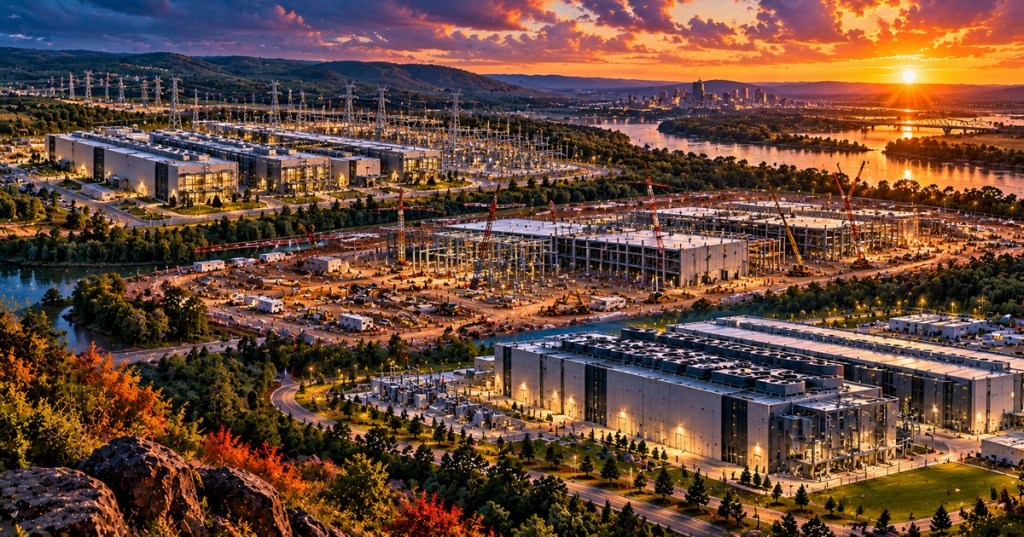
Arkansas is developing a major new data-center corridor spanning Little Rock, Clarksville and West Memphis. Its largest projects combine cloud-computing campuses, on-site gas generation, new utility contracts and multibillion-dollar investments. This fourth installment of BitcoinVersus.Tech’s state-by-state Top 3 data-center series ranks three substantial named campuses, with clear labels for firm power commitments versus modeled estimates as of October 27, 2026.
Methodology: Project #1 is ranked using its developer’s published maximum total baseload design; #2 uses the stated multi-building facility capacity; #3 has no officially disclosed total site IT load, so its figure is an explicitly labeled planning estimate. The list is a documented major-project comparison, not a definitive audited statewide power ranking. Power generation and contracted supply are not automatically equivalent to server IT load.
3. Google West Memphis — 270 MW indicative demand estimate; actual campus load undisclosed
Google announced $4 billion of Arkansas investment through 2027 in October 2025, anchored by its first state data center on more than 1,000 acres in West Memphis. Construction is underway. The Arkansas government’s February 2026 water-demand planning presentation estimated approximately 270 MW initial baseload for West Memphis using an assumed watts-per-square-foot ratio. This is a planning estimate, not Google’s announced critical IT load. The same presentation does not specify a verified full-buildout MW figure.
A major new development arrived on October 19, 2026: Entergy Arkansas announced an expanded service agreement for Google’s campus, subject to regulatory review. The utility described two new 230 kV transmission lines, expansion of the Galet substation, 440 MW of solar generation and additional battery storage. It projects at least $500 million in incremental customer savings from 2028 over twenty years, on top of its earlier $1.6 billion pledge; those are utility projections, not realized bill reductions. Google’s associated 600 MW solar project is generation capacity, not the data center’s IT demand.
2. Serverfarm Clarksville — 432 MW stated campus design
Serverfarm’s Clarksville ARK campus in Johnson County is among Arkansas’s most advanced projects. Its first 300,000-square-foot building was topped out in October. Data Center Dynamics reported October 12 that the first building is planned for 108 MW, with four buildings totaling 432 MW at full development. An October Arkansas Business investigation describes roughly 430 MW for the first four buildings and a $6.6 billion development supported by up to 40 gas turbines. Later phases could change the ultimate campus footprint; do not add speculative capacity beyond the four-building figure.
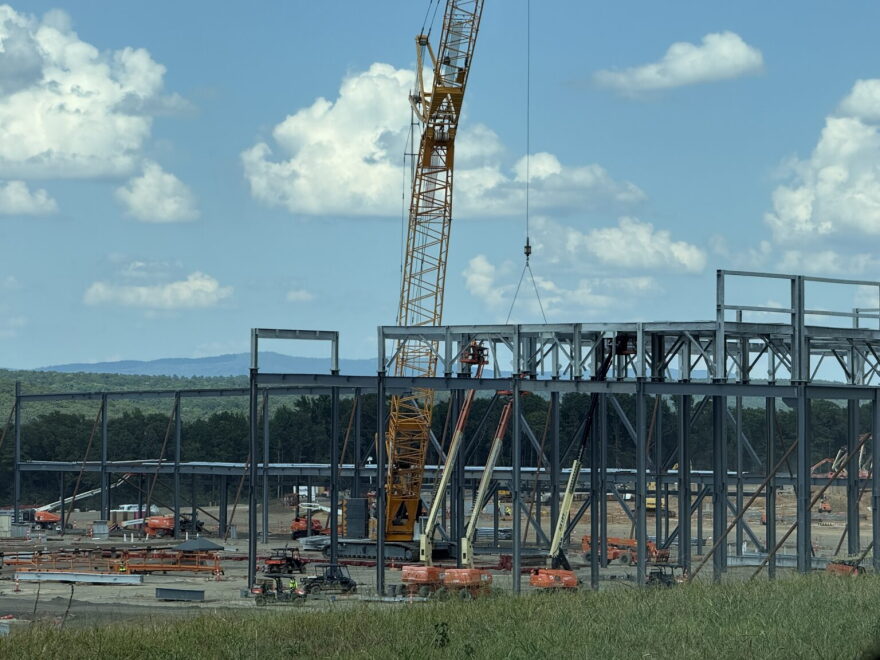
Serverfarm says its closed-loop cooling recirculates water, reducing consumption relative to conventional evaporative cooling. The company also plans substantial behind-the-meter natural-gas generation, limiting dependence on the municipal grid while introducing air-emissions and pipeline questions. Its first phase targets early 2028. Community discussion has focused on local utility rates, water demand, noise and the terms of the development agreement. Construction progress does not mean the full 432 MW is energized.
1. AVAIO Digital Leo, Pulaski County — 1,070 MW total baseload design
AVAIO Digital’s current official campus specifications advertise 1,070 MW total baseload power, comprising 570 MW of planned grid supply and 500 MW of behind-the-meter power. The company first announced the project in January with an initial 150 MW Entergy contract and a potential 1 GW expansion. These figures describe supply architecture and buildout plans, not 1,070 MW of operating IT equipment. The current project page describes a 296-acre developed site, while the original announcement discussed a broader 760-acre campus—different site-scope descriptions that should not be conflated.
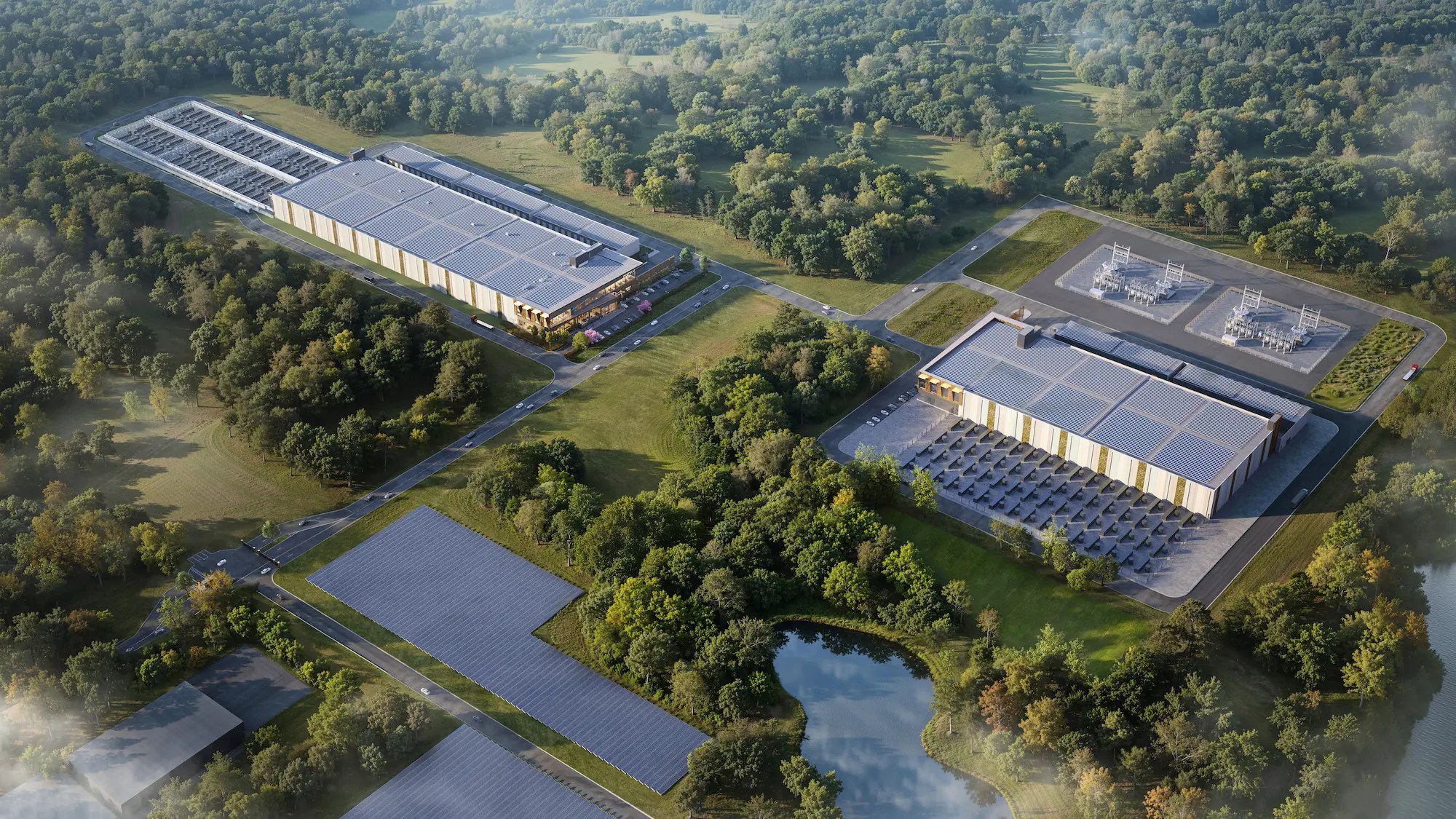
The Arkansas Economic Development Commission’s January announcement described an initial $6 billion investment and potential full development exceeding $21 billion, along with more than 500 permanent jobs. AVAIO’s current site page says groundbreaking has occurred and contracted initial power is targeted online in 2027. Regulatory requirements, construction phasing and tenant commitments will determine how much capacity is ultimately used.
Arkansas’s electrical infrastructure challenge
The three headline figures—1,070 MW, 432 MW and an estimated 270 MW—total about 1,772 MW, but they combine different measurement types and must not be interpreted as 1.77 GW of confirmed future IT load. AVAIO’s figure includes proposed power generation, Serverfarm’s is building capacity, and Google’s is a government planning estimate. Electricity supply, transformer procurement, transmission construction, natural-gas availability and fiber interconnection will determine actual commissioning schedules.
Arkansas also has additional proposals around Little Rock’s port, Conway and Grant County. Their public MW disclosures are incomplete or differently scoped, so they are not presented as smaller verified projects by default. The debate over local zoning and water protection has intensified: Pulaski County’s permit and moratorium chronology documents disputes in September and October. The key question is not only how much capacity is announced, but who pays for grid upgrades and when servers actually come online. For a neighboring-state comparison, see our Dakotas report.
Editor’s Note: This report differentiates committed utility service, proposed baseload generation, building capacity and modeled estimates. Each ranked project has its own relevant media item, including an original YouTube news report. Support independent infrastructure journalism by scanning the 5,000-satoshi QR code below.

Scan the QR code with a Bitcoin wallet, preferably while reading on a second device.


Leave a Reply