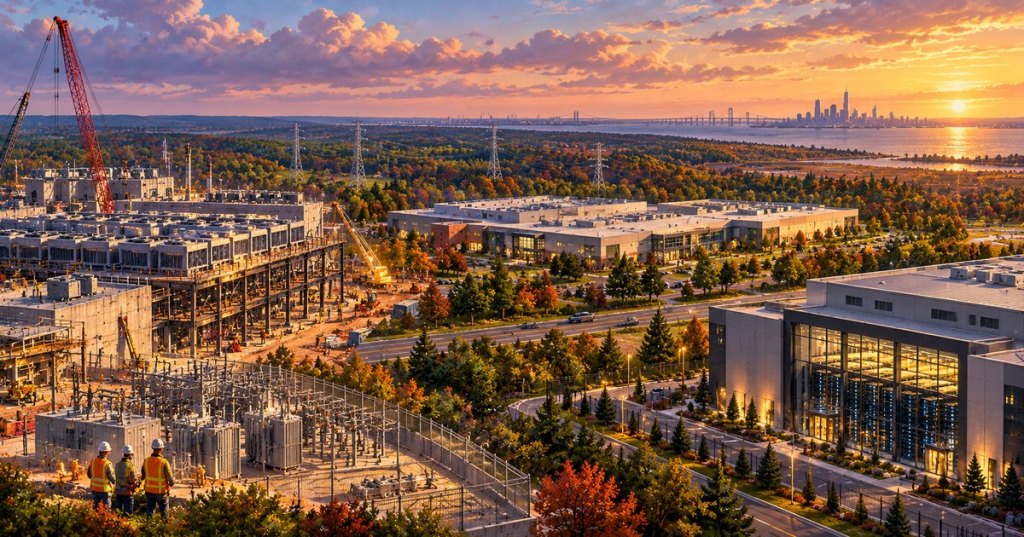
New Jersey’s largest documented data center developments are taking sharply different paths in 2026. A major artificial-intelligence campus is rising in Vineland while regulators investigate its power generation. In Piscataway, a developer is marketing a two-building expansion for 2027. Farther north, QTS is seeking to enlarge an established East Windsor campus. Together, the projects reflect the state’s appeal to cloud and AI operators—and the growing debate over electricity costs, environmental permits and local control.
Three sites stand out among identifiable New Jersey campuses with current owner-published power figures and documented development or operating activity: DataOne/Nebius in Vineland (300 MW), Chirisa Technology Parks in Piscataway (90 MW announced), and QTS East Windsor (70 MW-plus advertised critical capacity). These figures measure different development stages. They are not a claim that 460 MW of new computing has been switched on or that every reported megawatt is already committed to customers.
3. QTS East Windsor — 70 MW-Plus Campus, Operating and Expanding
QTS Data Centers lists 70 MW-plus of critical power capacity at its East Windsor campus, located at 159 Princeton-Hightstown Road in Mercer County. The site already serves business-continuity and disaster-recovery customers in the Northeast corridor and has its own substation. QTS is proposing an additional data center building, but has not published a separately confirmed megawatt addition for that building.
The company’s community information page puts the proposed expansion investment at approximately $600 million, with expectations of around 400 construction jobs and five to eight permanent jobs. QTS also operates an approximately 14 MW solar installation associated with the campus. That figure describes generating capacity, not additional server load, and is not added to the 70 MW-plus rating.
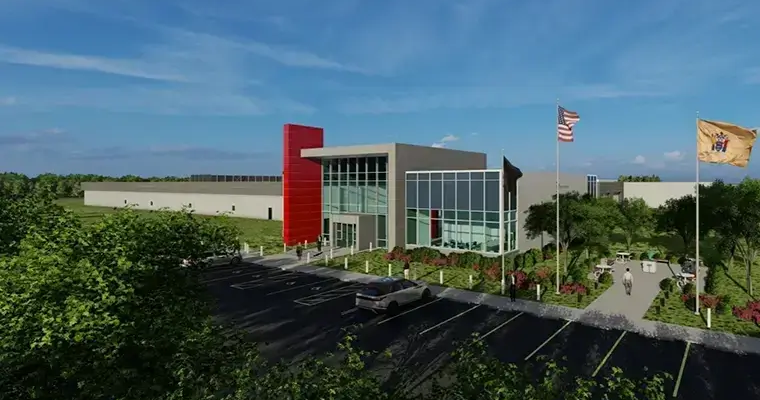
The proposed second building has generated objections over noise, property impacts and electricity prices. In April, the township’s planning board delayed a decision following public testimony. Data Center Dynamics reported that residents sought greater clarity on the plan’s consequences. QTS says it will pay for project-specific utility infrastructure and is consulting with local officials. Its public campus rating remains a marketed capacity figure, not a measured October 2026 electrical draw.
2. Chirisa Piscataway — 90 MW Planned for Two Buildings
Chirisa Technology Parks markets a 20-acre campus in Piscataway, Middlesex County, with 90 MW of power associated with its PNJ-01 and PNJ-02 buildings. The plans involve repurposing an existing building shell and constructing a neighboring two-story data center. The developer identifies the site as reserved for 2027 delivery. That scheduling language does not establish that 90 MW is already energized.
Chirisa had previously acquired data center property in Piscataway, part of a broader expansion with partner PowerHouse Data Centers. In January 2024 reporting, the company described an earlier 25 MW buildout ambition at a local facility. Its current 90 MW description concerns the larger planned two-building campus; those figures should not be added together as if they represented separate operating developments.
A developer can reserve property and market utility capacity well before a facility has its full electrical service, tenants, cooling systems and equipment commissioned. Chirisa has not furnished comparable public evidence that the entire 90 MW was in service as of October 29, 2026. Its progress will be clearer when it provides construction and commissioning milestones or names the eventual customer.
Piscataway’s location is commercially attractive because of nearby business customers, established fiber routes and access to the New York metropolitan market. The proposed redevelopment may reuse industrial space rather than opening an untouched site, while any new load must still be evaluated against interconnection timelines and energy costs. Existing Chirisa operations elsewhere should not be mistaken for completed capacity at PNJ-01 and PNJ-02.
1. DataOne and Nebius, Vineland — 300 MW Under Construction
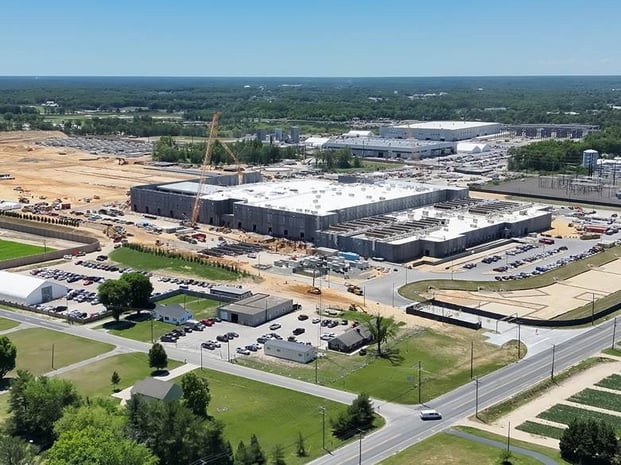
The largest New Jersey data center campus in this comparison is being built at South Lincoln Avenue in Vineland, Cumberland County. Nebius says DataOne is developing and owning the facility while Nebius will operate its GPU and server infrastructure. Local reporting and municipal proceedings describe a 300 MW development linked to Nebius’s infrastructure agreement with Microsoft. That number refers to the campus’s planned scale, not to a measured 300 MW of live computing load.
Vineland’s planning board approved a revised site plan for an additional phase in August. WHYY reported that the approval covered components of the intended on-site electricity system, including fuel cells and liquefied-natural-gas storage. The facility was already under construction at the time, and Nebius’s current project page expects its AI factory to be operational by 2027. Earlier schedules suggesting completion in 2026 should not automatically be treated as current.
The project has faced substantial environmental and community scrutiny. On September 22, the New Jersey Department of Environmental Protection announced a $1.07 million penalty for installing and operating 62 natural-gas generators without required air permits. The department said inspectors found the units during a July visit. Residents have separately complained about noise and raised questions about cooling, water consumption and emissions.
Nebius says the long-term power design will use Bloom Energy fuel cells and closed-loop cooling, and it projects approximately 1,000 construction jobs and 200 permanent on-site positions. Those are company expectations, not a tally of jobs already created. Fuel-cell generation and the temporary generator fleet should not be counted as extra data center IT demand on top of the 300 MW project figure.
The Press of Atlantic City filmed the DataOne/Nebius construction site in Vineland on January 16, 2026.
The next test is whether the company can complete the campus, resolve environmental permitting obligations and demonstrate the promised performance in everyday operation. Investment and tax revenue could benefit Vineland; independently enforceable emissions, noise and utility safeguards are equally important to nearby communities.
Why Some Larger New Jersey Claims Are Excluded
Some New Jersey projects have attracted even larger numbers, but including them without explaining their status would mislead readers. A1 Data Center has advertised a potential 1.4 GW redevelopment of a former industrial site in Millville. The city voted in May to ban new data centers, and the proposal is now described by independent project trackers as blocked or stalled. Company marketing is not evidence of approval to construct a 1.4 GW campus.
Likewise, the Earth Station-76 concept in Logan Township appeared in planning material with a 100–150 MW ambition. Logan subsequently adopted a data-center ban, and officials disputed that an active project was proceeding. Without current permission or a clear grandfathered approval, it is not responsibly counted here as an advancing 150 MW construction project.
The CoreWeave NEST 11 project in Kenilworth is a real development, with approximately $1.8 billion of announced investment. However, CoreWeave’s own current project page specifies a 40 MW planned electrical load. Some third-party listings quote 250 MW without a convincing site-specific explanation. The company-published 40 MW figure is therefore the appropriate reference for this building, placing it below the three identified sites in this ranking.
New Jersey’s Data Center Trade-Off
These campuses serve different markets. Vineland is being built for large AI computing clusters. Chirisa is developing a prospective high-density campus. QTS already provides conventional enterprise and cloud data center services and plans to expand. Each offers different economic benefits, from high-skill electrical construction and long-term infrastructure investment to dependable computing capacity for businesses. None is exempt from proving that electrical and environmental costs are manageable.
Regulators and municipalities across New Jersey are also changing the rules for large computer facilities. The state has tightened oversight of large power consumers, and local governments have adopted a range of restrictions. Those measures reflect concerns about ratepayer exposure, noise, emissions and land use, but they also create uncertainty for developers seeking to expand the state’s digital economy.
For readers comparing stages across the country, see BitcoinVersus.Tech’s New Hampshire ranking, Massachusetts ranking, Nevada ranking, and data center capacity planning lesson. They explain why designed IT load, advertised campus power, utility studies and energized capacity must remain separate.
BitcoinVersus.Tech
BitcoinVersus.Tech Editor’s Note: We volunteer daily to ensure the credibility of the information on this platform is Verifiably True. If you would like to support our work and help further secure the integrity of our research initiatives, please scan the QR code below to donate 5,000 sats. For best results, scan the QR code from a laptop or larger screen.
Bitcoin address: 3C9o19EH5HSiwEPyCTmEKzxhNCbo2X6TTb. Confirm the destination address before sending.

BitcoinVersus.tech is not a financial advisor. This media platform reports on financial subjects purely for informational purposes.


Leave a Reply