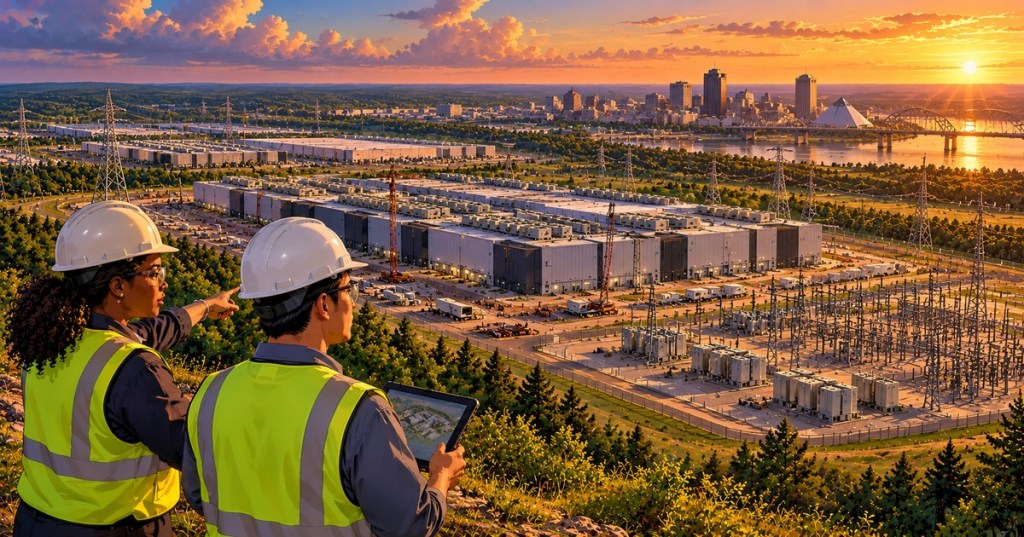
Tennessee’s largest publicly documented data center power commitments are concentrated around Memphis and Gallatin. A 1,563-megawatt planned rating for Colossus 2 leads the state’s February 2026 official inventory, followed by Meta’s 300 MW Gallatin campus and the original xAI Colossus facility at 280 MW. Two of those facilities are already operating, while Colossus 2 has brought computing equipment online as its power and building work continues.
Those figures come from the Tennessee General Assembly Fiscal Review Committee’s February 26 report. They are reported facility capacities or plans, not metered electricity consumption or independently verified IT load. Newer satellite-based models produce different figures, and some sources combine power plants with data centers. This ranking therefore uses one clearly identified official reporting baseline, explains subsequent developments and excludes sites without established data-center capacity.
3. xAI Colossus 1, Memphis — 280 MW Reported; Operating
The original Colossus complex occupies the former Electrolux appliance manufacturing plant on Paul R. Lowry Road in southwest Memphis. It became operational in 2024, after the company rapidly installed an enormous cluster of Nvidia GPUs. The Tennessee fiscal note reported 280 MW of capacity for the original Memphis data center, but that does not mean the utility was supplying 280 MW continuously.
The distinction matters because the Tennessee Valley Authority approved an initial 150 MW firm power commitment through Memphis Light, Gas and Water, while xAI also used battery systems and gas turbines. The underlying utility and permitting record distinguishes authorized grid power, turbine generation and facility demand. Their different capacities should not be added as if every megawatt were running servers full time.
ServeTheHome’s tour inside the original xAI Colossus supercomputer, documented in its published technical report with Supermicro.
The project helped establish Memphis as a high-density AI infrastructure center, but it also became the focus of environmental scrutiny. Residents and advocacy groups have challenged the use of turbines near established neighborhoods, while the operator says its recycling and emissions-control investments are intended to mitigate local impacts. Its published facility statements say permanent on-site turbines at the original site are ultimately intended for backup.
2. Meta Gallatin — 300 MW Reported; Operating
Meta’s Gallatin Data Center began serving internet traffic on November 14, 2024, after breaking ground in 2020. The 300 MW site capacity cited in Tennessee’s fiscal review places it slightly above the original Colossus facility on that published baseline. The figure is not a disclosure that 300 MW of GPUs or servers are currently in use.
Meta says the Gallatin project represents more than $1.5 billion in investment at full buildout and supports more than 100 operational jobs. Its data halls serve the infrastructure behind Facebook, Instagram, WhatsApp and other Meta services. In a contrasting technical estimate, Epoch AI’s October 5 model suggests roughly 87 MW of active IT power; that is an independent estimate, not Meta’s reported electrical site rating.
WKRN News 2 reports on the opening of Meta’s Gallatin data center in November 2024.
The local economic effects remain contested. A September 2026 public-radio investigation found that the mayor described Meta as the area’s largest taxpayer, while some residents questioned incentives, utility impacts and the pace of growth. Officials also debated a pause on future proposals. The experience shows why a functioning campus can be economically significant without resolving every question about public costs and land use.
1. xAI Colossus 2, Memphis — 1,563 MW Planned in State Report; Partially Operational
The second Colossus development, near Tulane Road and Whitehaven in Memphis, dwarfs the other two sites on Tennessee’s reported planning figures. The state’s February fiscal note assigned it 1,563 MW of planned capacity and anticipated a 2026 start. Subsequent reporting and independent assessments indicate that parts of the campus are now operating, with more infrastructure still being built. The 1,563 MW figure is a planned site rating, not a confirmed current grid draw.
Epoch AI’s July 30 assessment estimated about 946 MW of installed IT power at Colossus 2 and projected further growth into 2027, using satellite imagery, cooling-system modeling and company disclosures. That is a different method from a facility’s planned electrical capacity; neither number should be presented as a measured utility demand. The project’s actual deployed GPU inventory and energization will continue to change as construction progresses.
CNBC’s July 2026 report examines the power requirements and community concerns surrounding the Colossus data centers in the Memphis area.
Power for the larger Memphis-area cluster has created a cross-border regulatory fight. The adjacent gas-turbine installation serving Colossus 2 sits in Southaven, Mississippi, rather than on a Tennessee grid site. In its July 30 statement, the operator described a 1.2 GW permanent gas-fired plant and a timetable to remove 69 temporary turbines by July 2027. The Mississippi plant’s generating rating is not an additional 1.2 GW Tennessee data center and is not added to the ranked capacity.
Environmental organizations and local residents have challenged emissions and noise from the turbine operations, while xAI disputes allegations that its practices disregard public health and says it is investing in sound barriers and emissions controls. The company’s longer-term power plans and enforcement of air-permit conditions will be key tests of whether expanding AI infrastructure can coexist with nearby communities.
Why Project River’s 1,500 MW Power Campus Is Not Ranked as an Operating Data Center
A much larger industrial proposal is under discussion in Bradley County. The Wright family’s Project River describes 1,000 MW of natural-gas generation and 500 MW of biomass generation for a future large industrial user, potentially a data center, plus a 360 MW grid reservation for backup and peaking. The developer’s own materials say that no end-user offtake agreement is in place. That makes 1,500 MW an electricity-generation proposal, not an established 1,500 MW computing load.
The project also remains in a local approval process. On September 18, the family requested a delay in Cleveland’s consideration of the plan while independent technical issues and neighborhood concerns were reviewed. If the site secures a data center customer, publishes a server-capacity commitment and receives required approvals, it could alter Tennessee’s leaderboard. Until then, ranking its generating plant ahead of operating data centers would overstate the evidence.
Other apparent contenders also require care. A 350 MW Cielo Clarksville project appears in market directories, but Montgomery County planning officials said in September that no new data centers were currently proposed. Without a verifiable local application, its reported capacity is insufficient to displace the documented three. Conversely, 5C’s Memphis MEM01 facility is a real, expanding project: the operator lists 20 MW for 2026 and additional capacity in 2027, while reporting points to an 84 MW expansion target.
Tennessee’s Next Test Is Delivering Power Without Shifting Hidden Costs
The state’s questions now extend beyond how many megawatts developers announce. TVA changed its wholesale rate structure in August as fast-growing electricity demand raised questions about grid investment and customer protections. On October 20, the Memphis City Council approved a 135-day pause on new data center approvals while it develops siting rules. Existing lawful facilities and projects with protected rights are not automatically shut down.
A credible next update should identify which megawatts are authorized, under construction, energized and actually consumed, along with who pays for power infrastructure, water systems and emissions controls. Tennessee offers a useful comparison to South Dakota’s still-emerging pipeline, South Carolina’s proposed campuses and Pennsylvania’s large power-led developments. Our capacity planning lesson examines why planning headroom, contracted supply and live IT demand must be tracked separately.
BitcoinVersus.Tech
BitcoinVersus.Tech Editor’s Note: We volunteer daily to ensure the credibility of the information on this platform is Verifiably True. If you would like to support our work and help further secure the integrity of our research initiatives, please scan the QR code below to donate 5,000 sats. For best results, scan the QR code from a laptop or larger screen.
Bitcoin address: 3C9o19EH5HSiwEPyCTmEKzxhNCbo2X6TTb. Confirm the destination address before sending.

BitcoinVersus.tech is not a financial advisor. This media platform reports on financial subjects purely for informational purposes.


Leave a Reply