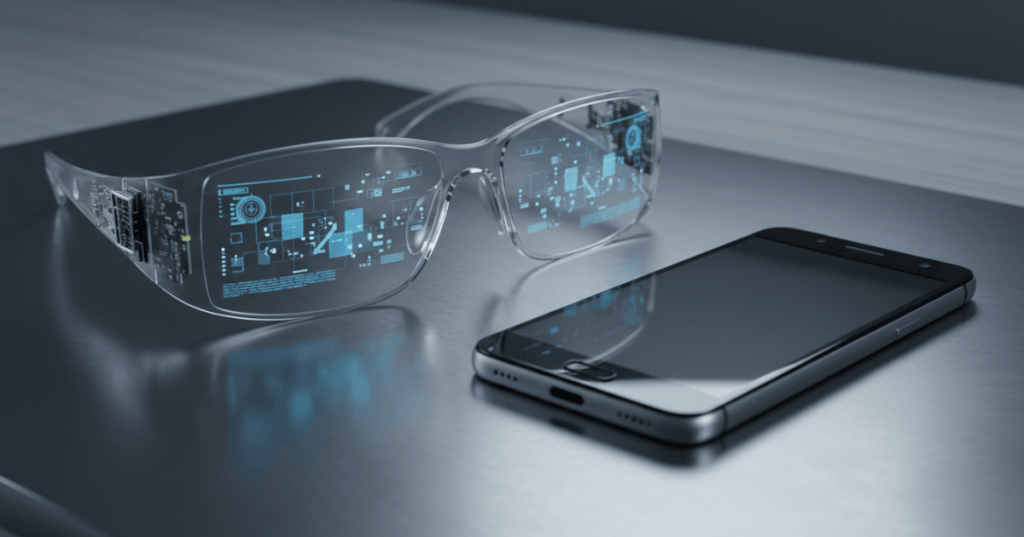
Google and XREAL launched XREAL AURA on October 28, 2026, bringing Android XR to transparent, wired smart glasses in the United States, Canada and South Korea. Orders start at $1,099 during the launch promotion, with shipments expected in mid-November. Japan orders begin November 2.
Unlike enclosed virtual-reality headsets, AURA overlays applications onto the wearer’s view of the real world. Google specifies a 70-degree field of view and glasses weighing less than 95 grams. Its split-compute design moves the battery and Qualcomm Snapdragon Reality Elite processing platform into a separate puck connected by cable.
Official launch demonstration: Google’s Android XR launch page includes first-party product demonstrations and images. XREAL’s official Project Aura showcase documents its earlier public demonstrations.
The arrangement trades complete freedom of movement for lower weight on the face. The puck also works as a trackpad, while Bluetooth peripherals can support a more conventional desktop experience. Google says users can position several windows around them and mirror a compatible laptop display over USB-C.
Google’s Gemini assistant is integrated with Android XR and can respond to questions about applications and visible surroundings. Google also says more than 150 applications have been built for XR, alongside access to familiar Google Play software. These are platform capabilities, not independent measurements of AURA’s battery endurance or everyday usability.
The initial price is promotional. XREAL’s earlier announcement listed $1,279 for 12GB RAM and 256GB storage, and $1,499 for 16GB and 512GB. Launch reporting puts the respective promotional prices at $1,099 and $1,299 through December. Buyers should distinguish the limited offer from standard list prices.
The release expands the competition for spatial computing beyond bulky headsets. For developers, the larger question is whether Android’s application ecosystem can make wearable displays useful for technical workflows, gaming and AI-assisted productivity rather than occasional demonstrations.
Important unknowns remain. Real-world comfort, heat, battery life, optical clarity and long-session performance need independent testing. Google’s announcement confirms ordering and intended shipment timing; it does not establish how many units have shipped or whether consumer demand will meet expectations.
BitcoinVersus.Tech
BitcoinVersus.Tech Editor’s Note: We volunteer daily to ensure the credibility of the information on this platform is Verifiably True. If you would like to support our work and help further secure the integrity of our research initiatives, please scan the QR code below to donate 5,000 sats. For best results, scan the QR code from a laptop or larger screen.

Bitcoin address: 3C9o19EH5HSiwEPyCTmEKzxhNCbo2X6TTb. On a phone, open the QR image on another screen or copy and verify the address in your wallet before sending.
BitcoinVersus.tech is not a financial advisor. This media platform reports on financial subjects purely for informational purposes.


Leave a Reply