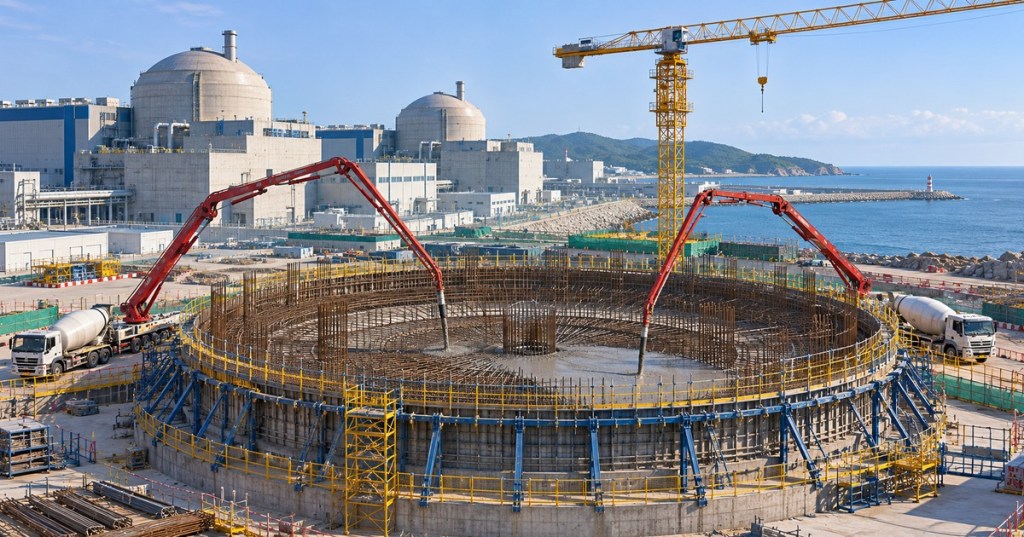
China began the first safety-related concrete pour for Haiyang nuclear reactor Unit 5 on October 31, opening the main construction phase of a new CAP1000 unit in Shandong province. State Power Investment Corporation (SPIC) reported the milestone at its coastal Haiyang site, where two reactors already operate and two others are under construction. The start was confirmed by China’s Xinhua news agency and follows construction permits issued by the country’s nuclear regulator on October 29.
Contractor China Nuclear Industry 24 Construction said the initial nuclear-island foundation pour involves approximately 6,626 cubic meters of concrete and was expected to take nearly 62 hours. A continuous, temperature-controlled pour matters because the reinforced foundation carries major reactor structures and must meet stringent quality requirements. The October 31 announcement confirms that pouring began; it does not mean the entire nuclear island is finished, fuel has been loaded or electricity has entered the grid.
CGTN’s March 23, 2025 report shows the steel containment dome installed at Haiyang Unit 3. The footage documents earlier construction at the same facility, not the October 31, 2026 Unit 5 concrete pour. Watch the original CGTN video on YouTube.
CAP1000 capacity and construction phases
Unit 5 uses China’s CAP1000 pressurized-water reactor design, developed from the Westinghouse AP1000 technology family. The World Nuclear Association lists 1,161 megawatts of net electrical capacity, while the Chinese developer describes a 1,300 MW rated unit. Gross or rated figures and net output delivered after station consumption are not interchangeable. Both figures describe intended generating capability, not power currently produced by Unit 5. Unlike the smaller designs discussed in our SMR availability analysis, Haiyang 5 is a conventional large reactor. The distinction also matters for six-reactor proposals in Kentucky, where announced capacity remains separate from operational generation.
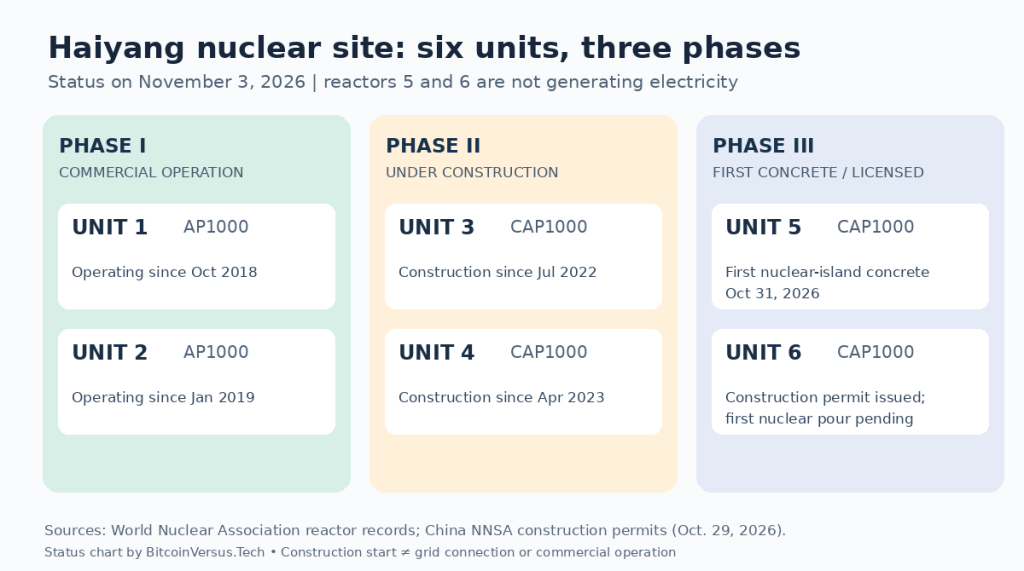
Haiyang Units 1 and 2 entered commercial operation in October 2018 and January 2019, respectively. Units 3 and 4 form Phase II and remain under construction. Units 5 and 6 comprise Phase III. Under the National Nuclear Safety Administration’s October 29 licensing notice, Unit 5 received permission to start its first nuclear-island concrete. Unit 6 received a construction license but requires release of a separate regulatory control point before its equivalent pour may begin.
CCTV Video News Agency’s September 8, 2025 report shows a steel containment module installed at Haiyang Unit 4. The footage documents an earlier construction phase, not Unit 5’s first concrete pour. Watch the original CCTV video on YouTube.
Safety oversight and the remaining work
The regulator also requires quality-assurance controls, construction progress reports and supervisory clearance before specified major coolant-pipe welding work. A separate environmental approval identifies construction dust, noise, wastewater, solid waste and radioactive-waste management as continuing obligations. A reactor foundation is an important physical milestone, but installation, inspection, testing, grid connection and commercial licensing all remain ahead. No verified Unit 5 startup date or final project cost was established in the reviewed announcements.
SPIC forecasts that a completed six-unit Haiyang complex could generate about 60.9 billion kilowatt-hours annually and substantially expand district heating. The figure is a developer projection for the eventual complex, not measured annual production from all six reactors. The company’s heat-supply ambitions likewise depend on completion and supporting distribution infrastructure. Nearby energy development, including China’s Tianwan offshore solar project, illustrates how different sources are being developed around established transmission systems, although each plant retains separate engineering and operating requirements.
For comparison, Bangladesh’s Rooppur reactor tests have progressed further toward initial electricity delivery but still require additional approvals before routine grid supply. Haiyang Unit 5 has only entered the nuclear-island construction stage. Upcoming checkpoints include verified completion of foundational civil work, reactor equipment installation and later regulatory inspections. China has cleared a meaningful hurdle; delivered electricity remains years of construction and commissioning away.
Editor’s Note: We volunteer daily to ensure the credibility of the information on this platform is Verifiably True. If you would like to support our work and help further secure the integrity of our research initiatives, please scan the QR code below to donate 5,000 sats.

Scan the QR code with a compatible Bitcoin wallet while viewing the article on a laptop or larger screen. Donation address: 3C9o19EH5HSiwEPyCTmEKzxhNCbo2X6TTb.
BitcoinVersus.tech is not a financial advisor. This media platform reports on financial subjects purely for informational purposes.


Leave a Reply