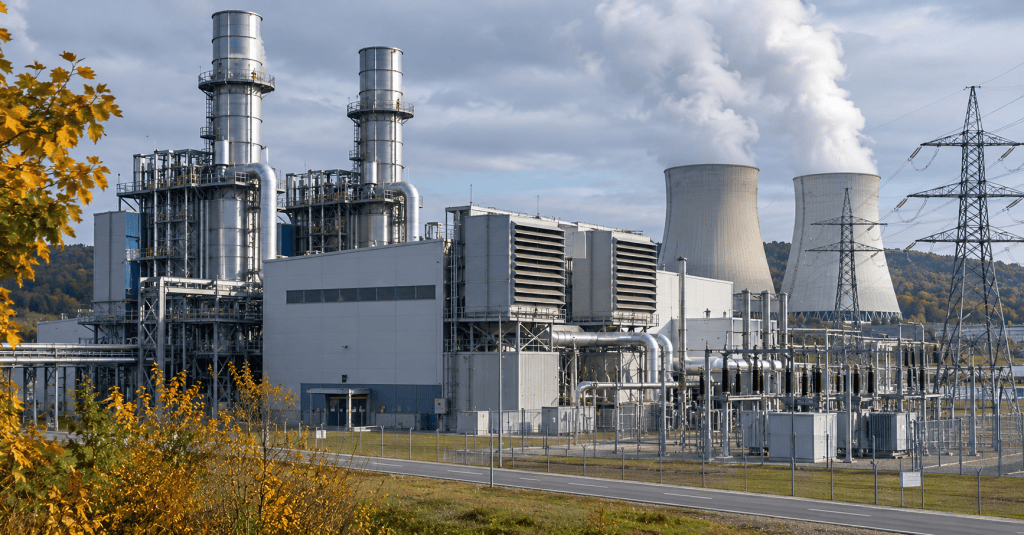
Germany awarded contracts covering 5.16 gigawatts of dispatchable electricity capacity on November 3, 2026, advancing a program intended to support the grid when wind and solar generation falls short. The Federal Network Agency issued eleven awards, with energy groups LEAG and RWE receiving most of the capacity and municipal utility Stadtwerke Karlsruhe securing another project. The award is a commitment to support future plants, not evidence that 5.16 GW has already entered service.
The tender provides payments for keeping eligible generating capacity available over a 15-year period. Germany expects the new plants to help replace retiring coal capacity and maintain electricity supply during extended periods of weak renewable output. The winning projects must meet requirements for sustained delivery, and the first round was oversubscribed.
Primary reporting: RWE announcement, November 3, 2026; Tagesschau summary of Federal Network Agency awards.
LEAG and subsidiaries secured approximately 2,998 megawatts of reduced tender capacity across seven plant blocks, primarily at existing industrial locations in eastern Germany. RWE won about 2,118 megawatts for three planned hydrogen-compatible combined-cycle plants at Voerde, Weisweiler and Werne in North Rhine-Westphalia. The remaining award went to Stadtwerke Karlsruhe. RWE said preliminary permitting and equipment preparations were already underway, with construction of its first facility expected to begin within weeks.
An important distinction is that the tender uses reduced megawatts, or rMW, rather than simply adding the manufacturers’ nameplate ratings. RWE says 85% of installed gas capacity counts toward the tender. Its approximately 2,100 rMW award therefore does not mean its turbines have exactly 2,100 MW of installed physical capacity.
The average successful bid was €155,296 per megawatt of reduced capacity per year, compared with a €244,000 ceiling. Multiplying the average award by 5,160 MW produces roughly €801 million in annual gross capacity payments. Over fifteen years, the arithmetic approaches €12 billion, before contract-specific adjustments and any revenue-sharing arrangements. Those payments compensate availability, not a guaranteed amount of electricity produced.
Consumers are expected to finance the mechanism through an electricity levy. Supporters argue that paying for dispatchable backup capacity can reduce blackout risk and encourage continued solar deployment alongside batteries. Critics question the cost to households, the concentration of awards among major incumbent utilities and whether the program locks in fossil-gas dependence.
Gas-fired generation generally emits less carbon dioxide per unit of electricity than coal combustion, but it remains a fossil-fuel source. Upstream methane leakage, fuel-price volatility and imported gas exposure complicate its environmental and economic profile. The plants are designed for future hydrogen use, yet hydrogen compatibility does not demonstrate that low-emissions hydrogen will be available at competitive prices when the stations begin operating.
Germany’s broader electricity transition involves transmission reinforcement, storage and variable renewable generation. Recent island wind-grid integration illustrates the engineering importance of connecting new generation to demand centers. The country’s backup-power challenge also differs from FirstEnergy’s proposed West Virginia gas development, where regional fuel supply and market rules shape the business case.
The procurement is part of a larger program targeting roughly 11–12 GW, with further tenders expected in December 2026 and 2027. Germany’s coal phaseout, grid constraints and the affordability of hydrogen conversion will determine how useful the new stations ultimately become. Until construction, permitting and commissioning are complete, the awarded capacity remains a future resource rather than measured operating generation.
For context on alternative large-scale supply options, China’s Haiyang nuclear construction program demonstrates a different investment pathway: long-lived generation capacity rather than gas-fired backup. Neither approach removes the need to distinguish rated capacity from annual energy output.
Editor’s Note: Awarded reduced capacity, installed capacity, potential output and actual electricity generation are distinct metrics. Payment calculations are illustrative, and future hydrogen use is not confirmed.


Leave a Reply