
OpenAI introduced GPT-6 Cyber on November 5, 2026, a specialized artificial-intelligence model for authorized cybersecurity research. The launch follows a Linux kernel experiment in which an automated pipeline generated 948 working local privilege-escalation exploits and candidate patches, according to OpenAI’s technical report. The model is restricted to approved organizations rather than broadly available to ordinary ChatGPT users.
A local privilege-escalation vulnerability can allow a user with limited system permissions to gain higher privileges, potentially including root access. The Linux kernel manages hardware, memory, processes and security boundaries across servers, personal computers and embedded devices. Such flaws can be consequential when attackers already have an initial foothold, but they do not necessarily permit compromise from the public internet.

What the Linux experiment actually measured
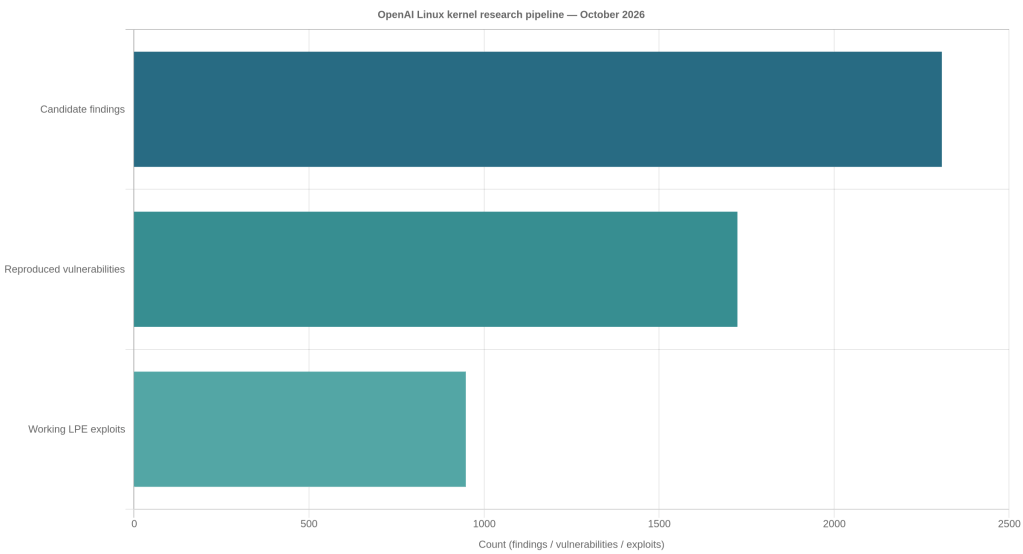
OpenAI said its October research pipeline screened 2,308 candidate kernel findings, dynamically reproduced 1,724 vulnerabilities and generated 948 working local privilege-escalation exploits on a commonly used Linux distribution. The experiment consumed about $1.21 million in API credits, equivalent to roughly $1,279 per reported exploit. The company also reported proof-of-concept demonstrations for 291 information-disclosure vulnerabilities.
OpenAI’s official GPT-6 Cyber announcement explains the restricted rollout and cybersecurity benchmarks. The work combined static analysis, isolated dynamic testing, exploitability assessment and automated patch proposals. Human researchers reviewed results before reporting vulnerabilities and candidate fixes. OpenAI’s published methodology does not mean 948 patches have been merged into the Linux kernel or that every vulnerability affects every deployed Linux system.
Restricted access and safeguards
The GPT-6 Cyber system card classifies the model’s cybersecurity capabilities as Critical under OpenAI’s preparedness framework. Access through the Daybreak Red program requires identity verification and organizational controls, including multifactor authentication and API IP allowlisting. OpenAI says the model is designed to respect authorized testing scope, while its evaluation also acknowledges shortcomings in responses to some warnings.
The dual-use risk is substantial: tools capable of finding and validating security flaws can assist both defenders and attackers. OpenAI’s evaluations measure behavior under specific conditions; they do not establish immunity from misuse. Earlier BitcoinVersus.Tech reporting on AI-assisted Linux vulnerability discovery and microkernel security repairs provides additional context for the growing role of automated research.
Maintainers still control the fixes
OpenAI reported that, during the ten-day research window, 61 identified local privilege-escalation issues had already been patched upstream, 43 had staging patches and hundreds more were being discussed. Those overlapping efforts illustrate why vulnerability counts require deduplication and current-version retesting. Discovery at scale can overwhelm maintainers unless reports contain reproducible evidence and practical patches.
Organizations should continue timely kernel updates, least-privilege controls, workload isolation and security monitoring rather than treating an AI-generated patch as automatically production-ready. BitcoinVersus.Tech has also covered Linux patching and active exploitation risks. The critical next measure is how many findings are independently confirmed, responsibly disclosed and safely repaired—not simply how many exploits a model can generate.
BitcoinVersus.Tech Editor’s Note: We volunteer daily to ensure the credibility of the information on this platform is Verifiably True. If you would like to support to help further secure the integrity of our research initiatives, please donate using the QR code provided.

For best QR-code scanning results, scan from a desktop or larger screen. Verify the receiving address 3C9o19EH5HSiwEPyCTmEKzxhNCbo2X6TTb before sending.
Disclaimer: BitcoinVersus.Tech is not a financial advisor. This media platform reports on financial subjects purely for informational purposes.


Leave a Reply