
The U.S. Cybersecurity and Infrastructure Security Agency added WordPress Core vulnerability CVE-2026-119977 to its Known Exploited Vulnerabilities catalog on November 3, 2026, citing active attacks against the software’s upgrade process. WordPress patched the weakness in its October 28 security release. Federal civilian agencies face a November 6 remediation deadline, while independent site operators are urged to verify updates and investigate possible exposure. The warning concerns a real exploited defect, not evidence that every WordPress website has been breached.
Background: What is WordPress Core? WordPress is an open-source content management system that powers websites through PHP code, a database, themes and optional plugins. Its core provides the dashboard, editing system, permissions and update mechanisms. During a full-package update, WordPress temporarily stages replacement files before activating the new version. Keeping software current is normally protective, but a security mistake in temporary update handling can introduce a short attack window.
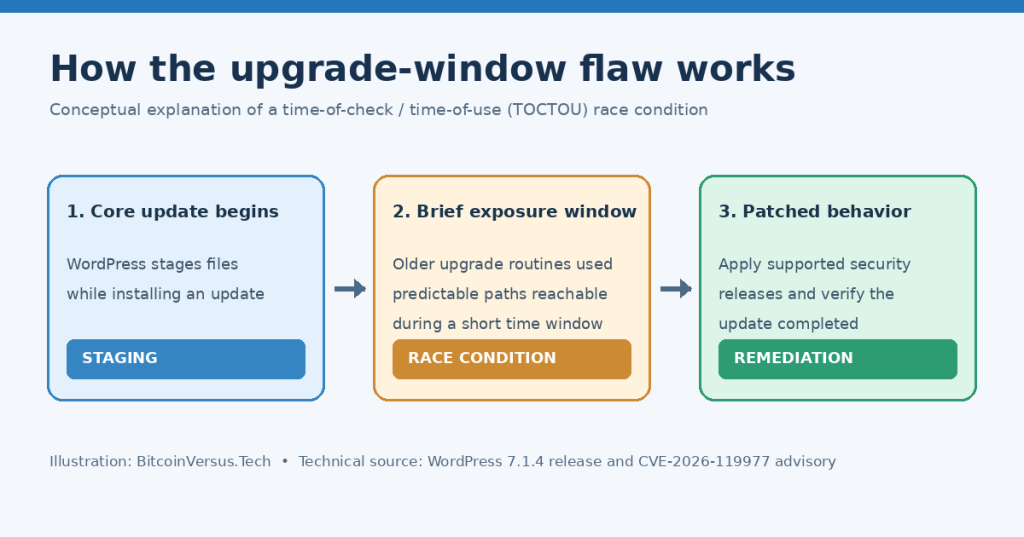
Security researchers describe the flaw as a time-of-check/time-of-use race condition, or TOCTOU. Earlier core versions used predictable staging locations that could become web-accessible while an update was running. An unauthenticated attacker reaching the exposed location at the right time could potentially execute server-side code. The GitHub vulnerability advisory identifies affected WordPress Core versions from 4.7 through 7.1.3, subject to available maintenance backports. The critical timing detail separates the weakness from a permanent open endpoint exploitable at any hour.
WordPress 7.1.4 fixes the upgrade weakness and several separate security defects, including stored cross-site scripting and information-disclosure issues. In the official technical release notes, the project credits researcher Umut Bayram for the upgrade-race finding. Security backports are also available for supported older branches; administrators should confirm their branch’s patched version rather than assuming the 7.1.4 version number applies to every installation.
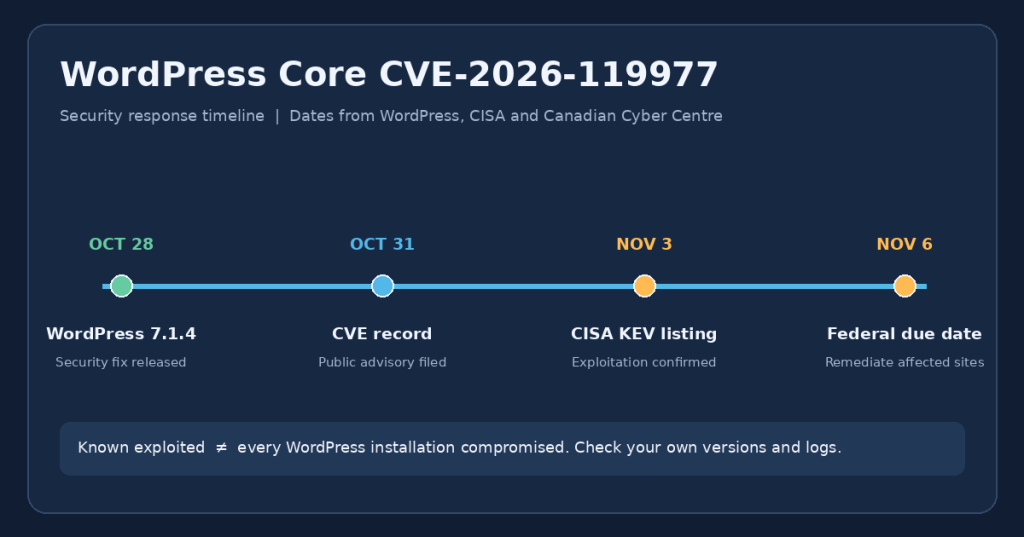
CISA’s listing changes the prioritization from a theoretical vulnerability to confirmed exploitation. However, it does not identify how many websites were compromised. An independent report described thousands of blocked suspicious requests observed by Wordfence, which measure attempted attacks, not successfully compromised sites. The distinction matters when evaluating incident severity and defensive effectiveness.
The remediation approach depends on hosting. Self-managed WordPress administrators should follow their provider’s backup and security procedures, apply the available core fix promptly, confirm the installed version and review relevant logs. WordPress.com says it manages core software updates automatically for its hosted sites; owners can check the reported version in the Hosting Dashboard where supported. Managed hosting must not be confused with an independently administered WordPress.org server.
Website operators also face risks outside the core itself. BitcoinVersus.Tech previously covered emergency PHP2Shell security patches and active exploitation of a GitLab server flaw. Other CISA alerts involved Ivanti VPN attack chains and Cisco firewall service disruptions. Each requires product-specific verification rather than a single blanket update.
The immediate milestone is November 6, the federal remediation date. For other organizations, the practical question is whether an affected version performed a vulnerable full-package upgrade and whether suspicious access occurred. Administrators should preserve evidence when indicators warrant investigation, verify the fix, and continue monitoring vendor notices. Routine checks, reinforced by tools such as GitHub CodeQL’s code analysis, remain complementary to timely patching rather than substitutes for it.
BitcoinVersus.Tech Editor’s Note: We volunteer daily to ensure the credibility of the information on this platform is Verifiably True. If you would like to support to help further secure the integrity of our research initiatives, please donate using the QR code provided

For best QR-code scanning results, please scan this donation code from a desktop or larger screen. Mobile screens may prevent camera recognition. Verify the receiving address 3C9o19EH5HSiwEPyCTmEKzxhNCbo2X6TTb before sending.
Disclaimer: BitcoinVersus.Tech is not a financial advisor. This media platform reports on financial subjects purely for informational purposes.


Leave a Reply