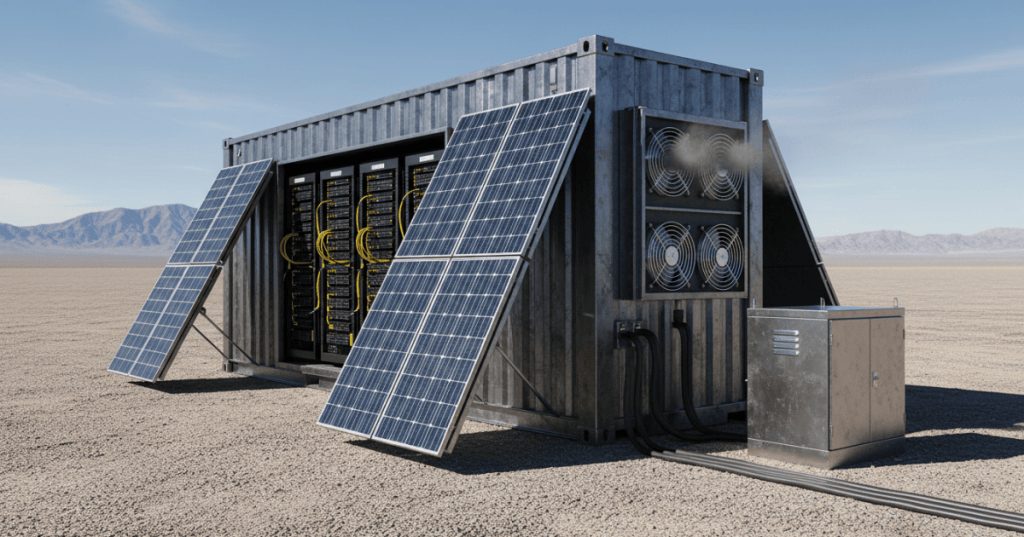
Canadian startup Liquid Energy has introduced NanoDC, a factory-built, solar-powered AI inference data center that arrives in a metal container with integrated compute, power, cooling and networking. Announced on November 5, 2026, the design closely resembles the prefabricated pods long used at Bitcoin mining sites, but adds deployable photovoltaic panels and battery storage to reduce reliance on conventional grid connections.
The company describes four-week deployment, a roughly 30-minute on-site startup and initial operating units planned for November. Those figures are company claims, not independently verified commissioning results. Its website separately advertises less than eight weeks from a signed contract to the first generated AI token.
Liquid Energy’s original November 5, 2026 NanoDC launch post, featuring its approximately 68-second product video. Credit: Liquid Energy (@_LiquidEnergy) on X. If the inline X player does not load, watch the original NanoDC demonstration directly on X. In-page playback depends on X’s external widget.
A complete data center inside a shipping-style enclosure
NanoDC is presented as a transportable, factory-assembled module rather than a conventional concrete data hall. A fold-out solar array provides electricity during daylight, while batteries are intended to support operation outside solar-production hours. Liquid Energy says its design uses high-density air cooling and Starlink connectivity, avoiding a dedicated cooling-water supply and a conventional utility interconnection. Actual on-site requirements remain dependent on climate, land use, electrical safety and connectivity.
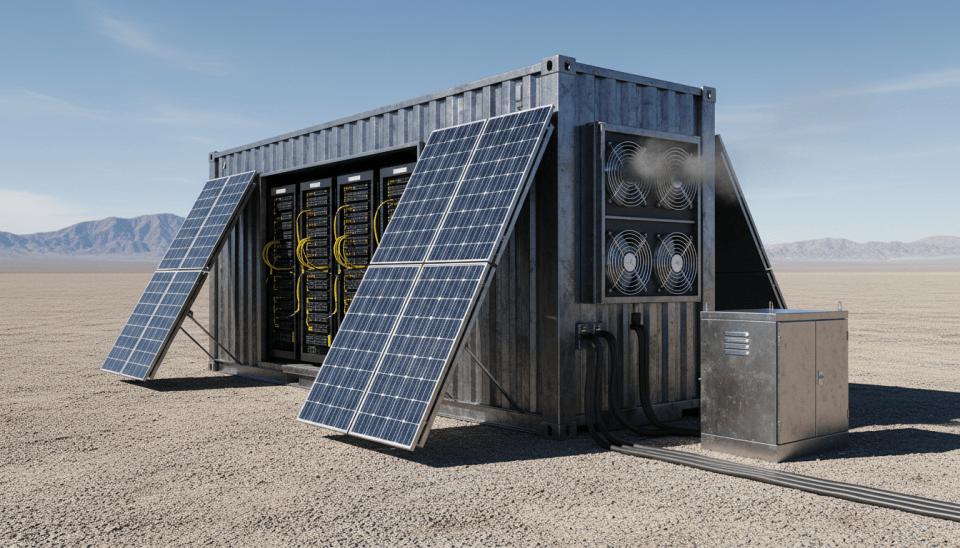
The resemblance to a Bitcoin mining container is substantial at the facility level: both can consolidate processing machines, power distribution, forced-air thermal management, remote monitoring and service access inside rugged modular shells. Container-based mining projects helped demonstrate how compute can be packaged and moved near inexpensive or otherwise underused energy. Earlier BitcoinVersus.Tech reporting examined solar panels powering a micro Bitcoin data center and the reuse of heat from mining equipment.
Same enclosure, different silicon and economics
The principal computing distinction is workload. Bitcoin mining containers typically house application-specific integrated circuits performing SHA-256 hashing; AI inference containers use processors or accelerators to serve trained-model requests. Their utilization patterns, latency requirements, software stacks and cooling densities differ. Liquid Energy intends to sell inference capacity rather than individual shipping containers, according to its company website.
One comparable alternative is the floating-solar GPU deployment previously covered by BitcoinVersus.Tech. Modular AI concepts also have to solve the same engineering problems explored in data-center capacity planning: reliable power headroom, cooling reserves, maintenance access and network availability.
Solar and storage are the decisive tests
A self-powered enclosure does not automatically imply uninterrupted computing. For perspective, a hypothetical 100 kW continuous IT and facility load consumes 2.4 MWh in 24 hours; covering twelve hours without solar generation would require at least 1.2 MWh of usable battery energy before storage, conversion and reserve losses. The 100 kW figure is an illustrative calculation, not a published NanoDC specification. Actual capacity depends on solar irradiance, array area, battery size, weather and the system’s ability to reduce computing load.
Cooling introduces another constraint. High-density air cooling must reject server heat to outdoor air, where high ambient temperatures and dust can reduce cooling margin and increase maintenance. Container dimensions also impose limits on rack layout, fire protection and service clearances. The related air-cooling advances discussed in earlier data-center coverage illustrate why thermal designs require measured performance rather than visual impressions.
Manufacturing ambitions are not deployed capacity
Liquid Energy’s Y Combinator company profile states that the startup has 20 units and can manufacture modules representing approximately 2 MW per month, with a stated goal of 20 MW per month during the following year. The listing does not establish that all 20 units are already producing commercial AI inference. In its launch communication, the company said initial units would go live in November 2026 and projected shipments of thousands beginning in 2027.
Published primary materials do not provide independently measured GPU throughput, per-unit electrical load, panel and battery ratings, battery autonomy, total installed cost, availability, or delivered inference cost. Claims about operating without grid connections should not be interpreted as exemptions from local permits or building and electrical rules. The decisive milestones will be operating installations, audited solar-to-compute performance and commercial workloads maintained through variable weather.
Editor’s Note: Reporting is based on Liquid Energy’s product information, its Y Combinator profile and the November 5, 2026 launch announcement. Deployment timing, production throughput and future shipment volume are attributed claims. The battery calculation is explanatory, not a product rating. The article’s container illustration is AI-generated concept art; the launch post is the manufacturer’s own media.

For mobile scanning, open the article on another display and use a compatible Bitcoin wallet to scan the original donation QR. Verify the destination before donating 5,000 sats: 3C9o19EH5HSiwEPyCTmEKzxhNCbo2X6TTb.
We volunteer daily to ensure the credibility of the information on this platform is Verifiably True. If you would like to support our work and help further secure the integrity of our research initiatives, please scan the QR code below to donate 5,000 sats.
BitcoinVersus.tech is not a financial advisor. This media platform reports on financial subjects purely for informational purposes.


Leave a Reply