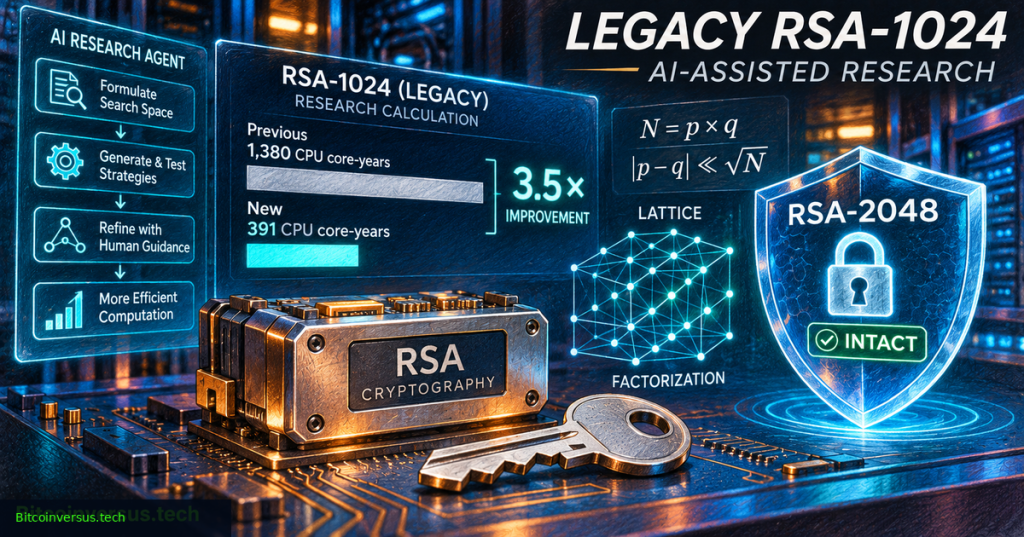
Google DeepMind researchers say AI agents helped reproduce a previously studied 1024-bit RSA cryptanalysis computation using 391 CPU core-years, down from 1,380 in earlier work. The November 6, 2026 findings represent a 71.7% reduction in recorded CPU work for a specific modular-root benchmark—not a break of modern internet encryption.
RSA is public-key cryptography built around mathematical operations related to large integers. Its security depends in part on the difficulty of reversing those operations without a private key. The researchers studied obsolete 1024-bit RSA under specialized conditions, rather than attacking live banking, messaging or web systems.
Official Google DeepMind X announcement, November 6, 2026. View the original social post.
The measured gain came from better code, not a new universal attack
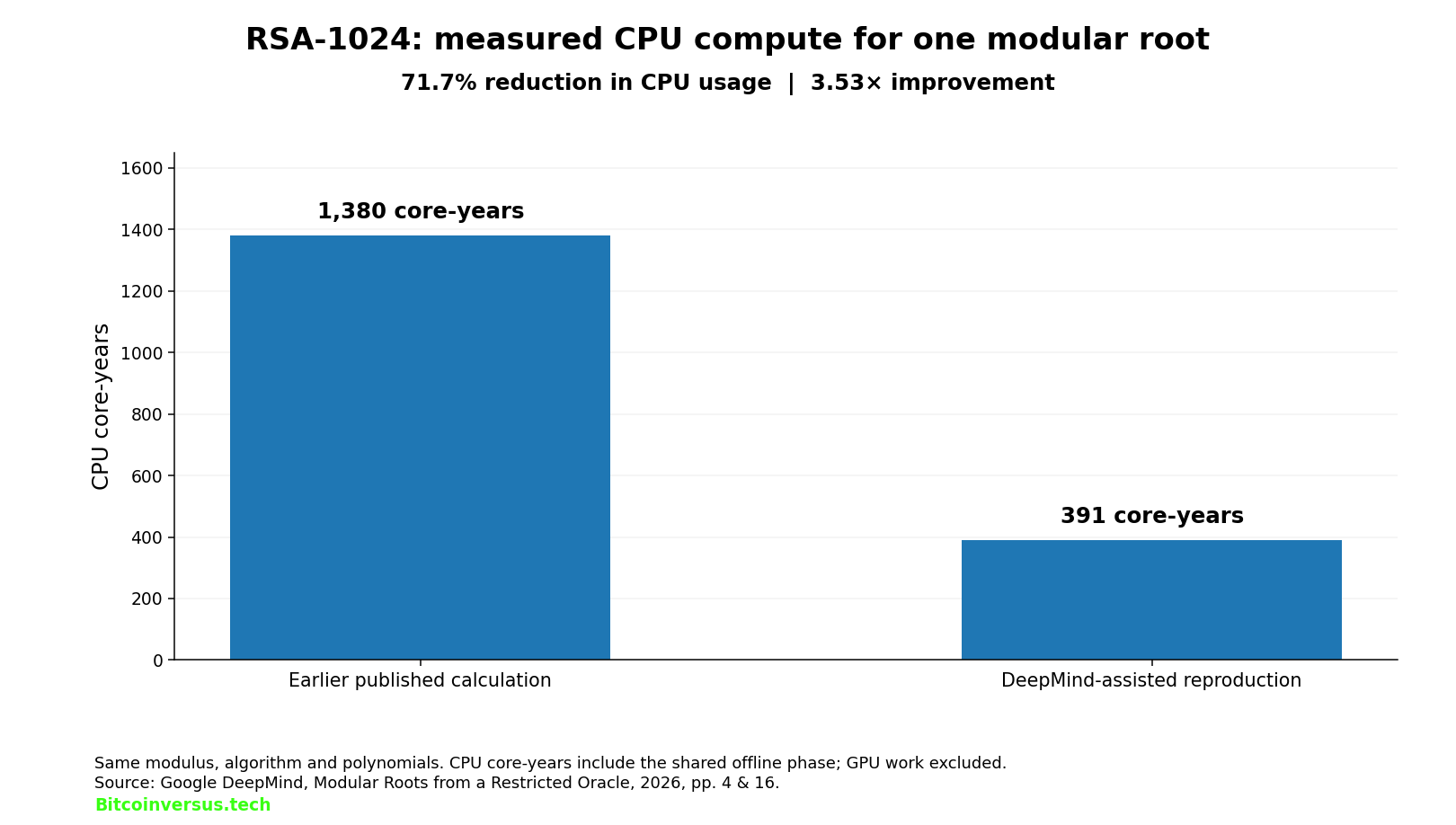
The first Google DeepMind working paper, Modular Roots from a Restricted Oracle, reports 318 CPU core-years for a reusable offline phase and 73 for obtaining the first root. Prior research required approximately 1,200 and 180 core-years, respectively. The totals are 391 versus 1,380.
The ratio, 1,380 ÷ 391, equals about 3.53; subtracting the totals gives 989 CPU core-years saved. The researchers used the same modulus, algorithms, polynomials and factor-base bounds. Their paper attributes the measured improvement primarily to software implementation and execution, not a fundamentally cheaper asymptotic algorithm. GPU work was excluded from the reported CPU totals.
Two cooperating agents designed, ran and debugged the computation. The paper reports approximately 33,500 lines of new code, 336 distributed experiments and completion in 3.2 days using extensive parallel hardware. Calendar days are not CPU core-years: many processors can perform hundreds of core-years of aggregate work simultaneously. Earlier coverage of DeepMind’s AI-security warnings provides context for the broader research direction.
A second paper models faster batch factoring
A separate November 5 working paper analyzes factoring many same-sized integers using shared precomputation. Under standard number-field-sieve assumptions, after an initial preparation roughly as costly as one conventional factorization, its proposed method could make each additional 1024-bit target about 30 times less costly than an earlier multiple-number-field method.
The 30-fold figure is a leading-order mathematical estimate, not a completed batch-factoring demonstration. The analysis also gives a comparison near 1/58 the cost of ordinary number-field-sieve factoring per additional key, but under a different baseline. Conflating those denominators would misrepresent the result.
What security teams should infer
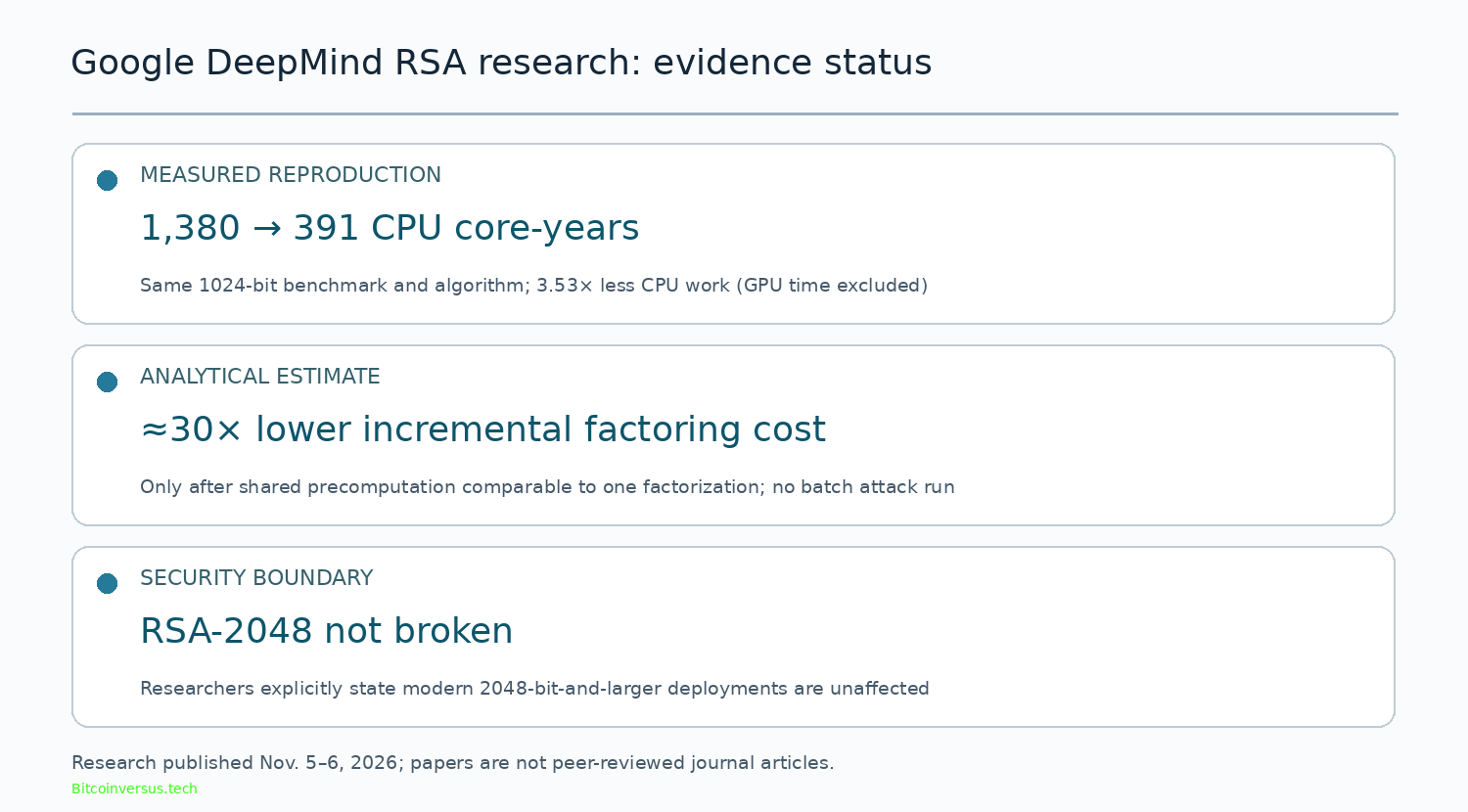
The papers explicitly state that their results do not threaten deployed cryptosystems using RSA keys of 2048 bits or greater. NIST transition guidance already favored stronger RSA key sizes well before the new findings. Defenders should inventory obsolete signing interfaces and key lengths, review any hardware security modules that still support legacy operations, and plan validated upgrades.
RSA factoring is also not equivalent to defeating every cryptographic scheme. Separate Bitcoin quantum-security questions involve different algorithms and threat models; post-quantum cryptography addresses longer-horizon risks. Neither is established by the DeepMind RSA-1024 experiment.
The findings illustrate how AI-assisted research can accelerate cryptographic testing without proving that widely deployed security has failed. Independent reproduction, implementation details and peer review remain important before generalizing beyond the paper’s carefully specified conditions.
Primary sources and methodology
Google DeepMind announcement, November 6, 2026; Modular Roots from a Restricted Oracle (working paper; first-root measurements and GPU exclusions); Fan Factories (working paper; asymptotic estimates); NIST SP 800-131A Revision 2 (key-transition context). Calculations: 989 ÷ 1,380 × 100 = 71.7%; 1,380 ÷ 391 = 3.53. Values and comparison conditions are attributed to the paper authors, not independently rerun by BitcoinVersus.Tech.
Editor’s Note: The article separates a recorded computation from unimplemented theoretical cost estimates. Neither paper claims a demonstrated RSA-2048 compromise, a live-system attack, or a general-purpose RSA factoring breakthrough. Featured artwork is an original conceptual illustration, not a photograph of the experiments. In-story graphics are original and distinct from the cover; the official X post is third-party material reproduced through the publisher’s embed.
Support BitcoinVersus.Tech
To make an optional 5,000-satoshi contribution, scan the original BitcoinVersus.Tech QR below with a compatible Bitcoin wallet. Check the payment destination before approving any transaction.

We volunteer daily to ensure the information on this platform is Verifiably True. If you would like to support the research, please scan QR code.
Cybersecurity research is reported for informational purposes. No claim of unauthorized access or successful exploitation of a live system is made.


Leave a Reply