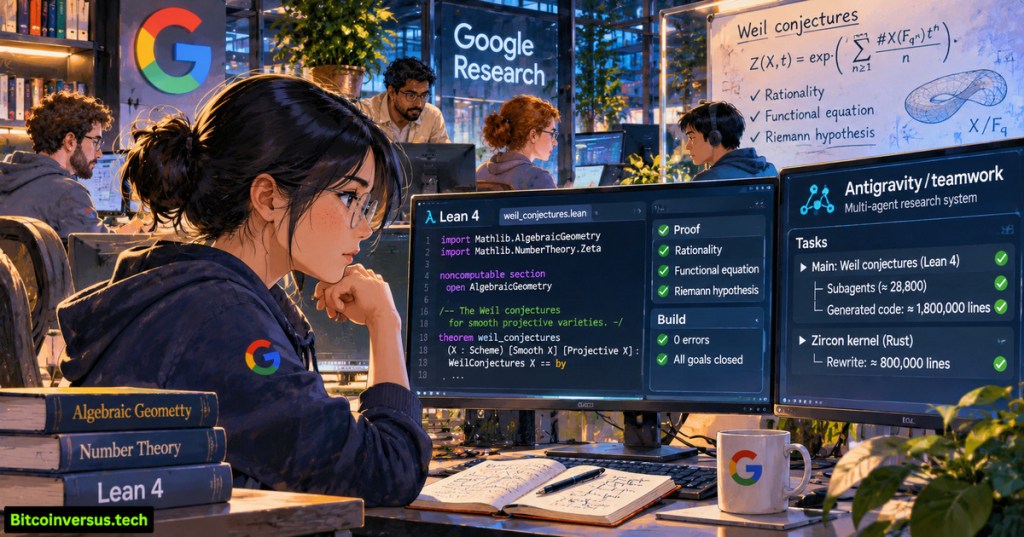
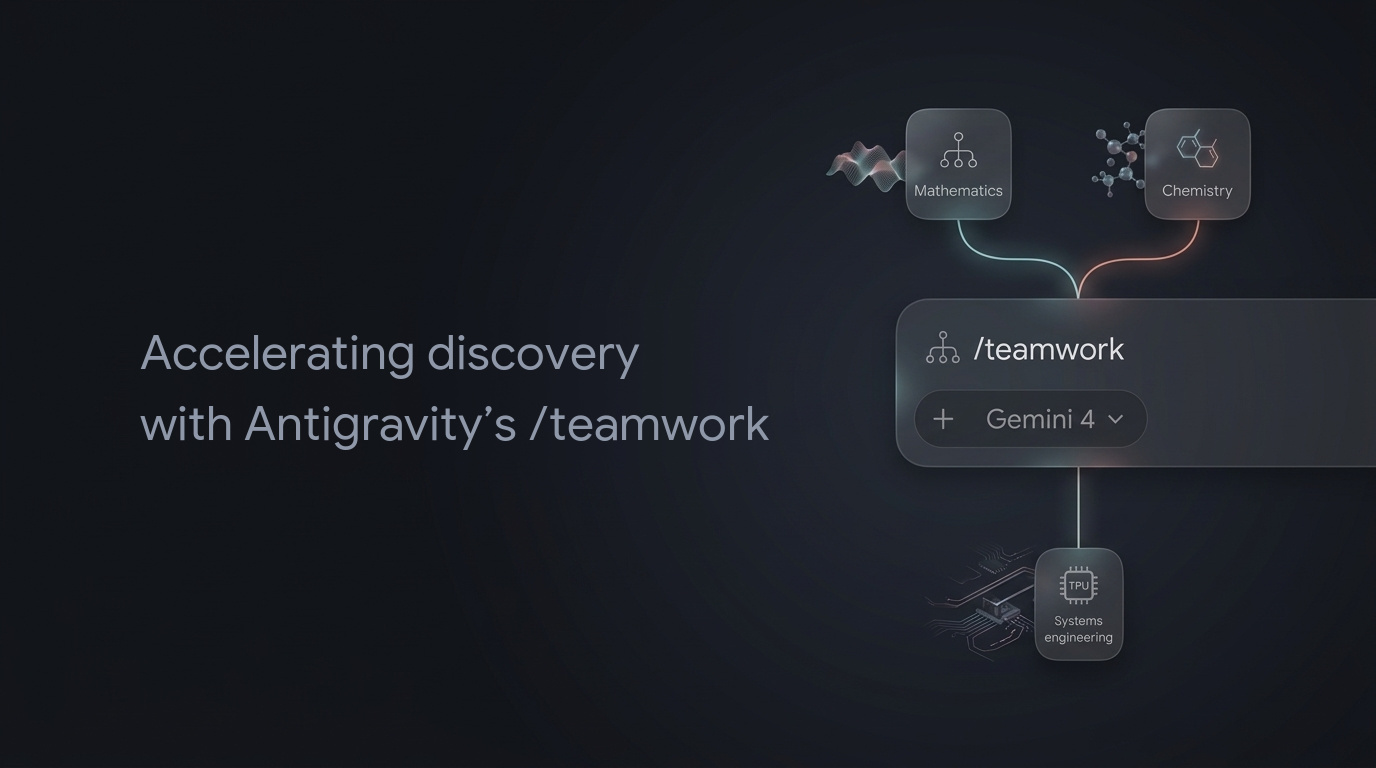
Google Research says its Antigravity /teamwork agent system generated an approximately 1.8-million-line Lean 4 formalization of the Weil conjectures through 28,800 subagent invocations. The company described the work on November 13, 2026 as part of a larger campaign combining Gemini 4 models, specialist agents and automatic verifiers. The reported result is substantial, but Google did not link a public repository for its Weil formalization, preventing independent inspection of the precise statements and proof dependencies.
The Weil conjectures concern the number of solutions to polynomial equations over finite fields. Their mathematical proofs were established decades ago, culminating in Pierre Deligne’s 1974 work. Google is reporting an automated translation of existing mathematical reasoning into machine-checkable form, not the original discovery of the conjectures’ truth.
Google’s official Antigravity demonstration at I/O 2026, published May 22. The video explains multi-agent orchestration; it predates the November formalization announcement and does not document the reported Weil proof. Credit: Google/YouTube.
Verification agents, not an all-knowing chatbot
Under Google’s approach, different agents explore candidate proofs, challenge intermediate steps and delegate work to fresh contexts. Lean 4 acts as an external proof checker: a proof term only compiles when the formal theorem follows from its stated assumptions under the kernel’s rules. Human mathematicians still must ensure a formal statement represents the intended mathematical question. Passing Lean therefore does not eliminate independent research review.
Google describes a framework called LEAP built with Google Cloud AI. It also reports more than 919,000 lines of Lean for a separate Hilbert’s tenth problem formalization and work on other long-standing mathematical questions. These are company-reported outcomes. The site’s earlier analysis of AI-assisted algorithm optimization similarly distinguishes measured computational work from broader theoretical claims.
Axiom released a public Weil formalization first
The timing complicates claims of technical precedence. Axiom published its own formalization on November 6, seven days before Google’s announcement. Its public Lean repository states all four conjectures and says the proofs contain no admitted gaps or extra axioms. Axiom also cautions that approximately 980 AI-written modules have not received human review.
By contrast, the November Google post provides no public Weil source tree. An independent repository-level examination of another Google-associated formalization found that most of its 50 million Lean lines were generated numerical certificates, illustrating why code volume alone is a weak measure of mathematical originality. The competing projects cannot be fairly ranked without comparable code, dependencies, rebuilds and formal statements.
Google’s official August 2026 demonstration of Antigravity 2.0 shows developers assigning simultaneous agent tasks. It illustrates the platform rather than independently confirming any November 2026 theorem claim. Credit: Google/YouTube.
The same system rewrote kernel and video-decoder code
The announcement also describes a two-week project that migrated remaining C++ components of the Fuchsia Zircon microkernel into approximately 800,000 lines of safe Rust, reportedly passing kernel unit tests and booting on Arm64. A separate rewrite of Google’s libgav1 AV1 decoder produced roughly 170,000 Rust lines. Google says profiling subsequently made the decoder 20–30% faster than its original C++ and assembly implementation in tested conditions.
Those engineering results are not interchangeable with external production certification. Passing existing tests cannot prove an absence of defects, and Google supplied no independently reproduced performance dataset or linked port repositories in its research announcement. The recent Rust 1.100 coverage provides language context, while earlier Antigravity software-demonstration reporting documents how human review remains necessary.
Research access is expanding, but not every tool is released
Google says developers can use /teamwork and /boost today, while the specialized formal-proof and software-rewrite patterns are scheduled for later releases. Applications are open for 10,000 academic researchers to receive six months of higher-tier access; the offer requires approval, not automatic enrollment. Google’s Gemini 4 Hydrogen coverage explains another model in the broader Antigravity ecosystem.
The central development is a more ambitious agent-verifier workflow, not proof that mathematical discovery has become automatic. Public artifacts, reproducible builds and external review will determine how much of Google’s latest mathematics and software claims can be independently validated.
Sources and methodology
Primary sources: Google Research, November 13, 2026; Google Research’s announcement on X; official Antigravity teamwork documentation; Axiom’s November 6 statement and open repository; independent artifact audit. Reported line counts and performance gains are attributed to their authors, not treated as independently reproduced experiments.
Editor’s Note: Google’s November 13 publication supports the announcement and reported figures, but the claimed 1.8-million-line Weil formalization was not linked for independent audit. Axiom’s separate November 6 public formalization is noted to avoid an unsupported first-to-prove claim. The 1200 × 630 cinematic anime cover is original editorial fiction depicting a conceptual research laboratory, not Google employees, an authentic workspace or executable Lean source. The in-story Google graphic is official, and the two verified Google videos document older Antigravity demonstrations rather than the reported proof. End-user playback and mobile layout require separate checks.
Support BitcoinVersus.Tech
Optional support of 5,000 satoshis helps fund independent AI and technology research. Scan the original donation QR from another screen with a compatible Bitcoin wallet. On mobile, save the image and import it into a wallet offering saved-image QR scanning, if supported. Verify the recipient and amount before authorizing payment.

BitcoinVersus.Tech is volunteer-run and works daily to keep independent technical journalism verifiably true. Donations are optional; Bitcoin payments may be irreversible. Verify destination 3C9o19EH5HSiwEPyCTmEKzxhNCbo2X6TTb and 5,000 satoshis before sending. Research reporting is informational and does not constitute a production safety certification, academic peer review, or investment advice.


Leave a Reply