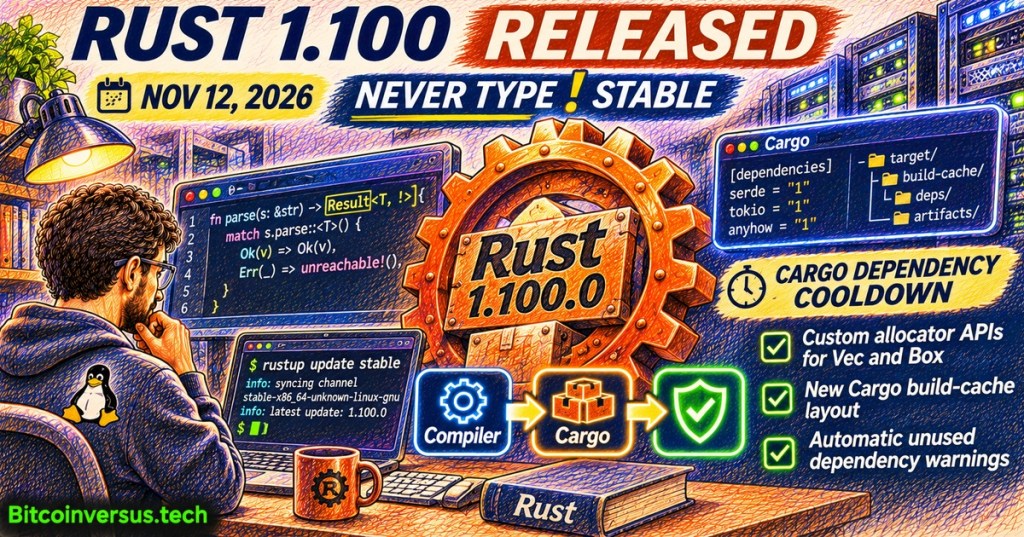
Rust 1.100 arrived on November 12, 2026, stabilizing the programming language’s long-delayed never type and delivering new memory-management and dependency controls. The milestone follows a decade of work on the ! type, while Cargo 1.100 adds an optional delay before newly published package versions can be selected. Developers using Rust in infrastructure, embedded systems or security-sensitive applications should review both the new APIs and the limited compatibility risks.
Rust compiler contributor waffle explains the never type and its stabilization difficulties at RustWeek 2026, recorded May 19 and published June 11 by RustNL. The talk predates Rust 1.100 and is explanatory background—not footage of the November release. Credit: RustNL / YouTube.
Rust can finally name an impossible value
The Rust Release Team says stabilization followed 10 years and five unsuccessful attempts. In Rust, ! is an uninhabited type: no possible runtime value can have that type. Diverging operations such as ending a process or returning early are represented by never-producing expressions. Earlier compiler versions allowed some never-type uses but did not allow developers to name ! freely in all type positions.
Rust 1.100 permits signatures such as Result<T, !>, expressing a computation that can produce a successful value but cannot produce an error alternative. The existing Infallible type becomes an alias for !. That makes impossible branches clearer to the compiler and library users without promising that ordinary Rust programs can no longer fail.
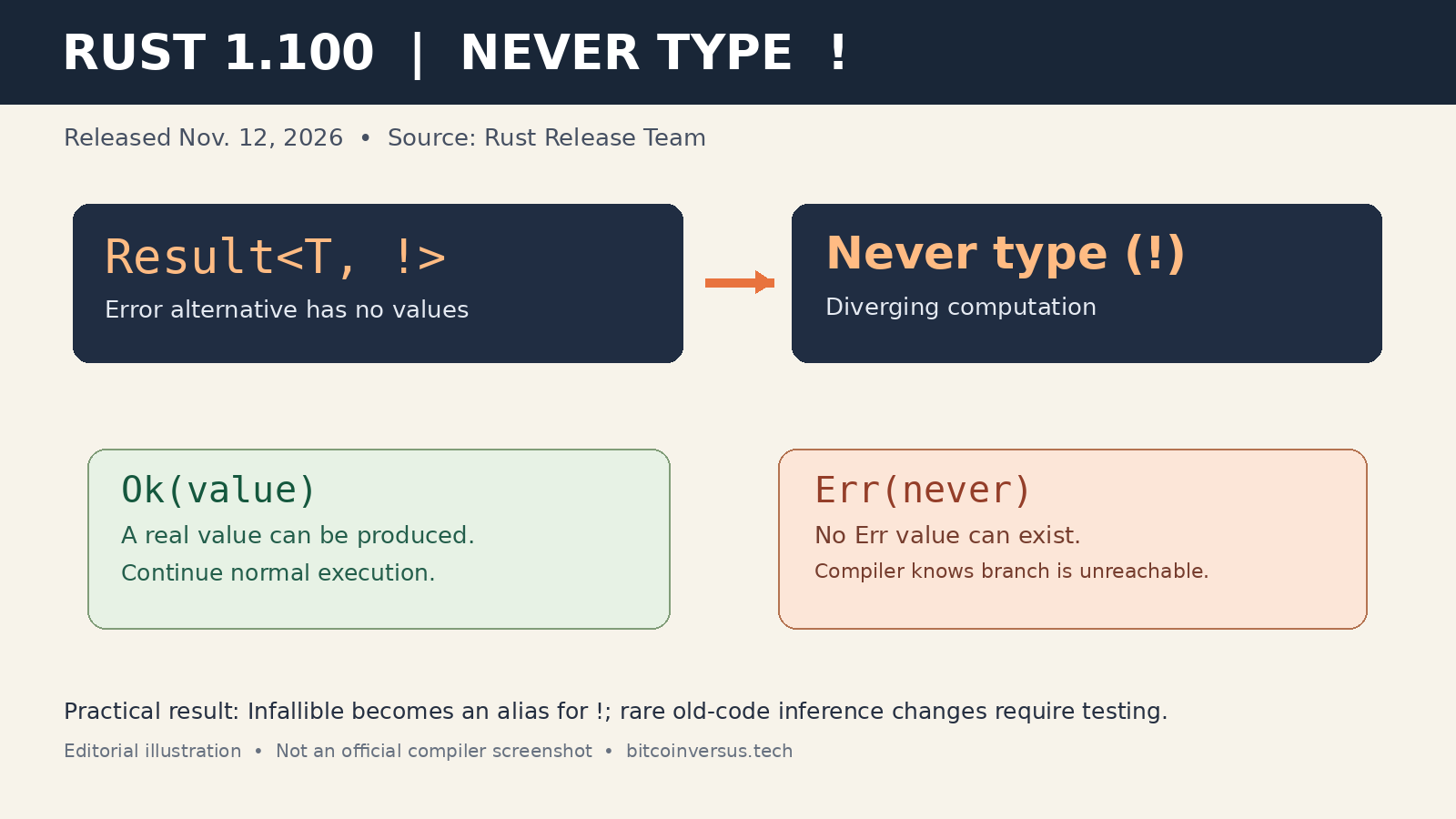
One compatibility change deserves attention: older Rust editions now use ! rather than () as the fallback in ambiguous never-type inference. The team prepared future-compatibility warnings, but rare crates can still fail to compile. Existing rustup and Cargo workflows remain a useful starting point for testing a project on the new stable toolchain.
Custom allocators and safer cleanup patterns
Rust 1.100 also stabilizes core pieces of the Allocator interface for Vec and Box, giving library authors more control over where certain objects allocate memory. The broader allocator API is not fully stabilized across every collection type. A new DropGuard helper can invoke cleanup logic on scope exit or be dismissed after successful completion, supporting transactional rollback patterns.
Those additions complement the language’s established ownership and borrowing rules. They do not automatically make foreign interfaces safe or replace the testing required around unsafe code.
Cargo introduces a package-release waiting period
Cargo 1.100 stabilizes an optional minimum publish age. A project can configure global-min-publish-age = "3 days" under [registry] in .cargo/config.toml. Cargo then ordinarily skips newly published dependency versions during resolution until the waiting period elapses. An already locked version can remain selected, and cargo install ignores the rule.
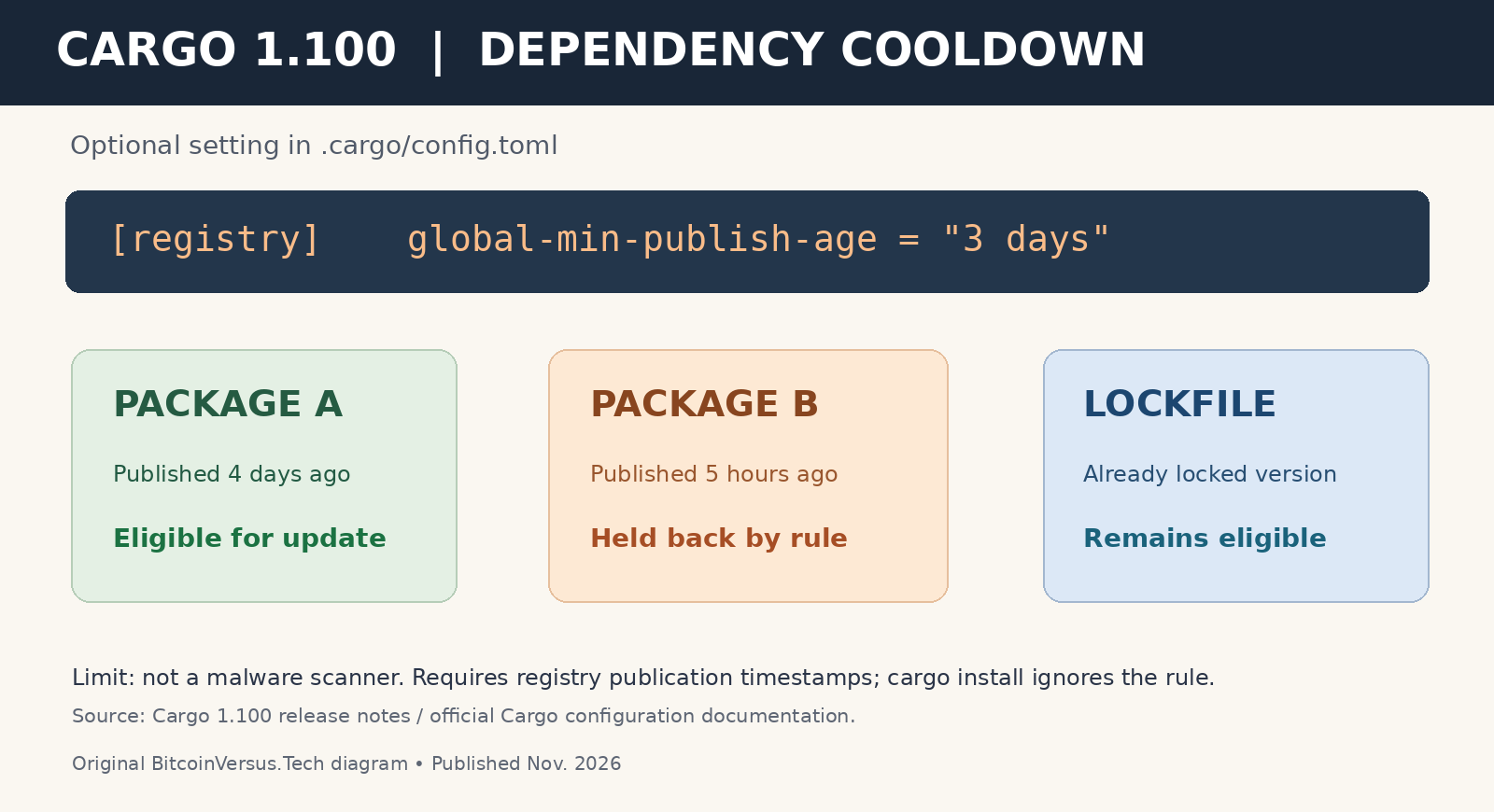
A cooldown may give maintainers and automated scanners time to discover malicious or broken releases before an update reaches more users, but it is not a substitute for vulnerability scanning, lockfiles or package review. The policy depends on registries providing publish timestamps. Cargo also introduces warnings for unused dependencies and reorganizes build-cache paths to reduce collisions between configurations and Git worktrees.

Previous BitcoinVersus.Tech reporting covered Rust 1.99’s compiler changes, recent compiler benchmark improvements and Discord’s Rust adoption. The 1.100 release addresses language expressiveness and software supply-chain controls rather than establishing a universal runtime performance increase.
Developers can update with rustup update stable, then run their full build, tests and linting before changing production toolchains. Projects relying on custom build-artifact paths or never-type inference should receive additional scrutiny. The practical outcome is better type expression, more allocator control and optional dependency-update friction—not automatic protection from software defects.
Primary sources: Rust 1.100 official announcement, November 12, 2026; Rust 1.100 compiler release notes; official Cargo configuration and publish-age semantics; Cargo 1.100 changelog; RustWeek speaker’s original never-type talk, published June 11. All functionality and compatibility details are based on the official project documentation; no local Rust 1.100 compilation or dependency-resolution test was performed.
Editor’s Note: Rust 1.100 was released November 12, 2026. The never type, selected allocator features, DropGuard, Cargo’s minimum publish age and the new cache layout are documented stable changes; supported APIs and known compatibility exceptions are explicitly distinguished. The original 1200 × 630 colored-pencil featured cover and two in-story diagrams are editorial illustrations, not official compiler screenshots or verified code execution. The RustWeek video and thumbnail are genuine educational media predating the release. The YouTube shortcode’s rendered HTML, independent playback and mobile appearance are treated as separate checks; no unperformed test is claimed. The Rust logo is used referentially without implying endorsement by the Rust Foundation.

BitcoinVersus.Tech is volunteer-run and publishes independent educational technology reporting. An optional 5,000-satoshi donation supports ongoing research. Scan the original QR from a second screen with a compatible Bitcoin wallet; on mobile, use a wallet that supports scanning a saved image. Independently verify the recipient address 3C9o19EH5HSiwEPyCTmEKzxhNCbo2X6TTb and the payment amount before sending. Bitcoin transfers are generally irreversible.
We volunteer daily to ensure information on the BitcoinVersus.Tech platform is Verifiably True. Coverage is educational and informational and does not constitute financial or investment advice.


Leave a Reply