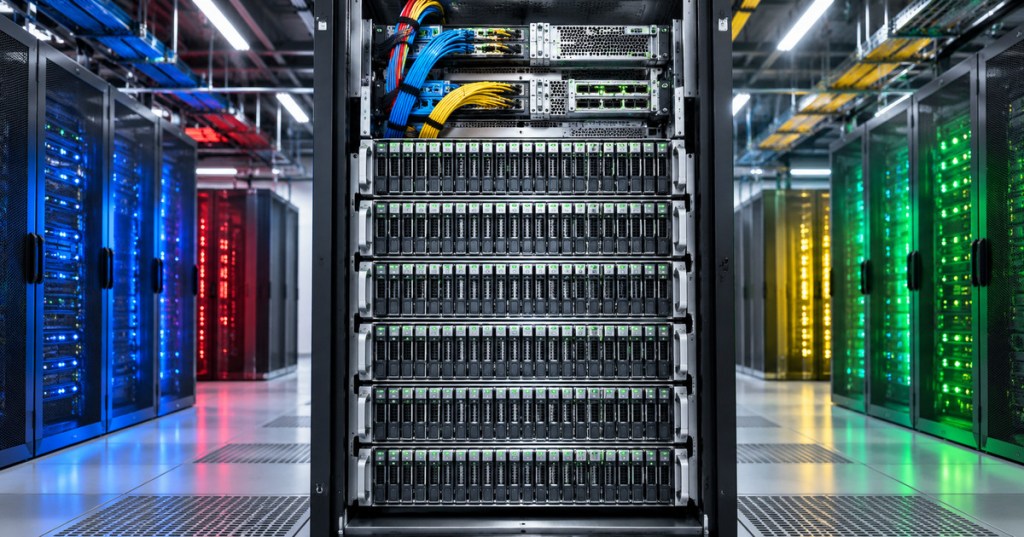
Google Cloud has launched its Z4M storage-optimized machine series for artificial-intelligence training pipelines, parallel file systems and high-throughput databases. Announced on November 6, 2026, the generally available Compute Engine family offers virtual machines and bare-metal configurations with up to 168,000 GiB of local Titanium SSD storage and 400 Gbps of internal networking. Availability is limited to selected regions. The figures describe upper-end configurations rather than performance every customer will receive.
Z4M targets a problem familiar to large AI clusters: accelerators can sit idle while nearby systems fetch checkpoints, move training data or retrieve stored key-value cache entries. SSD means solid-state drive, while remote direct memory access, or RDMA, lets network hardware transfer data with less CPU involvement. The new machines emphasize storage density and fast data movement instead of placing GPUs inside every storage server.
Dense storage for AI and databases
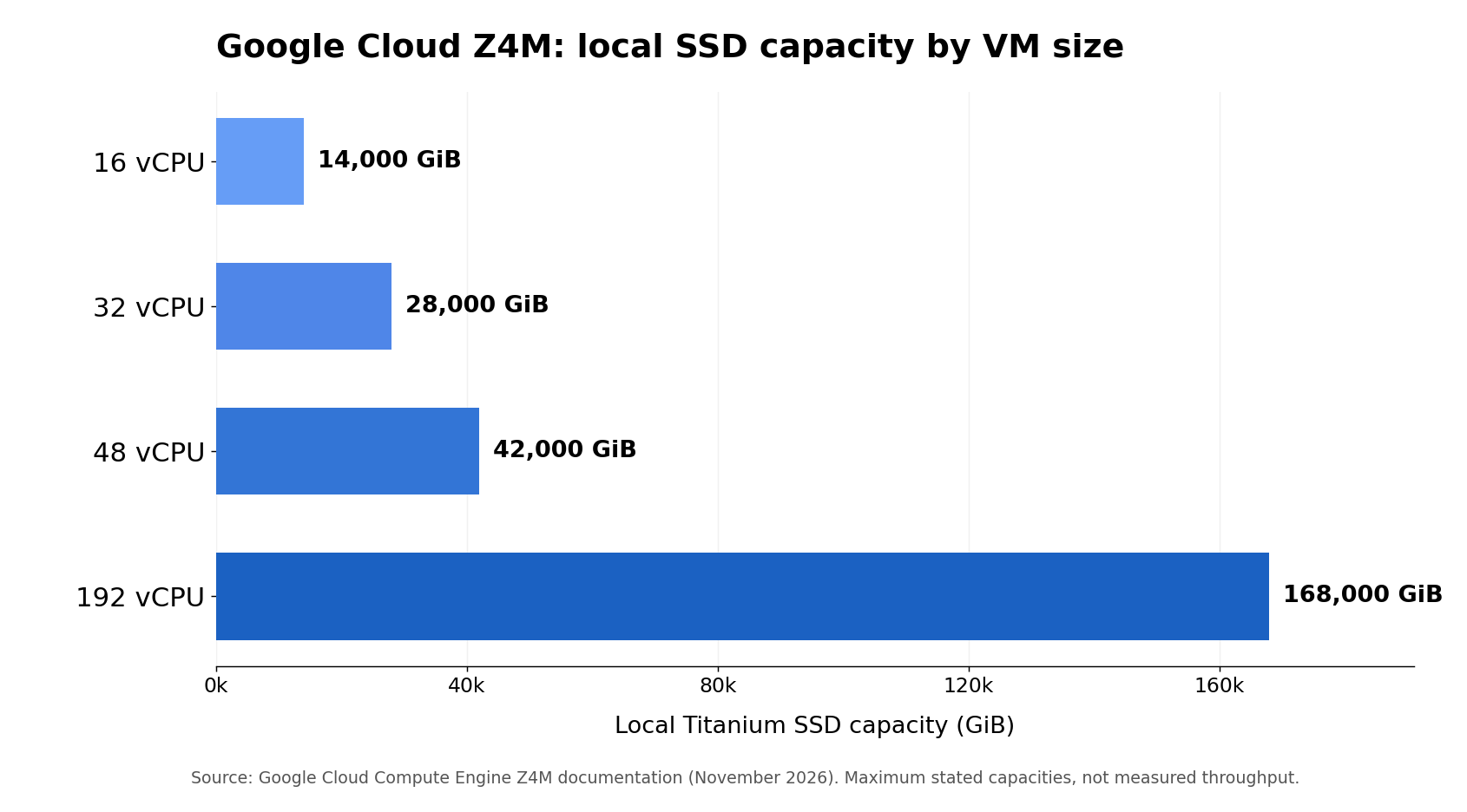
Google lists four principal VM sizes with 16, 32, 48 and 192 virtual CPUs, providing 14,000, 28,000, 42,000 and 168,000 GiB of local SSD respectively. The largest VM carries up to 1,488 GB of RAM; the 192-vCPU bare-metal option lists 1,536 GB. A virtual CPU represents one hardware thread, not necessarily an entire physical processor core. Z4M uses fifth-generation Intel Xeon Scalable processors and Google’s Titanium offload technology.
A key application is keeping storage close to the GPU and TPU clusters performing model training and inference. Google Cloud’s separate A5X Vera Rubin launch focuses on accelerator hardware; Z4M addresses the data-feeding side of the infrastructure. Direct-memory-transfer fundamentals are explored in BitcoinVersus.Tech’s RDMA programming guide.
Throughput claims need careful reading
Google advertises up to 15.6 million random-read input/output operations per second (IOPS) and 75,600 MiB/s of sequential-read throughput. Its announcement describes improvements of up to 70% in local-SSD performance and 110% in throughput against Z3, plus up to 60% lower data-access latency with RDMA compared with TCP networking. All are vendor-reported upper-end comparisons; workload, configuration and benchmark conditions determine actual results.
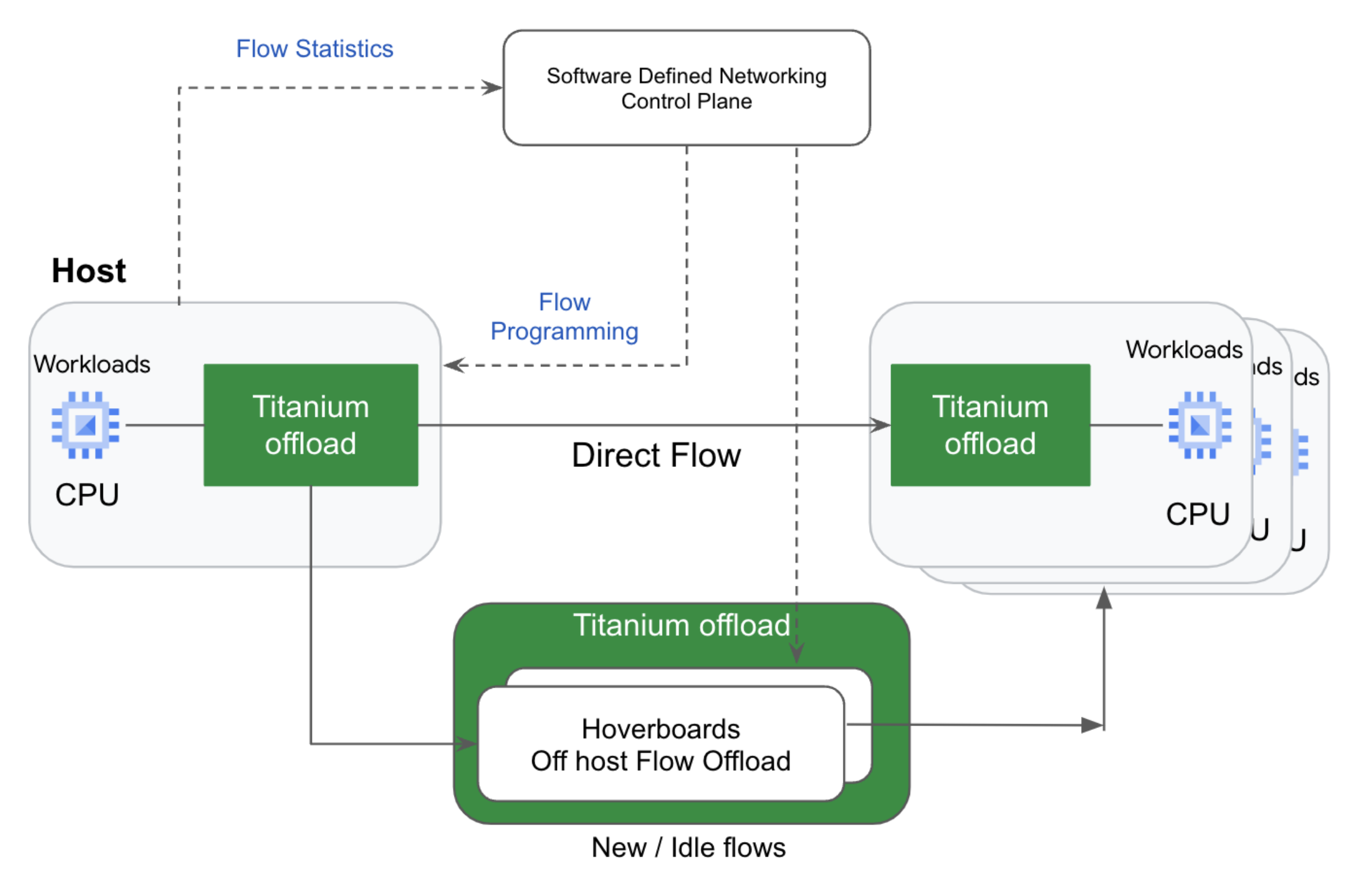
Titanium shifts selected networking and storage processing away from host CPUs. Google says its 400-Gbps ceiling applies to two-network-interface configurations between compute instances; internet egress is separately capped at up to 50 Gbps. Engineers should not interpret the internal link rating as public internet speed. For broader context, BitcoinVersus.Tech previously covered Oracle’s RDMA resilience design and the fundamentals of direct memory access across CPUs and PCIe.
Practical restrictions remain
Google’s technical documentation states that Z4M machines cannot have GPUs attached directly, do not support Windows images and cannot use custom machine types. Live migration is restricted to VM configurations with no more than 42,000 GiB of Titanium SSD, and enabling Cloud RDMA disables live migration. Larger instances or RDMA configurations must be restarted for maintenance under supported data-persistence procedures. Local SSD should not be mistaken for an independently replicated backup.
Those constraints affect capacity planning. Z4M can complement accelerator fleets, including the high-bandwidth networks described in BitcoinVersus.Tech’s 102.4-Tbps Meta network-rack report, but deployment decisions still require testing application IOPS, recovery behavior, regional availability and total infrastructure cost. The November launch establishes commercial availability of a storage-focused cloud family, not an independently validated breakthrough for every AI workload.
Primary sources: Google Cloud’s November 6 Z4M announcement; Compute Engine machine types and restrictions; Local SSD persistence guidance; and Google’s Titanium architecture reference.
Editor’s Note: Z4M maximum capacity, IOPS, bandwidth and performance improvements are Google-published specifications and company comparisons, not independent BitcoinVersus.Tech test results. The 1200 × 630 featured artwork is conceptual, not a photo of an identified Z4M installation. The Google Cloud Tech video was published in 2020 and explains Local SSD generally rather than documenting Z4M. Live playback and mobile layout require a separate rendered-page check.
Support BitcoinVersus.Tech
To support independent technology reporting, scan the original QR below for an optional 5,000-satoshi contribution. Mobile readers can display the article on another device and scan with a compatible Bitcoin wallet, or use a wallet’s image-scanning feature where available. Verify the destination and amount before confirming payment.

We volunteer daily to ensure the information on this platform is Verifiably True. If you would like to support the research, please scan QR code.


Leave a Reply