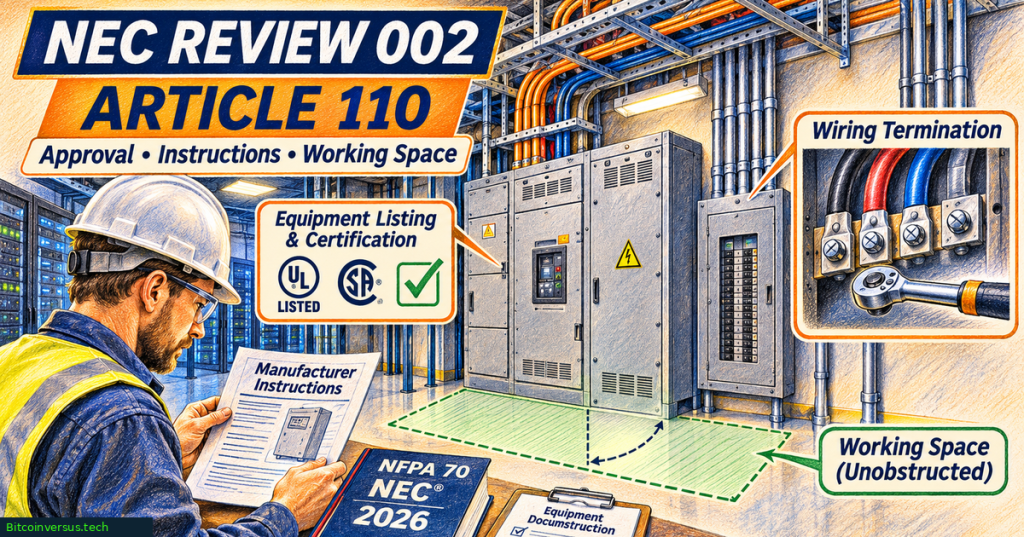
NEC Review 002 moves from identifying the governing electrical code to evaluating an actual equipment installation. Article 110 of NFPA 70 covers foundational requirements for equipment examination, approval, installation and working space. The 2026 National Electrical Code is the current publisher edition, but a project’s adopted edition, local amendments and authority having jurisdiction (AHJ) remain controlling. Begin with NEC Review 001 if code adoption and jurisdiction are unfamiliar.
Video: Mike Holt, “Are All Terminals Rated 75 Degrees C?” (2020). The publisher’s free educational video examines terminal temperature ratings under Section 110.14; its examples predate the 2026 NEC and require comparison with the locally adopted edition.
1. Check approval and equipment identification
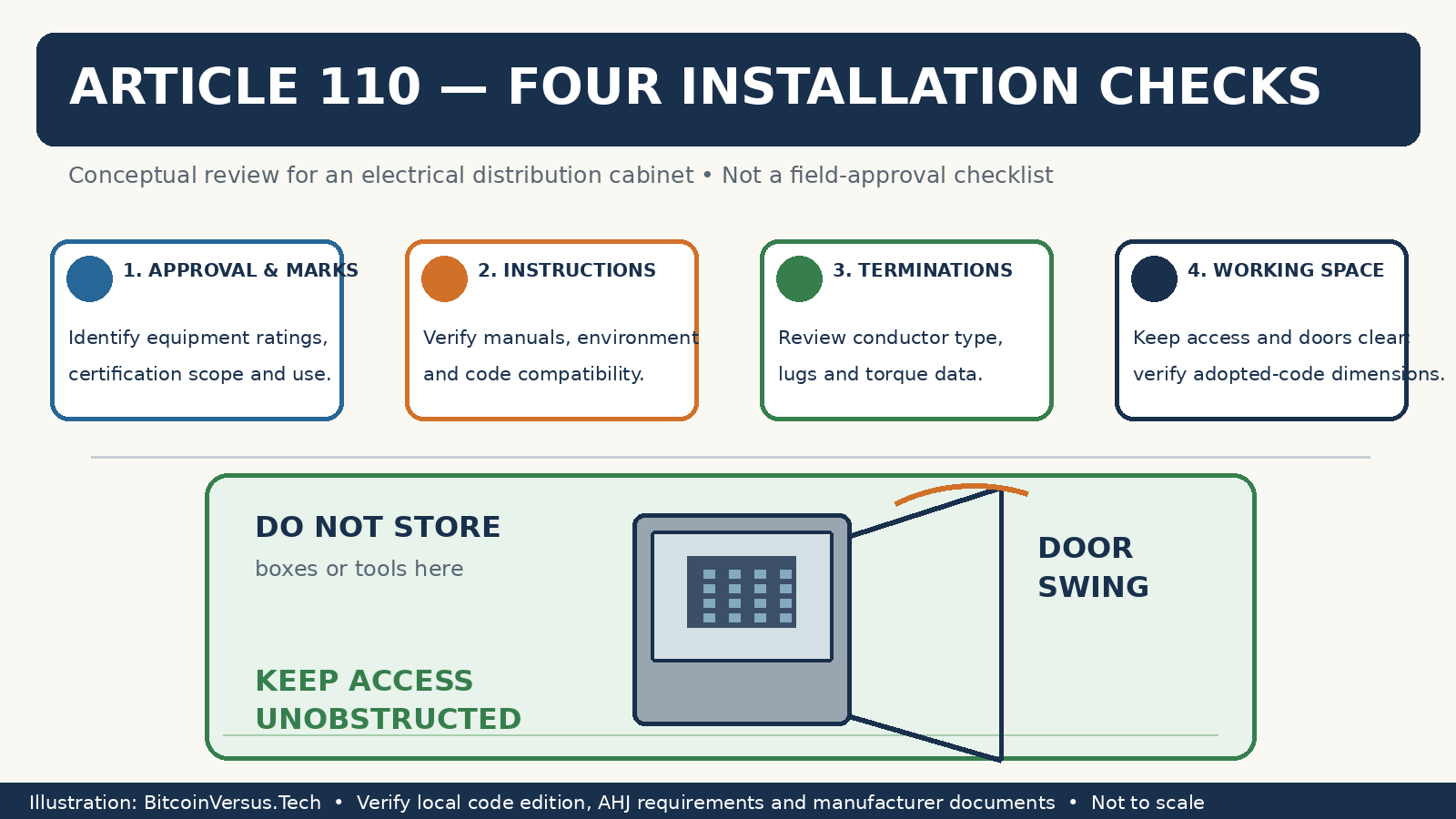
An electrical cabinet or distribution assembly must be suitable for its intended service. The review begins with its nameplate, voltage and current ratings, enclosure environment, listing or other acceptable approval evidence, and the equipment’s intended use. A mark alone does not establish that every installation configuration is approved. UL Solutions explains that its certification marks identify products covered by particular evaluations. Modified or noncertified equipment may require review through an AHJ-accepted process; UL’s field-evaluation program is one example, not automatic approval.
2. Follow instructions without displacing the code
Section 110.3(B) addresses installation and use in accordance with instructions included in product listing, labeling or identification. The 2026 edition clarifies that manufacturer guidance cannot reduce applicable NEC requirements. Minnesota’s Department of Labor and Industry explicitly discusses the change in its 2026 NEC FAQ; independent technical educator Mike Holt reaches the same conclusion in his 2026 Article 110 review. If a product instruction conflicts with a required safety provision, do not invent an exception: stop and refer the issue to the responsible designer, manufacturer and AHJ.
For a data-center assembly, verify mounting, airflow clearances, cable-entry limitations and any manufacturer-approved distribution components before use. OSDCTC.002 on rack power distribution covers related power-path concepts; redundant feeds do not excuse an unsuitable enclosure or unauthorized modification.
3. Respect terminal compatibility and connection quality
Article 110.14 addresses electrical connections, including the suitability of terminals and splices. A terminal identified for one conductor material, size, temperature class or number of conductors cannot be assumed suitable for another. Specified tightening torque matters where applicable, but a random wrench setting is not an acceptable substitute for product instructions. Incorrect terminations can increase contact resistance, heating and failure risk. OSHA’s 29 CFR 1910.303 separately addresses equipment examination, installation, use and electrical connection safeguards in applicable workplaces.
Video: Rocky Broad Solar, “NEC 110.26 Explained | Electrical Working Clearances & Dedicated Space Requirements” (September 25, 2025). The installer-led lesson illustrates workspace and access checks. View its measurements as instructional examples, not a substitute for the adopted code and equipment-specific conditions.
4. Keep electrical working space usable
Section 110.26 concerns access and working space around electrical equipment. Required depth, width, height, door movement and egress depend on the equipment and applicable rules; a universal floor stencil is not sufficient. The 2026 update adds clarity on evaluating access when doors swing into a required egress route. OSHA also requires clear working space for applicable equipment and prohibits storage in designated working areas. Use actual floor plans, door swings and the governing code to verify the installation, including during future facility changes.
Review questions and limits
Knowledge check: (1) Does a manufacturer’s installation sheet cancel a NEC requirement? (2) Does a certification mark approve any field modification? (3) Can materials or conductor count be assumed interchangeable at a terminal? (4) Is a clear cabinet door enough to establish compliant egress? Answers: No to all four; each decision requires the exact product, installation and governing provisions.
Electrical safety during examination and servicing remains a distinct requirement. The arc-flash engineering lesson covers hazardous energy and boundaries; the data-center redundancy lesson covers failure domains. Article 110 education is not authorization to open energized equipment or alter an approved installation.
Sources and editorial note (November 15, 2026): NFPA, 2026 NEC; Minnesota DLI, 2026 NEC FAQ; OSHA, 29 CFR 1910.303; UL Solutions, certification and field-evaluation guidance; Mike Holt, Article 110 based on the 2026 NEC. Original illustrations are conceptual. Training videos use earlier editions and must not be treated as 2026 code text.


Leave a Reply