
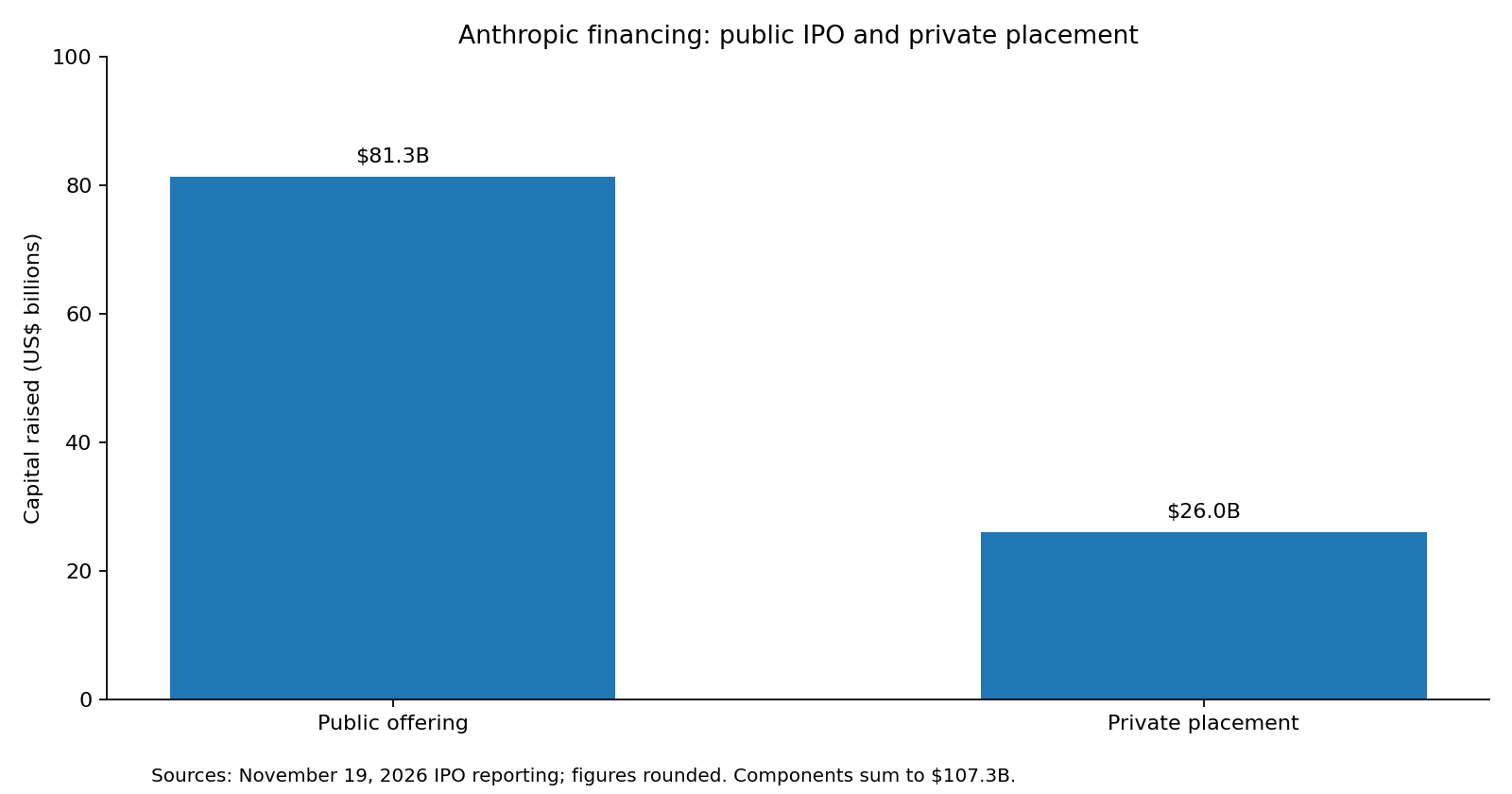
STATS | AI Finance. Anthropic priced its initial public offering at $83 a share, raising approximately $81 billion and assigning the Claude developer an equity valuation near $1.5 trillion, according to November 19 reporting. Investors have called the stock essential exposure to frontier artificial intelligence even as some question whether the valuation can be justified by future earnings. Demand for shares is not proof of durable profitability.
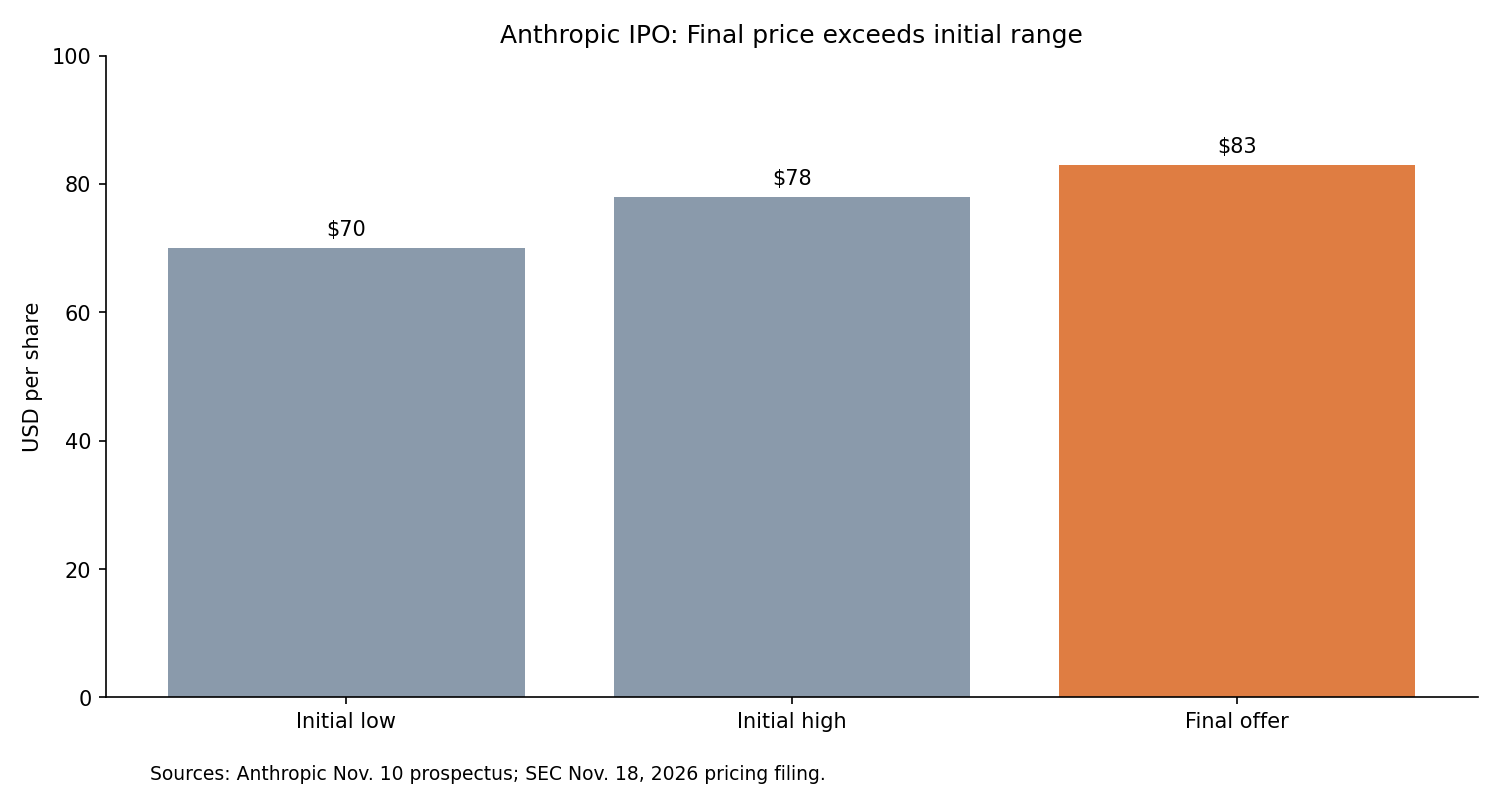
The $83 final offer price exceeds the $70 to $78 range in Anthropic’s November 10 preliminary prospectus. Compared with the $78 upper bound, the increase is ($83 − $78) ÷ $78 × 100 = 6.41%. Compared with the $74 midpoint, the increase is 12.16%. Those percentages measure IPO price revisions, not trading returns or changes in operating revenue.
Why investors call Anthropic a must-own stock
The Financial Times reported demand for roughly $500 billion of shares, substantially above the offering size. At face value, $500 billion divided by $81 billion equals approximately 6.17 times. That comparison is indicative only: reported order books can include nonbinding indications and orders that change before allocation. Large passive index funds could also eventually purchase shares, but anticipated index inclusion is not guaranteed.
Anthropic’s product portfolio includes Claude models, enterprise APIs and coding tools. Revenue growth reflects demand for model inference and developer services, yet higher usage also requires expensive accelerators, electricity, networking, storage and cloud contracts. Investors buying exposure to AI software are also indirectly betting that computing costs decline relative to revenue and that customers continue paying for premium models.
Revenue is growing faster than the company is earning profits
Anthropic’s IPO prospectus reports approximately $33.24 billion in recognized revenue for January through September 2026, compared with $4.6 billion for the entire 2025 calendar year. The periods differ in length, so their ratio is not a valid year-over-year growth rate. The prospectus also reports a roughly $1.26 billion operating loss for the first nine months of 2026, and a much larger GAAP net loss affected heavily by noncash convertible-debt remeasurement.
A rough valuation-to-nine-month revenue ratio of $1.5 trillion ÷ $33.24 billion = 45.1 is not a standard trailing-twelve-month price-to-sales multiple, because the denominator covers only nine months. Annualizing nine-month revenue mechanically would yield about $44.32 billion and an indicative ratio near 33.8, but assumes a constant run rate despite rapid growth. Neither calculation establishes fair value.
Infrastructure obligations and shareholder rights
The preliminary filing lists approximately $900.9 billion in computing and infrastructure commitments over future years. Commitments are not recognized current-period expenses, and contract timing, cancellation provisions and actual consumption affect cash requirements. Anthropic also disclosed a special founder share with 50.1% of voting power, while a long-term benefit trust can elect or remove a majority of directors. Ordinary IPO shareholders therefore have limited governance influence despite their economic ownership.
The offering connects to trends already covered by BitcoinVersus.Tech, including NVIDIA’s AI infrastructure revenue, Anthropic employee share restrictions, Goldman Sachs’ long-range revenue forecast, and the original IPO filing. Forecast revenue, recognized sales and future infrastructure commitments are separate measures and must never be added together.
What could challenge the valuation?
Competition from OpenAI, Google and lower-priced open-weight models could compress pricing. AI infrastructure spending might remain elevated even if revenue expands. Regulatory requirements, model reliability, concentration among large cloud providers and investor sentiment all affect risk. An oversubscribed offering can still fall in secondary-market trading once allocations settle and insiders become eligible to sell.
The most useful chart would compare the $70 lower bound, $78 upper bound and $83 final IPO price on a zero-baseline vertical axis in US dollars per share. A separate valuation discussion should identify the fully diluted share basis rather than treating offering proceeds as company value. Revenue and contractual obligations should never share an unlabeled axis.
Editor’s note, sources and disclaimer
The final IPO price and reported order demand are attributed to contemporary financial reporting; prospectus financial statements and governance terms are company disclosures. The original featured cover is conceptual artwork, not a photograph of the Nasdaq listing. Sources: Financial Times, November 19, 2026; Anthropic preliminary IPO prospectus, November 10, 2026; Associated Press, November 19, 2026. Financial analysis is informational and does not constitute investment advice.


Leave a Reply