Open-source Bitcoin miners are getting a new firmware option written in Rust. The WarpAxe project released version 0.1.46 on November 18, 2026, adding IPv6 connections to mining pools and correcting a fan-controller setting on Nerd-family ASIC boards. The changes target operational reliability, not faster Bitcoin block discovery or a new ASIC chip. Developer tests support specific hardware combinations, but the software remains an early alternative to established AxeOS, NerdOS and ForgeOS firmware.
HarloLabs’ September 2026 Naja Duo hardware review shows a dual-BM1373 Bitcoin miner. The video predates WarpAxe 0.1.46 and does not verify its firmware.
Pool connections now support IPv6
According to the official release notes, a miner may connect to a mining pool over IPv6 when both endpoints support it. If IPv6 has not answered after roughly 0.25 seconds, an IPv4 connection attempt begins; the first successful path wins. The developer tested native dual-stack connections, IPv4-only pools, TLS and Stratum V2 on a Bitaxe Gamma. A network that silently drops IPv6 traffic was not hardware-tested.
The firmware derives its IPv6 address from the device’s MAC address, potentially exposing a stable hardware identifier to connected pools. Its web interface is restricted to local-network IPv6 access. Operators should review the network setting rather than assuming every IPv6 deployment is private. Our Stratum and mining-pool guide explains the protocol between ASICs and pools.
A new board joins the tested fleet
The project began running a Bitaxe Naja Duo with two BM1373 ASICs on November 12, after firmware version 0.1.44 addressed initialization and display handling. Its documentation also identifies running devices from the Bitaxe Gamma, NerdQAxe++, NerdOctaxe, NerdAxe Gaia, BitForge Nano and NerdNOS families. Other supported profiles, including the Gamma Hex, have not undergone the same hands-on validation. A listed board profile is not proof that a particular revision can safely be flashed.
The distinction matters for hardware owners. BitcoinVersus.tech previously covered the six-chip Gamma Hex hardware, but its presence in WarpAxe’s profile table does not establish a successful operating test. The Naja Duo’s reported chip counters and tuning ceilings are developer observations, not independent endurance certification.
Solo Blockhunter’s August 2026 walkthrough demonstrates the established AxeOS 2.15 firmware update process. It is background context, not an installation guide or verification of WarpAxe.
A fourfold change in fan signaling, not fan speed
The latest release corrects the EMC2302 controller’s pulse-width modulation setting on Nerd-family boards. The intended PWM frequency was 19.53 kHz, while an incorrectly positioned register field produced 4.88 kHz, according to the maintainer. The frequency is approximately four times higher after correction, but PWM frequency is not the same measurement as fan revolutions per minute.
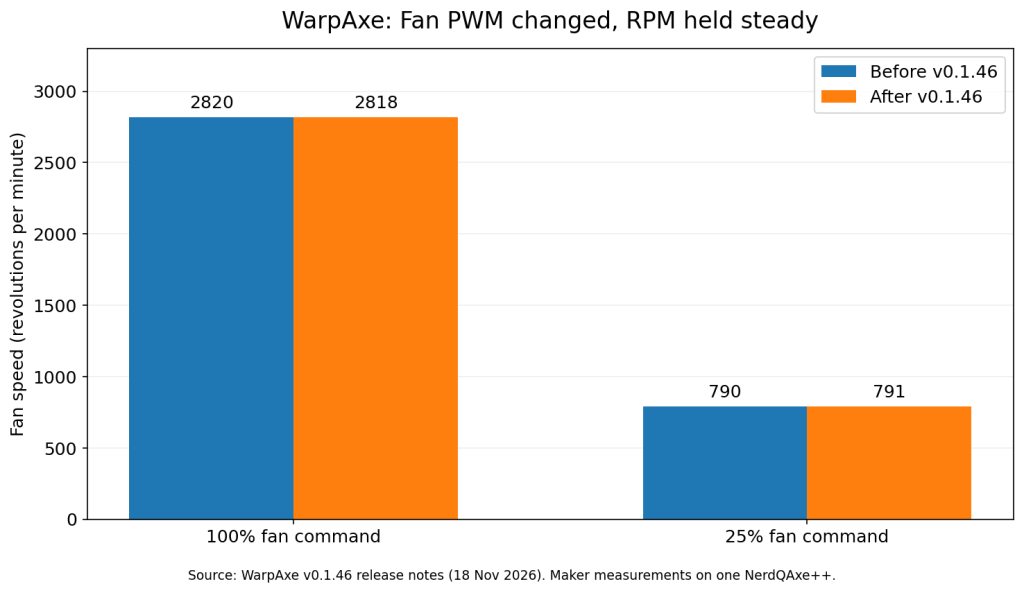
The maker’s measurements show almost identical speeds: 2,820 versus 2,818 RPM at full command and 790 versus 791 RPM at 25% command. The practical improvement is a corrected control signal, not a claimed fourfold cooling gain. Those four observations come from one NerdQAxe++ test, so they cannot establish noise, lifetime or temperature changes across every compatible fan.
Firmware safety remains the deciding factor
WarpAxe supports Stratum V1 and V2, signed online update images and rollback when an update fails to start. Rollback requires the relevant bootloader from firmware 0.1.22 or later; an older installation may need a USB reinstall first. The maker also warns against flashing boards that exist only as untested profiles. Mining operators should verify board revision, power supply, cooling, configuration backups and accepted shares before wider deployment.
For context, our NerdQAxe TLS regression report shows how even security improvements can interrupt pool connectivity. Our safe firmware flashing lesson covers recovery planning. WarpAxe’s Rust drivers and published tests are useful contributions, but stable hashrate, electrical safety and verified share submission still need real-world checks on each machine.
Sources and verification
Primary sources: WarpAxe release 0.1.46, November 18; release history, including 0.1.44 and 0.1.45; supported-board testing and risk disclosures; Bitaxe Naja Duo open-hardware repository. The speed and board measurements are developer reports, not BitcoinVersus.tech laboratory tests.
Editor’s Note: We volunteer daily to ensure the credibility of the information on this platform is Verifiably True. If you would like to support our work and help further secure the integrity of our research initiatives, please scan the QR code below to donate 5,000 sats.

Disclaimer: BitcoinVersus.tech provides independent educational journalism, not financial advice, firmware safety certification or device-repair instruction. Flashing an incompatible image or modifying voltage and clock settings can damage hardware, interrupt mining or create a safety hazard. The featured cover is original conceptual artwork, not a photograph of the WarpAxe project’s devices.


Leave a Reply