
A new 131-page security analysis offers Bitcoin developers a deeper mathematical examination of SHRINCS, a proposed defense against future quantum computers. Dated November 18, 2026, the research was announced publicly on November 19 by Blockstream cryptographer Mikhail Kudinov and collaborators. It is a research draft, not a Bitcoin software activation, completed audit or guarantee that funds are quantum-safe.
Blockstream Research director Jonas Nick explained the SHRINCS approach at OPNEXT 2026 in April. Official technical background, recorded before the November security paper.
What the new analysis actually adds
SHRINCS, short for Shrunken SPHINCS, uses hash-based signatures built around SHA-256, a cryptographic primitive already central to Bitcoin. The August working-group specification described the signing algorithms but flagged formal security proofs as unfinished. Kudinov’s new repository now supplies a main security analysis and supporting papers covering classical bounds and hash-function properties.
The authors examine attacks under stated classical and quantum security models. Contemporary reporting describes modeled classical security bounds of approximately 121.4 to 122.7 bits, versus a nominal 128-bit classical design target. Such calculations depend on their assumptions and parameters; they are not an empirical demonstration of unbreakable cryptography. The research repository explicitly warns that the drafts lack sufficient peer review and independent auditing and may contain errors.
The wallet recovery problem
SHRINCS has two signing paths under one public key. A smaller stateful path tracks which one-time signing keys were previously used. Losing or incorrectly restoring the counter can reuse signing material; a successful forgery could then authorize theft. A larger stateless fallback avoids relying on the saved counter. That safeguard carries a substantial data cost.
A seed phrase can restore secret-key material, but it cannot necessarily reconstruct a lost record of which one-time signatures have already been spent. Safe wallet software would therefore need to disable the compact signing path after uncertain recovery, backup cloning or state synchronization. The hard problem is not simply fitting a cryptographic routine onto a hardware wallet. It is protecting ordinary users through device loss, upgrades and recovery.
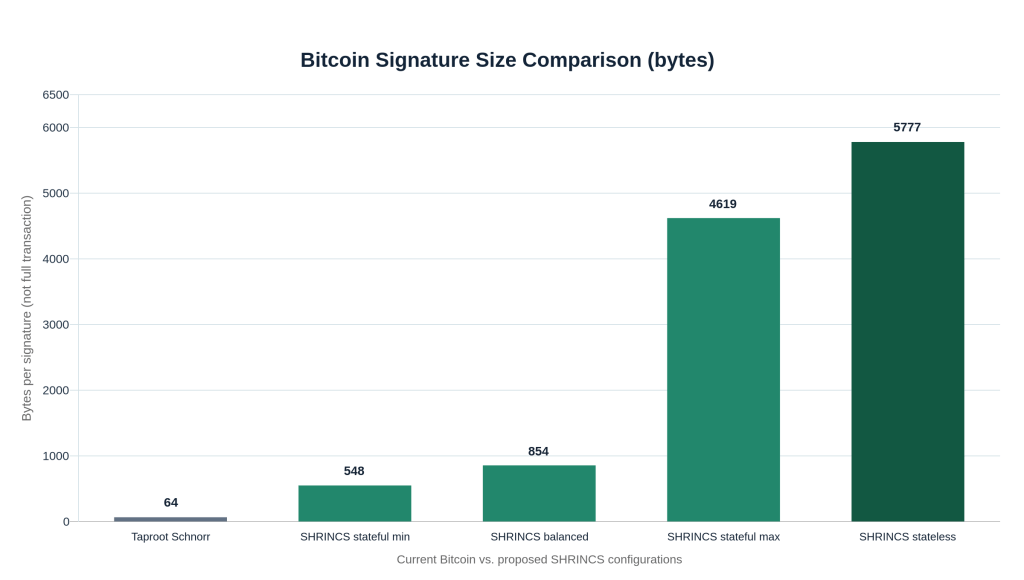
How much block space would signatures use?
Today’s Taproot Schnorr signatures are 64 bytes. The SHRINCS draft proposes stateful signatures from 548 to 4,619 bytes, including an 854-byte balanced-tree configuration, and a 5,777-byte stateless fallback. By direct division, 548 ÷ 64 = 8.56 times the Schnorr signature size; 5,777 ÷ 64 = 90.27 times. Those ratios compare signature fields alone, not complete transaction weight or network fees. Actual costs would depend on witness treatment, input counts, future consensus rules and demand for scarce block space.
Bitcoin Rails interviewed SHRINCS co-author Conduition in August 2026. The verified source video details wallet state, hash trees and the proposed signature formats; it does not present the November paper.
Does Bitcoin need to upgrade now?
Bitcoin’s existing elliptic-curve signatures could become vulnerable to a sufficiently capable future quantum computer. No publicly demonstrated machine can currently extract ordinary Bitcoin spending keys at the required scale. Our quantum-computing guide explains the distinction between theoretical algorithms, noisy physical qubits and fault-tolerant machines.
SHRINCS also differs from Blockstream’s earlier hardware-wallet signing demonstrations, which measured prototypes rather than approved Bitcoin transactions. Coinbase’s migration warning and the November 19 finance-regulator report address broader preparedness, not proof of an imminent attack.
Even if independent cryptanalysts validate SHRINCS, adoption would require a separate Bitcoin consensus proposal, implementation review, wallet support and agreement on handling older outputs. The near-term advance is an analysis other specialists can try to break. That scrutiny, rather than a countdown to quantum disaster, determines whether the proposed design can move forward.
Primary sources and editorial verification
- SHRINCS Security Analysis repository, Mikhail Kudinov, November 18–19, 2026. Documents are marked unaudited.
- SHRINCS draft specification and Bitcoin development mailing-list announcement, August 26, 2026.
- Decrypt’s reporting, November 19, 2026, for research context and security-bounds characterization.
Reporting note: The featured colored-pencil image is original conceptual artwork, not a photograph of a live quantum attack. Both video embeds are historical educational material. The chart compares disclosed draft signature sizes only. The main 131-page PDF was identified via the authors’ public repository; detailed page-by-page independent proof validation was not performed. SHRINCS remains experimental and should not be deployed to protect funds.
Editor’s note: BitcoinVersus.Tech publishes technology reporting for informational purposes only and does not provide investment or cybersecurity assurances.


Leave a Reply