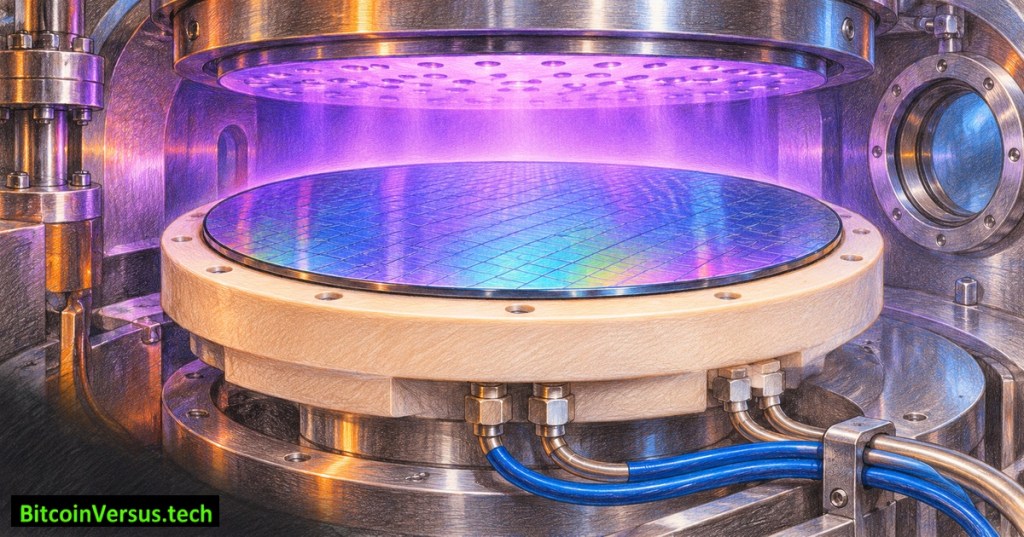
OSSTC.019 explains a counterintuitive semiconductor manufacturing technique: a wafer held inside a vacuum chamber can be cooled using a thin layer of helium gas. Plasma etching deposits energy into a wafer, and uneven temperature can change the resulting feature dimensions. An electrostatic chuck (ESC) holds the wafer against a temperature-controlled support, while backside gas improves heat transfer across small spaces between the two surfaces. The lesson follows OSSTC.018 on plasma endpoint detection.
Why an electrostatic chuck needs helium
The Lam Research technical glossary defines an ESC as a wafer support that uses a static electric field rather than mechanical or vacuum clamping. Buried electrodes and a dielectric surface provide the holding force. However, real wafer and chuck surfaces are not perfectly flat. In low-pressure surroundings, microscopic gaps create thermal resistance. Controlled helium between the surfaces improves heat conduction without filling the entire etch chamber to the same pressure.
Gas pressure, clamping force, wafer bow, surface cleanliness, and the chuck’s internal cooling system all influence temperature. Excessive backside pressure can oppose clamping and increase gas escape around the wafer perimeter. A small flow reading is not inherently evidence of insufficient cooling: a well-sealed gas pocket may require little makeup flow.
What helium leak-by actually indicates
A 2022 CS MANTECH study by Qorvo researchers tested 150 mm wafer-carrier assemblies spanning 2–52 µm of bow under backside helium pressures of 2–20 Torr. Experiments used chuck voltages of 5, 7.5, and 10 kV. Greater bow generally increased leak-by flow under less favorable clamp conditions. In the study’s equipment, 20 sccm marked a tool-fault threshold. Neither the voltage levels nor that flow threshold should be transferred to another tool as operating instructions.
The findings reveal a trade-off. Lower backside pressure can help maintain grip on a bowed assembly but may narrow thermal-management margin. Higher clamping voltage improved performance under some tested conditions but has equipment-specific limits. Incoming wafer planarity matters as much as control settings.
Diagnose temperature problems without disturbing the chamber
Begin with read-only records: chamber ID, wafer size, recipe identifier, chuck temperature, backside helium pressure and flow, clamp state, alarms, and timestamps. Compare matched recipe steps and prior known-good wafers. Rising helium makeup flow alongside pressure-control difficulty can suggest poor sealing, deformation, contamination, or a hardware problem. OSSTC.016 explains chamber vacuum leaks and helium leak tracing, a different diagnostic question.
Where qualified wafer temperature mapping is available, correlate spatial hot spots with metrology results. A published GLOBALFOUNDRIES/KLA study links wafer temperature differences with etch measurements. For adjacent training, consult OSSTC.010 on plasma equipment and OSSEC.017 on contamination protection.
Safety and knowledge check
Electrostatic chucks combine high voltage, vacuum, process gases, and potentially hot surfaces. Never defeat interlocks, open an energized chamber, alter voltage, or change helium pressure for a classroom exercise. Authorized personnel must follow equipment procedures and site safety controls. Question: At a fixed helium-pressure target, why might abnormally high makeup flow be concerning? Answer: Gas may be escaping through a poorly sealed wafer-to-chuck interface rather than failing to reach the wafer.
Takeaway: Helium cooling works only when clamping, contact geometry, gas delivery, and temperature controls operate together. Interpreting a fault requires an equipment-specific baseline, not a universal pressure or flow number.
Editor’s note: The Qorvo measurements concern controlled experiments on 150 mm assemblies, not general production specifications. Video identities were located in public listings, but playback and mobile embedding still require independent live-player verification. The colored-pencil illustration is conceptual artwork, not an actual chamber photograph.
We volunteer daily to ensure the credibility of the information on this platform is Verifiably True. If you would like to support to help further secure the integrity of our research initiative, please scan the QR code below.



Leave a Reply