
Every processor, satellite, electric motor and Bitcoin miner operates under physical relationships that engineers cannot negotiate away. A physical constant is a quantity treated as fixed across the relevant conditions of a physical theory. Some constants set the scale of nature; others enter fundamental equations. Understanding their roles helps separate an actual physical limit from an engineering target.
In November 2018, measurement scientists voted to redefine four SI base units, with the changes taking effect on May 20, 2019. The International Bureau of Weights and Measures (BIPM) explains that the modern International System of Units now rests on seven exact defining constants.
Which constants actually define our measurements?
The seven are the caesium-133 atomic transition frequency (time), speed of light in vacuum c (length), Planck constant h (mass), elementary charge e (electric current), Boltzmann constant k (temperature), Avogadro constant NA (amount of substance), and luminous efficacy Kcd at a specified light frequency (luminous intensity). Their combined definitions establish the SI units; each constant does not independently define only one unit.
| Constant | Numerical value | Status in SI |
|---|---|---|
| Speed of light, c | 299,792,458 m/s | Exact |
| Planck constant, h | 6.62607015 × 10⁻³⁴ J·s | Exact |
| Elementary charge, e | 1.602176634 × 10⁻¹⁹ C | Exact |
| Boltzmann constant, k | 1.380649 × 10⁻²³ J/K | Exact |
| Gravitational constant, G | 6.67430(15) × 10−11 m³/(kg·s²) | Measured; uncertain |
A fixed SI number is exact by definition, not a claim that laboratory equipment measures with perfect accuracy. Contrast gravitational constant G, which still carries experimental uncertainty, or the dimensionless fine-structure constant α, approximately 1/137.036. Scientists measure and refine their values. NIST’s CODATA database supplies internationally recommended results and uncertainty estimates.
From quantum physics to silicon circuits
Planck’s relation, E = hf, links the energy of a photon to its frequency. The elementary charge supplies the electrical charge scale for electrons and transistor operation. Boltzmann’s constant connects temperature to thermal energy: kT is about 4.14 × 10⁻²¹ joules at 300 kelvin. Thermal noise, leakage, switching losses and cooling requirements all matter when chipmakers improve energy efficiency.
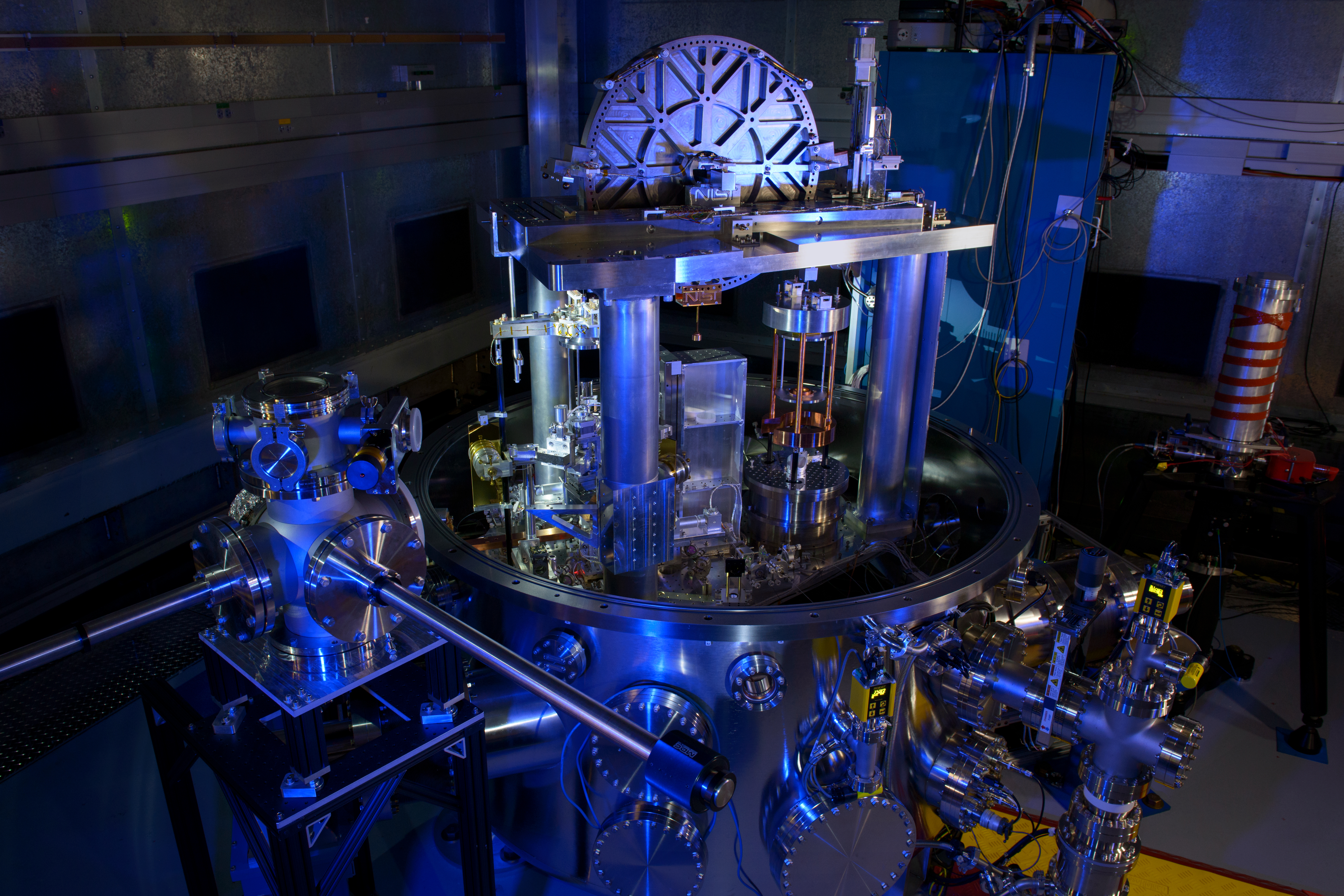
Metrology turns such equations into reproducible measurements. A Kibble balance relates electrical and mechanical power, making the Planck-based kilogram practical without a single metal prototype. The NIST apparatus pictured above illustrates why an exact definition still demands painstaking calibration, precision and uncertainty analysis.
Do physical constants establish a Bitcoin mining energy floor?
For SHA-256 ASICs, efficiency is commonly expressed in joules per terahash (J/TH). Consider hardware delivering 100 TH/s at 10 J/TH. Its implied power is 100 × 10 = 1,000 watts, before any distinction between chip power and whole-system input power. An efficiency number always needs a clearly defined measurement boundary.
A more fundamental calculation uses Landauer’s erasure limit: Emin = kT ln 2. At 300 K, the ideal minimum heat associated with erasing one bit is approximately 2.87 × 10⁻²¹ joules. Experimental work reported in Nature in 2012 tested the relationship. Importantly, one bit erased is not equivalent to one SHA-256 hash, making direct conversion into a universal J/TH floor unjustified.
Electrical design, voltage, clock speed, memory traffic, cooling and reversible-computing assumptions shape practical limits. For deeper comparisons, see our coverage of Landauer-limit experiments, compute per joule, and superconducting SHA-256 simulations. Models and prototypes are not production miner benchmarks.
What to remember
Physical constants give engineers reliable equations and meaningful comparisons. Some values are exact because the SI defines them; others are measured with uncertainty. A fundamental thermodynamic bound can constrain a specific operation without specifying the efficiency of an entire machine. Good engineering begins by naming the constant, the units, the assumptions and the measurement boundary.
Primary references: BIPM SI framework; NIST, Meet the Constants; NIST/CODATA physical constants; Bérut and colleagues, 2012.


Leave a Reply