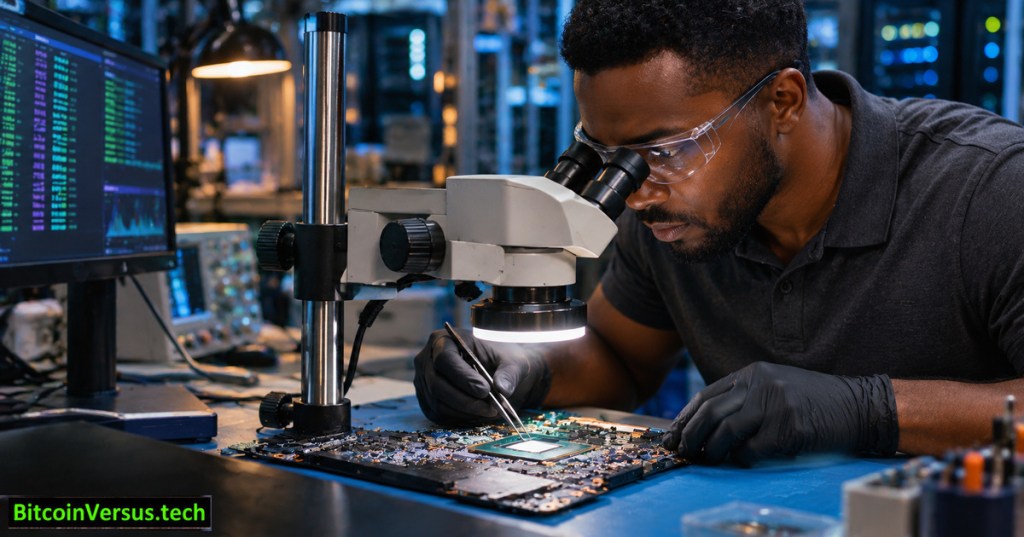
The Linux code that drives AMD’s built-in AI accelerators is reaching a version milestone. In patches reviewed in November 2026, AMD engineer David Zhang raised the open-source amdxdna kernel driver from 0.10 to 1.0 and added device recognition for NPU10 and NPU11. The changes have entered the DRM development pipeline targeting Linux 7.5, a future kernel expected in early 2027, rather than a version already shipping across Linux distributions.
A neural processing unit, or NPU, is a dedicated circuit for machine-learning tasks. Unlike a graphics card designed for broad parallel workloads, an NPU emphasizes local inference and data movement through purpose-built compute blocks. The upstream version-bump commit explicitly connects 1.0 to support for newer AMD AI Engine 4 devices, but a driver version number alone says nothing about measured performance.
Official AMD Developer Central explainer on how Ryzen AI PCs split language-model work between NPUs and integrated GPUs; published March 31, 2025. Background technology, not a demonstration of the new kernel patches. Watch on YouTube.
NPU10 and NPU11: what the code actually adds
The November device-support patch identifies NPU10 and NPU11 as NPU3 revisions 0x14 and 0x15. It adds ordinary device entries plus physical-function and virtual-function variants, matching firmware filenames and names shown to software. The two additions reuse existing NPU3 settings. Their commercial product names have not been confirmed in the reviewed patches.
AIE4 is a distinct architectural reference in the version-bump explanation. Identifying NPU10/NPU11 with NPU3 revisions does not establish that the two new device IDs are AIE4 products. Phoronix first reported the proposed Linux 7.5 integration on November 20, noting the expected late-December merge window. Until the patches reach a released kernel and distribution packages, availability remains prospective.
How an open driver puts local AI hardware to work
AMD’s kernel documentation describes a two-dimensional arrangement of compute and memory tiles. In the documented Ryzen AI hardware, each column includes four rows of compute tiles and a row of local memory. DMA engines move data between host RAM and the array. The driver coordinates device contexts and resource allocation, while an onboard microcontroller and firmware schedule work on the array.
On Linux, user software communicates with the driver through AMD’s XRT runtime and XDNA shim. Open-source compiler components such as Peano and IRON help construct workloads. However, AMD’s NPU firmware is signed and distributed as a binary, so an open driver does not make every layer of the accelerator stack open-source. The public XDNA driver repository includes source and build material for developers investigating compatibility.
Official AMD Developer Central overview of GAIA, an open-source local-LLM project; published March 18, 2025. Earlier software context, not footage of AMDXDNA 1.0 running. Watch on YouTube.
What changes for Linux builders and edge operators?
More reliable upstream support matters for compact systems running local inference, robotic controllers and private AI applications. Developers may eventually deploy models on Ryzen AI NPUs without maintaining as many out-of-tree kernel patches. Yet recognized hardware is not proof of an operational AI application: compatible firmware, compiler output, runtime libraries and model support still need validation on the exact processor and distribution.
BitcoinVersus.Tech has separately covered open Linux drivers for Bitcoin ASIC hardware, early Wi-Fi 8 kernel-driver work, open AI inference infrastructure, enterprise Linux updates, and isolated AI development environments. A recurring theme is that code availability and production readiness must be evaluated separately.
The next tests are straightforward: confirm the patch’s inclusion in an official Linux 7.5 release, identify actual NPU10/NPU11-equipped processors, validate XRT and firmware compatibility, and measure real applications using comparable models and power conditions. No throughput, latency or joules-per-token gain can be inferred from a driver-version bump.
Sources: AMD version-bump commit, November 2026; NPU10/NPU11 device-ID commit; official Linux NPU documentation; Phoronix, November 20.
We volunteer daily to ensure the credibility of the information on this platform is Verifiably True. If you would like to support to help further secure the integrity of our research initiative, please scan the QR code below.



Leave a Reply