
A magnetic memory device appears to need a magnet. Researchers led by Northwestern University have now demonstrated how to electrically write and read information in tiny structures made entirely from antiferromagnetic layers, materials whose opposing microscopic spins cancel their overall magnetization. Published in Nature on October 21, 2026, the peer-reviewed experiment establishes a new mechanism for controlling magnetic order at room temperature. The result is a working nanoscale research device, not a finished replacement for commercial computer memory.
How can a memory bit exist without an ordinary magnetic pole?
Conventional magnetic random-access memory (MRAM) commonly encodes data using ferromagnets, in which many electron spins align and create an overall magnetic moment. That stored state can be disturbed by sufficiently strong external magnetic fields. Antiferromagnets instead organize neighboring spins in opposing directions. The sum can vanish even while the material retains an ordered microscopic configuration. Readers familiar with the formation of semiconductor energy bands will recognize another example of atomic-scale structure determining electronic behavior.
The Northwestern-led team built an all-antiferromagnetic tunnel junction from two platinum-manganese (PtMn₃) layers separated by an ultrathin magnesium-oxide (MgO) barrier and placed the structure on oxidized silicon. Electrons can quantum-tunnel through the insulating barrier. Its electrical resistance changes with the magnetic arrangement, allowing a circuit to distinguish states. The effect is called tunneling magnetoresistance (TMR).
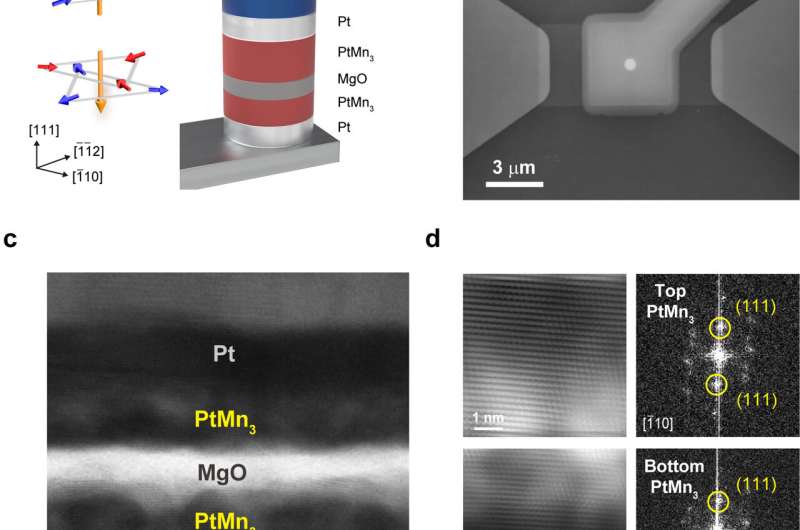
A current can switch the state even when the overall spin cancels
Writing information poses a harder question: How can an electric current turn a magnetic state when the material has no net magnetic dipole? The team reports octupole-driven spin-transfer torque, or OTT. The mechanism is associated with the collective, noncollinear arrangement of spins rather than the simple bulk spin alignment familiar from ferromagnets. The group’s theoretical model links switching to an imbalance of microscopic spin currents between magnetic sublattices. The result challenges the assumption that a spin-neutral total current cannot generate a useful torque in such a junction.
The researchers measured a 363% TMR ratio at room temperature and demonstrated current-driven switching at a current density on the order of 10 megaamperes per square centimeter (MA/cm²). The first quantity describes resistance contrast between magnetic states; the second is current per tiny device area, not 10 million amperes flowing through a full memory module. Neither number independently proves lower energy consumption, faster data access, or better lifetime than existing MRAM. Our examination of the physics of memory-switching energy explains why such comparisons need consistent device and circuit measurements.
Why the research matters for future chips
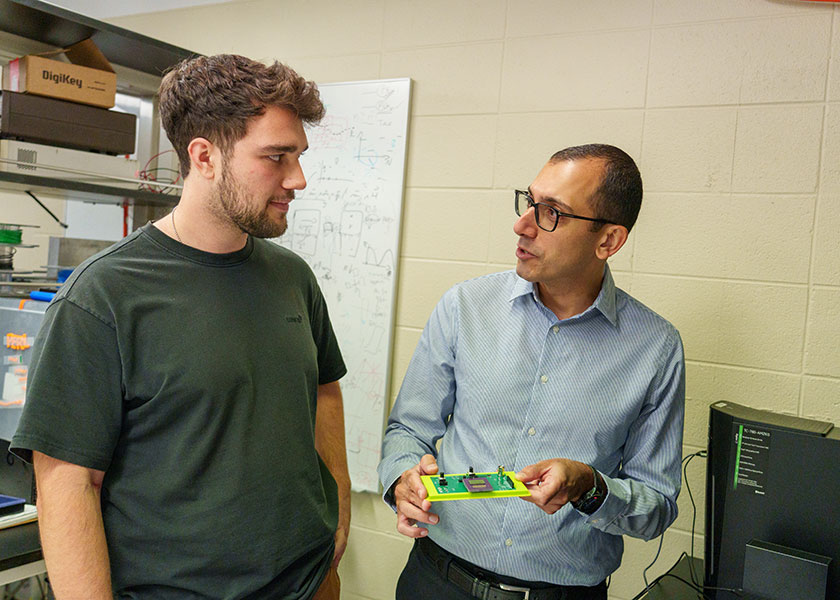
Antiferromagnetic devices could ultimately provide magnetic-field-resistant memory elements in dense electronics. Northwestern’s group also suggests the material platform might support high-frequency sensing or communication because some antiferromagnetic dynamics naturally occur at terahertz frequencies. Importantly, the published junction experiment did not demonstrate terahertz data rates or a functioning terahertz transmitter. Integrating a single laboratory device into scalable silicon production still requires reproducible fabrication, reliable switching endurance, array-level control and power measurements.
The distinction resembles other early-stage materials findings, including strain-sensitive magic-angle graphene and high-bandwidth photonic integration. Promising device physics is an essential prerequisite for a commercial component, not evidence of a product launch. The collaborators, including Western Digital, plan to investigate other noncollinear antiferromagnets and whether the switching process can access faster dynamics.
Further study must establish whether practical circuits can exploit the observed effects at competitive cost and efficiency. The achievement is narrower, and more significant, than a sweeping claim of revolutionized computing: researchers have experimentally demonstrated electrical readout and switching in a class of magnetic structures once considered difficult to control.
Primary documentation
- Kang et al., Nature, October 21, 2026: Octupole-driven spin torque switching of antiferromagnetic tunnel junctions (DOI: 10.1038/s41586-026-11172-5)
- Northwestern Engineering’s October 21 research announcement
- Full author preprint and experimental abstract (first posted September 3, 2025)
- November 19, 2026, syndicated science report
Media disclosure: The featured 1200 × 630 anime illustration uses an existing editorial artwork of semiconductor cleanroom equipment with the exact saved BitcoinVersus.tech watermark. It does not depict the specific experiment. The credited device figure and laboratory photograph are authentic research materials. No video playback or interactive embed has been represented as tested.
We volunteer daily to ensure the credibility of the information on this platform is Verifiably True. If you would like to support to help further secure the integrity of our research initiative, please scan the QR code below.



Leave a Reply