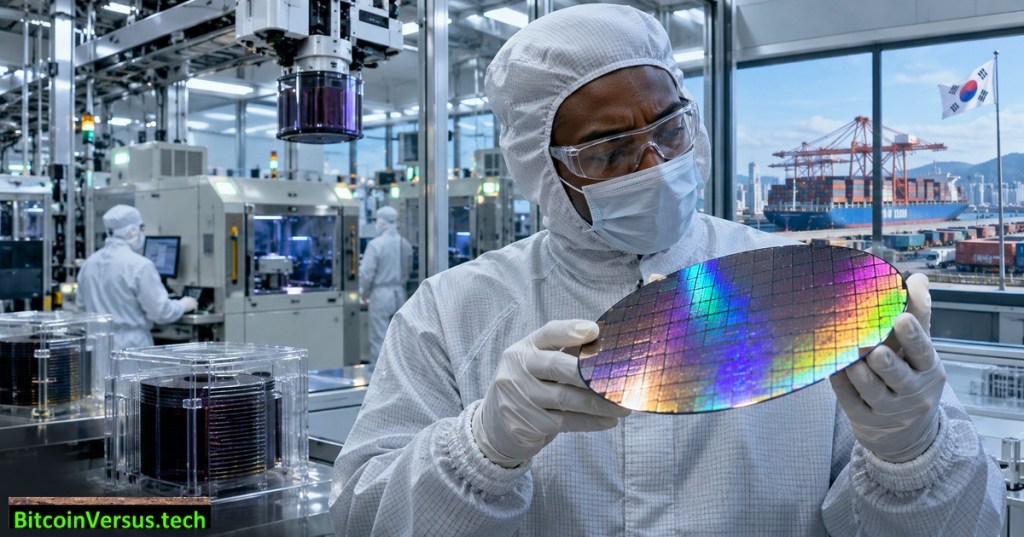
South Korea reached $1 trillion in cumulative 2026 merchandise exports at approximately 2:09 p.m. local time on November 19, according to preliminary figures from its Ministry of Trade, Industry and Resources. Only China, the United States and Germany had previously exceeded the same annual threshold. Rising demand and prices for AI memory were major contributors, according to the government’s official account. The November milestone is a year-to-date observation, not a completed 2026 annual total.
CNBC visited SK hynix manufacturing operations in August 2026. The documentary explains the factory and AI-memory context, rather than depicting the November 19 announcement. Watch the CNBC video directly.
Chips represent 42.7% of ten-month export value
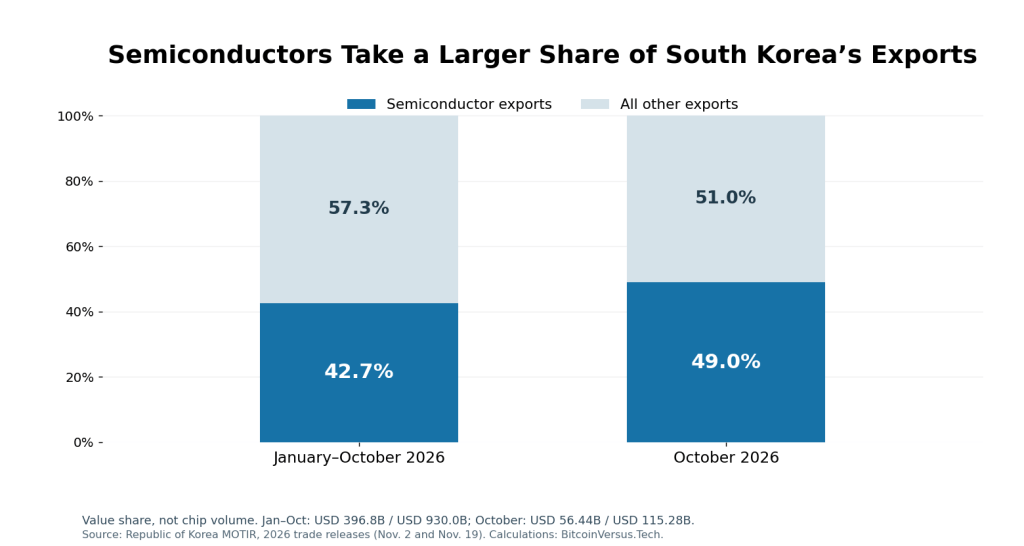
Korea’s January–October exports totaled $930.0 billion. The detailed ten-month semiconductor breakdown puts chip exports at approximately $396.8 billion, accounting for 42.7% of total merchandise exports. Comparable semiconductor exports in January–October 2025 were approximately $135.4 billion. The change is close to 193% growth in export value, calculated as (396.8 ÷ 135.4 − 1) × 100. The statistic does not mean the country manufactured 193% more chips.
October’s concentration was still higher. The ministry reported $56.44 billion of semiconductor exports out of $115.28 billion in total October merchandise exports. Dividing the values produces 49.0%, approximately 6.3 percentage points higher than the January–October share. The comparison uses different named reporting windows and should not be mistaken for a forecast of the following months.
A second dataset shows AI infrastructure demand spreading
The government’s October information-and-communications-technology report measured $70.35 billion in ICT exports, a 202.0% year-over-year increase. ICT represented 61.0% of total October exports. The category includes semiconductor products, along with computer peripherals, displays, phones and telecommunications equipment. ICT and semiconductor exports overlap and must not be added together.
Exports of computers and peripherals reached $5.85 billion in the wider trade report, reflecting server-related SSD demand. Electrical equipment exports reached $1.99 billion, up 74.0% year over year, with transformers, cables and other data-center equipment among the drivers. The figures document sales categories, however, not a direct count of deployed AI racks or power capacity.
YTN reported the accelerating semiconductor export trend in September, ahead of the November milestone. Watch the original Korean broadcast on YouTube.
Revenue is not the same as semiconductor output
More chips shipped, higher chip selling prices and a richer product mix can each increase export receipts. Government commentary cites DRAM and NAND flash prices among the major forces. The reported dollar totals do not independently measure wafer starts, memory bits shipped, yield or manufacturing utilization. Separating price and quantity is essential to understanding how far the export surge reflects physical capacity growth.
For complementary measures, BitcoinVersus.Tech has reported on SK hynix fab equipment plans, TSMC’s October sales, global silicon-wafer shipments, and semiconductor materials demand at Soitec. None of those measures is interchangeable with national export revenue.
The concentration risk behind the record
The government warns that volatile memory prices, trade restrictions and intensified competition could undermine future export receipts. Nearly half of October’s export value came from chips, meaning a sustained pricing decline could affect headline trade growth even if factories stayed busy. The forward indicator to watch is whether export volumes, prices and product mix move together as new AI and conventional memory capacity enters service.
Sources and calculations: Republic of Korea milestone announcement, November 19; MOTIR October trade release; MOTIR/MSIT ICT report; Yonhap ten-month export analysis. Figures are preliminary or rounded where identified. One contemporary report quoted $397.7 billion for January–October chip exports versus $396.8 billion in the detailed breakdown; the chart consistently uses $396.8 billion and identifies the chosen basis.
We volunteer daily to ensure the credibility of the information on the platform is Verifiably True. If you would like to support to help further secure the integrity of our research initiative, please scan the QR code below.


Leave a Reply