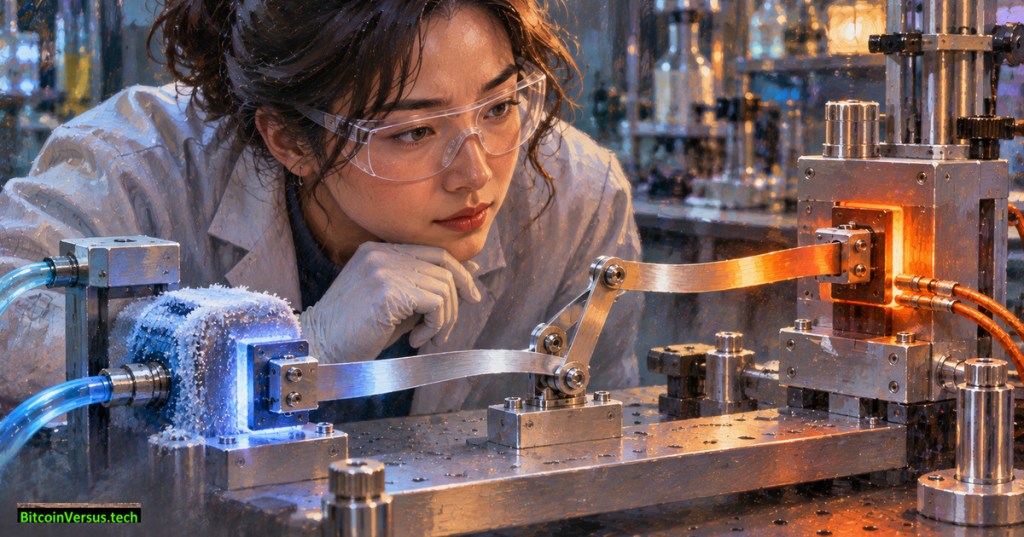
Could a computer chip’s waste heat help drive its own cooling system? Researchers at Germany’s Karlsruhe Institute of Technology (KIT) and Japan’s University of Tsukuba have built a miniature heat-driven elastocaloric cooler from two linked nickel-titanium-based films. Their August 28, 2026 announcement describes a laboratory demonstration in which heat replaces the electric motor normally needed to mechanically load a cooling material. It is a promising energy-engineering experiment, not a ready-to-install data-center refrigeration unit.
Independent 2026 explainer on elastocaloric cooling with nickel-titanium alloys. Educational engineering context, not video of the KIT–Tsukuba prototype. View the original YouTube video.
How heat can drive a cooling cycle
Conventional refrigerators usually compress and expand a working fluid to move heat. Elastocaloric cooling instead exploits a reversible structural transition in certain shape-memory alloys. Mechanically loading a film can release heat; unloading it produces a temperature drop that can absorb heat from nearby electronics. Prior prototypes generally required an electric actuator to apply the force, reducing the benefit of an otherwise solid-state cooling mechanism.
KIT’s innovation couples two films with different jobs. A titanium-nickel actuator film contracts as it is heated and supplies mechanical force. That motion stretches a superelastic titanium-nickel-iron refrigerant film, which releases heat during loading. After the actuator cools, the refrigerant relaxes, becomes colder and absorbs heat from the desired cooling region. Alternating contact with heat sinks and sources completes the cycle. The system still needs careful heat-transfer control and a way to remove the rejected heat.
Measured cooling: 4.0 K versus 2.2 K
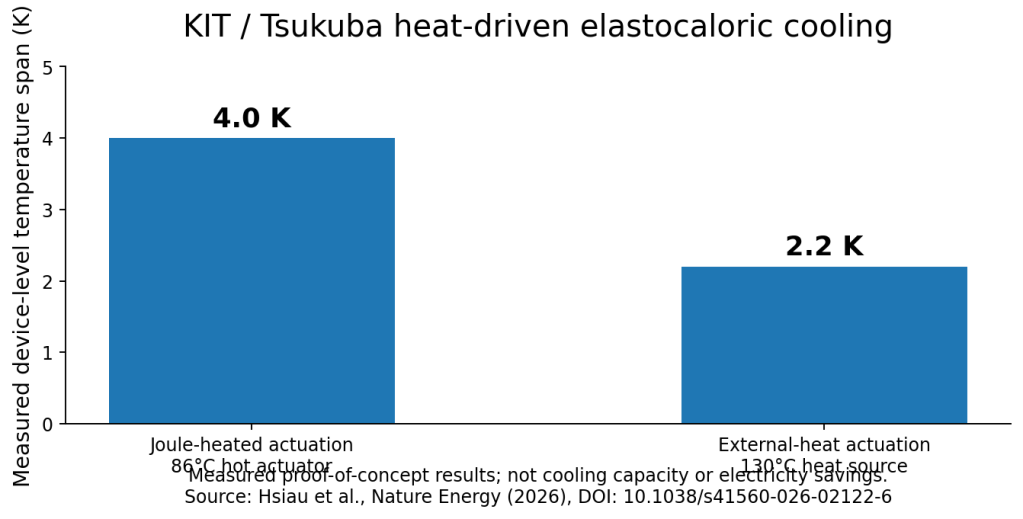
The peer-reviewed Nature Energy paper reports a 4.0 kelvin device-level temperature difference when its thermal actuator was heated electrically to 86°C. The refrigerant film itself experienced a larger 12.9 K temperature change, but device and material figures must not be interchanged. In a separate test using heat transferred from an external 130°C source, the integrated device maintained a 2.2 K temperature difference. A 1 K temperature difference equals a 1°C temperature difference.
Motor-free does not mean a complete system uses no electricity
The external-heat experiment is especially relevant because the alloy’s motion no longer needs a motor. However, the controlled laboratory heat source itself used a platinum microheater, along with instrumentation and active heat-transfer components. The experiment therefore demonstrates thermally driven actuation, not a fully passive, electricity-free commercial refrigerator. Its externally heated configuration delivered about 2.09 milliwatts of cooling power at zero temperature lift, equivalent to 3.32 watts per gram of active refrigerant. Such power is far below what a processor, let alone an AI rack, must dissipate.
Materials42’s University of Nottingham-linked demonstration shows the shape-memory and superelastic behavior of nickel-titanium alloys. Recorded in 2012; it illustrates the material physics, not KIT’s 2026 cooling performance. Watch the source video.
Why data centers might care
Processors, power converters and server voltage regulators constantly release heat. Future devices could theoretically divert part of a useful temperature gradient into mechanical force that drives local cooling. But temperature span is not coefficient of performance, electrical efficiency or cooling capacity. The team must increase active material area, lower thermal contact resistance, improve cycling life and quantify the system’s total energy balance before comparisons with pumps, compressors or liquid-cooled racks make sense.
Related BitcoinVersus.Tech coverage explains how rack heat removal is calculated from flow and temperature, coolant pump failover requirements, waterless two-phase AI cooling proposals, and a separate technique for recovering electricity from waste heat. Heat-to-electricity and heat-driven refrigeration are distinct thermodynamic approaches.
The next milestone is a repeatable prototype delivering practical watts of cooling under a realistic heat source, with independently measured thermal input, parasitic electrical draw and lifetime. Until then, the KIT–Tsukuba result is a verified miniature demonstration of using heat to produce cold, not proof that data centers can remove their electrically powered cooling systems.
Sources and methodology: KIT press release, August 28, 2026; Hsiau, Miyazaki, Kohl and Xu, Nature Energy; KIT institutional research record. Reported results are laboratory measurements, with commercial applications discussed as future possibilities.
We volunteer daily to ensure the credibility of the information on this platform is Verifiably True. If you would like to support to help further secure the integrity of our research initiative, please scan the QR code below.



Leave a Reply