A stellar explosion can become scientifically valuable for only a brief period before its earliest signals fade. Astronomers therefore need more than powerful cameras: they need software capable of deciding which observations deserve immediate attention. On November 20, 2026, the University of Minnesota announced a Schmidt Sciences award supporting an open-source system designed to analyze up to 100 million astronomical alerts nightly. The figure describes a development target, not verified operational throughput.
A camera made from 1,212 telescopes
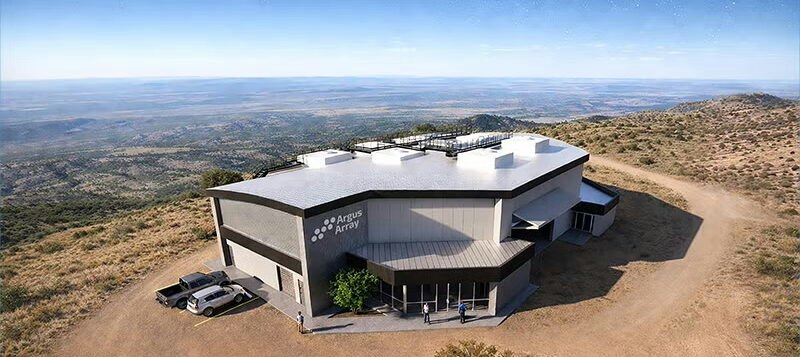
The software will support the Eric and Wendy Schmidt Observatory System, including the Argus Array under development at UNC-Chapel Hill. The system’s technical overview specifies 1,212 small telescopes, collectively observing 8,000 square degrees at once. Its planned combined collecting area is comparable to an eight-meter-class telescope, although combining separate apertures does not confer the angular resolution of a single eight-meter mirror.
Instead of pointing one instrument at successive patches of sky, Argus distributes its field of view across many cameras. The UNC engineering description estimates a 122-gigapixel combined image and incoming data rates reaching two terabits per second. At sustained peak rate, that equals 250 gigabytes per second, before overhead, compression or selective retention. Actual volumes depend on observing cadence and the pipeline configuration.
From pixels to actionable alerts
An alert broker receives records of detected changes rather than treating every raw image as a new event. Image-processing software can compare current observations with reference imagery, identify differences, and produce compact records. Brokers then enrich those records with catalog matches, brightness histories and machine-learning classifications. A changing star, moving asteroid or instrumental artifact may generate notifications; none automatically constitutes a novel discovery.
The team builds upon BOOM, the Burst and Outburst Observations Monitor. NASA’s General Coordinates Network describes how the existing BOOM software powers Babamul, a multi-survey broker handling observations from ZTF and Rubin. A June 2026 research publication documents the earlier system. The new Schmidt Observatory System Broker project extends the effort toward additional instruments and streams.
What 100 million alerts means for computing
Assuming a ten-hour observing window, 100 million alerts would average approximately 2,778 records per second. Bursts could exceed the average substantially. If each record hypothetically occupied 10 kilobytes, the nightly stream would contain one terabyte of alert data, excluding replication and database indexes. The assumed record size is illustrative, not a measured specification.
The challenge includes maintaining low latency under bursty workloads, preserving provenance and avoiding missed rare signals. Related infrastructure concepts appear in our reporting on Kubernetes workload energy monitoring, open-source KubeVirt infrastructure, network configuration orchestration and GPU memory observability.
Speed without sacrificing scientific judgment
Rubin Observatory already provides a practical comparison: its technical overview anticipates up to seven million alerts per night. The Argus broker target concerns a different instrument and broader architecture, so the figures are not a controlled performance comparison. The new system must demonstrate classification quality, reliability and follow-up usefulness as well as throughput. Open software and data could help independent researchers evaluate those results.
Further context: Schmidt Sciences’ original social announcement of the observatory system.
We volunteer daily to ensure the credibility of the information on this platform is Verifiably True. If you would like to support to help further secure the integrity of our research initiative, please scan the QR code below.



Leave a Reply